


RIYADH: Saudi-Palestinian artist Dana Awartani is one of the participants in the exhibition “Arduna” (Our Land), which runs until April 15 as part of the pre-opening program for the upcoming contemporary art museum from the Royal Commission for AlUla.
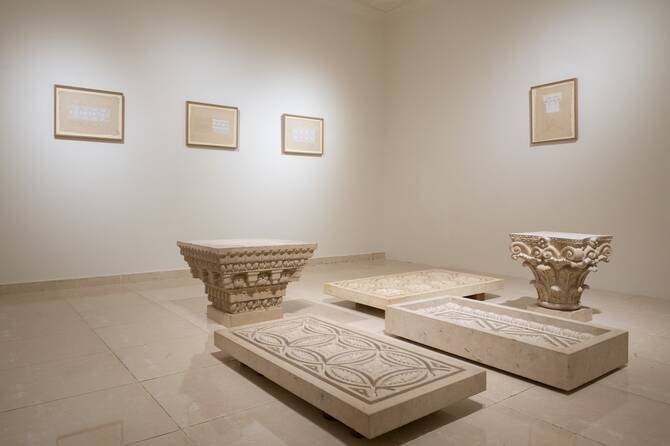
Awartani’s work for “Arduna” — “When the Dust of Conflict Settles” — is carved from stones from Naqab, Madaba and Ajloun, and the artist tells Arab News it “felt particularly meaningful to exhibit this work in AlUla because of the shared, layered histories of stone carving and craftsmanship across the region.”
The new work, commissioned for the show, is a continuation of Awartani’s series of the same name — an exploration of cultural heritage in the aftermath of conflict — which has been ongoing since 2023. Like the other works in the series, it was created in collaboration with Syrian stonemasons who were displaced by the civil war in their home country, although, Awartani notes, “some of the craftsmen have returned to Syria since 2023, so it is not entirely the same team, but it is the same workshop.”
The series acts, Awartani tells Arab News, as a “memorial to cultural heritage that has been lost or threatened.”

Dana Awartani 2020. (Image Courtesy of the Artist and Abdullah AlShehri, Photography by Abdullah Alshehri)
In her current work, framed gouache and walnut ink drawings on handmade cotton paper hang on the walls, accompanied by hand-carved stones at eye level. At first, the colors seem subdued but elegantly reveal their intricacy on closer inspection. These stones are not ‘stone cold’ but embedded with warmth, resilience and even a tinge of sadness.
Awartani draws on the long history of stone carving in the Levant, where artisans once adorned fortresses, places of worship and other civic architecture with ornamental motifs that spoke to both spiritual and communal life. Many such original works have been destroyed by conflict, but her works re-examine lost worlds through the lens of Islamic and Eastern sacred geometry, a discipline that, for the artist, offers analytical precision and a universal visual language.
“I first studied contemporary art and later trained at the Prince’s School of Traditional Arts, where I developed a deeper understanding of these geometric traditions,” she says. The motifs she works with come from traditions that date back centuries, drawn from architecture, textiles, and stone carving across the Islamic world.
By involving displaced artisans, now mostly based in Jordan and Saudi Arabia, the project highlights ancient skills that might otherwise be lost due to war or migration. Awartani presents stone carving as an evolving practice and one that can speak directly to present conditions of displacement and reconstruction, rather than a stoic remnant of history. She invites us to view heritage as a living continuum: fragile but enduring across borders and generations.

Detail from 'When the Dust of Conflict Settles. ' (Supplied)
“Stone carries a profound sense of permanence. It comes directly from the land and holds millions of years within it, carrying the geological memory, or even the DNA, of a place,” she says. “My work responds to this by focusing on the continuity of cultural heritage in the face of disruption, and the living knowledge embedded in traditional craftsmanship. By drawing from the ancient practice of stone carving in the Levant and working with displaced stonemasons now based in Jordan and Saudi Arabia, my work becomes a conversation between past and present.
“Collaborating with the stonemasons was humbling. They brought a depth of understanding of stone that I could never have achieved alone,” she continues. “They brought an incredible level of precision, patience, and knowledge of the material that shaped the work in meaningful ways.”
Hearing their stories of displacement also made the project feel like a shared act of preservation. In an era of AI and rapid machine-made production, Awartani still focuses on slow, manual craftsmanship.
“The human connection between maker and material is often lost in digital production,” she says. “Every mark carries the hand of the maker, along with their intention and skill. This is something no algorithm or machine can truly replicate.”
In that sense, “When the Dust of Conflict Settles” becomes as much about process and relationships as it is about the final work.
Growing up in Jeddah, and working on this and other projects in AlUla, has had a profound impact on Awartani’s work.
“In Jeddah, I’m inspired by its openness and connection to global exchange,” she says. “In AlUla, I’m reminded that heritage can be a living, evolving presence, something that inspires contemporary art while remaining firmly rooted in Saudi tradition.”


