

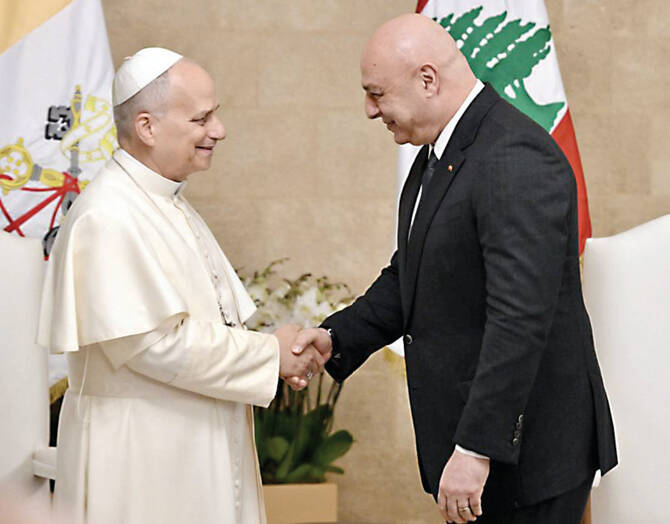
BEIRUT: Pope Leo XIV called for peace in Lebanon during a Beirut address to more than 400 of the country’s top political, religious and social figures.
“Peace in this land is more than a word; it is a desire, a message, a gift and a work in progress,” he said on the first stop of his historic three-day visit to Lebanon.
Lebanon has “a people who do not give up, but rather, in the face of adversity, always know how to rise again with courage,” he added.
“Your resilience is a fundamental characteristic of true peacemakers, because peacemaking is, in reality, a continuous new beginning. Commitment to and love of peace know no fear in the face of apparent defeat, nor are they discouraged by disappointment. Rather, they look ahead, welcoming and embracing all situations with hope.”
The pope, who arrived from a visit to Turkiye, told the Lebanese audience that “building peace requires perseverance.”
He added: “You are a diverse country, a community among communities, united by a common language. I am not referring here only to the Levantine Arabic language, in which your great past has left priceless treasures. I am referring, above all, to the language of hope, which has always enabled you to begin anew.
“Almost everywhere in the world around us, a kind of pessimism and sense of helplessness seems to have taken hold, where people are no longer able to ask themselves what they can do to change the course of history.
“It seems that the great decisions are made by a select few, often at the expense of the common good, as if this were an inevitable fate. You have suffered greatly from the consequences of a devastated economy and from global instability, which has had devastating effects even in the Levant, and from the extremism of identities and conflicts. But you have always wanted, and you have known how, to start anew.”
He called on the youth of Lebanon “never to separate yourselves from your people, and to place yourselves with commitment and dedication at their service, rich in their diversity. Speak only one language, the language of hope.”
On peacemaking in the country, he said: “There are personal and collective wounds that take many years, sometimes even generations, to heal. If they are not addressed, if we do not work, for example, to heal memories and reunite those who have suffered injustice and oppression, it will be difficult to move toward peace. We will remain trapped, each of us a prisoner of our own pain and way of thinking.”
“Peace is much more than a mere balance — which is always fragile — between those who live separately under one roof. Peace is knowing how to live together, in communion, as reconciled people. A reconciliation that enables us to work together for a common future, side by side. Thus, peace becomes that abundance that will surprise us when our horizons expand, transcending every wall and barrier. Mutual dialogue, even in the face of misunderstanding, is the path to reconciliation.”
The pope urged the Lebanese to “remain in their homeland and work day after day to build a civilization of love and peace, for this is a most precious thing. The church is not only concerned with the dignity of those who leave their homeland, but she does not want anyone to be forced to leave. Rather, she wants those who wish to return to their homeland to be able to do so safely.”
He added: “The challenge, not only for Lebanon, but for the entire Levant, is what can be done to ensure that young people, in particular, do not feel compelled to leave their homeland and emigrate? How can we encourage them not to seek peace elsewhere, but to find guarantees of peace and to be pioneers in their own country?”
Leo XIV highlighted “the essential role of women in the arduous and patient endeavor of preserving and building peace.”
He said: “Let us not forget that women have a special capacity for peacemaking, because they know how to foster and strengthen deep connections with life, people and places. Their participation in social and political life, as well as in their religious communities, represents a true force for renewal throughout the world.”
Later, Lebanese President Joseph Aoun said: “Lebanon, this small country in size but great in its mission, has always been and remains a land that unites faith and freedom, diversity and unity, pain and hope.”
He highlighted the country’s “uniqueness in the world,” which “necessitates that all living humanity preserve Lebanon.”
Aoun added: “For if this model of free and equal life among the followers of different religions were to fall, there is no other place on earth that can accommodate it.
“If the Christian presence disappears from Lebanon, the equation of the nation will collapse, and its justice will crumble. If the Muslim presence disappears from Lebanon, the equation of the nation will be disrupted, and its moderation will be shattered. If Lebanon is paralyzed or transformed, the inevitable alternative will be fault lines in our region and the world, between all kinds of extremism and intellectual, physical and even bloody violence. This is something the Holy See has always understood.
“We affirm today that the very survival of this Lebanon, present and present around you, is a prerequisite for peace, hope and reconciliation among all the children of Abraham.”
The president addressed the pope and said: “In our land today, and in our region, there is much oppression and much suffering. Their wounds await your blessed touch. Please, tell the world on our behalf that we will not die, we will not leave, we will not despair and we will not surrender.
“Rather, we will remain here, breathing freedom, creating joy, practicing love, embracing innovation and striving for modernity. We will remain the only space for encounter in our entire region, united representatives of all the children of Abraham, with all their beliefs, sacred values and shared heritage.”
The pope’s plane landed at Rafic Hariri International Airport in Beirut, arriving from Istanbul at about 4 p.m. amid tight security and organizational measures.
Two Lebanese Army jets escorted the papal plane as it entered Lebanese airspace.
The pope told the press delegation accompanying him on the plane that his visit to Turkiye had been “positive and successful.”
Thanking the Turkish president and the Eastern Church, he added that “the goal of his visit to Lebanon is to build peace.”
President Joseph Aoun, Speaker of Parliament Nabih Berri, Prime Minister Nawaf Salam, Maronite Patriarch Bechara Al-Rahi, Army Commander Gen. Rudolph Haykal, a host of religious leaders from across Lebanon, members of the Arab and foreign diplomatic corps, representatives of parliamentary blocs and groups of civilians awaited the pope on the tarmac at Beirut Airport.
As he emerged from the aircraft, the Lebanese Army fired a 21-gun salute in his honor, and church bells rang throughout Lebanon. Ships docked in Beirut’s port sounded their horns in welcome.
Two children from the Children’s Cancer Center presented the pope with a bouquet of flowers, bread, salt and soil from Lebanon on the tarmac in a symbolic tradition.
He received an official welcome in the VIP lounge, after which he proceeded to the Presidential Palace.
Leo XIV’s motorcade traveled along highways in Beirut’s southern suburbs, where dozens of residents lined the roads, waving Lebanese and Vatican flags. Some raised Hezbollah flags and pictures of former Secretary-General Hassan Nasrallah.
Along the route from the southern suburbs of Beirut to Hazmieh, passing through the roads leading to Baabda and the Presidential Palace, hundreds of people — children, women, men, the elderly and the sick — gathered despite the heavy rain. They carried white umbrellas, waved Vatican and Lebanese flags, and chanted his name. Some said he was “a beacon of hope for Lebanon,” while others hoped his “historic visit would be the salvation of this country from its crises.”
One woman said: “The diverse religious communities welcoming the pope demonstrates Lebanon’s commitment to coexistence.”
Before arriving at the Presidential Palace, the pope moved from his black armored car to his glass-fronted vehicle, greeting people along the way who had showered his motorcade with rose petals and rice.
To the sounds of traditional Lebanese dabke music and accompanied by a horse escort, the pope was received in the courtyard of the Presidential Palace.
In the VIP lounge, Leo XIV held separate private meetings with each Lebanese leader.
In another hall, the 400 political figures, including a delegation of Hezbollah MPs, heads of religious communities, members of the diplomatic corps and civil society representatives, waited to hear the pope’s speech.


