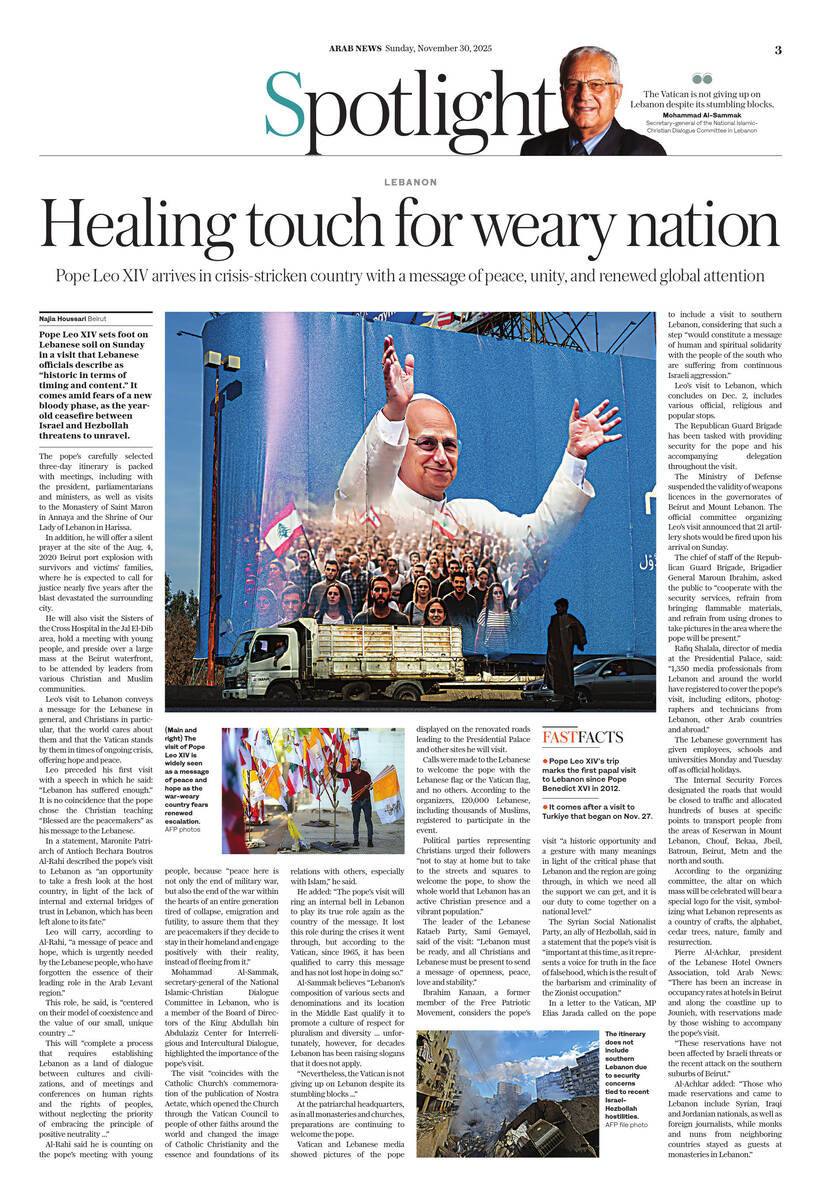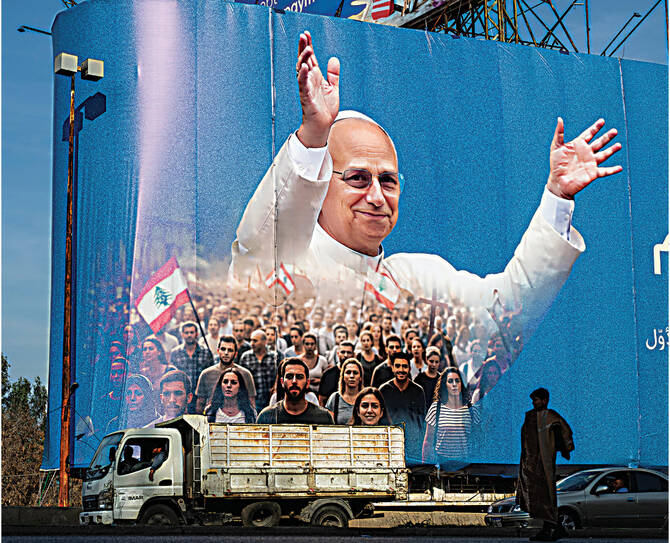
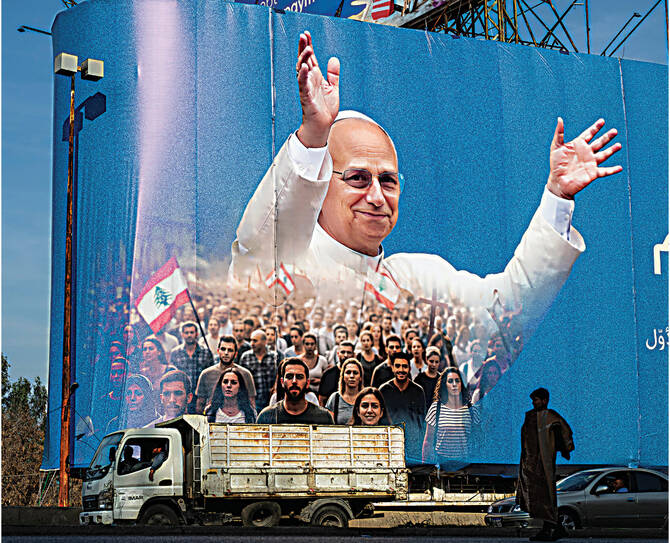
BEIRUT: Pope Leo XIV sets foot on Lebanese soil on Sunday in a visit that Lebanese officials describe as “historic in terms of timing and content.” It comes amid fears of a new bloody phase, as the year-old ceasefire between Israel and Hezbollah threatens to unravel.
The Pope’s carefully selected three-day itinerary is packed with meetings, including with the president, parliamentarians and ministers, as well as visits to the Monastery of Saint Maron in Annaya and the Shrine of Our Lady of Lebanon in Harissa.
In addition, he will offer a silent prayer at the site of the Aug. 4, 2020 Beirut port explosion with survivors and victims’ families, where he is expected to call for justice nearly five years after the blast devastated the surrounding city.
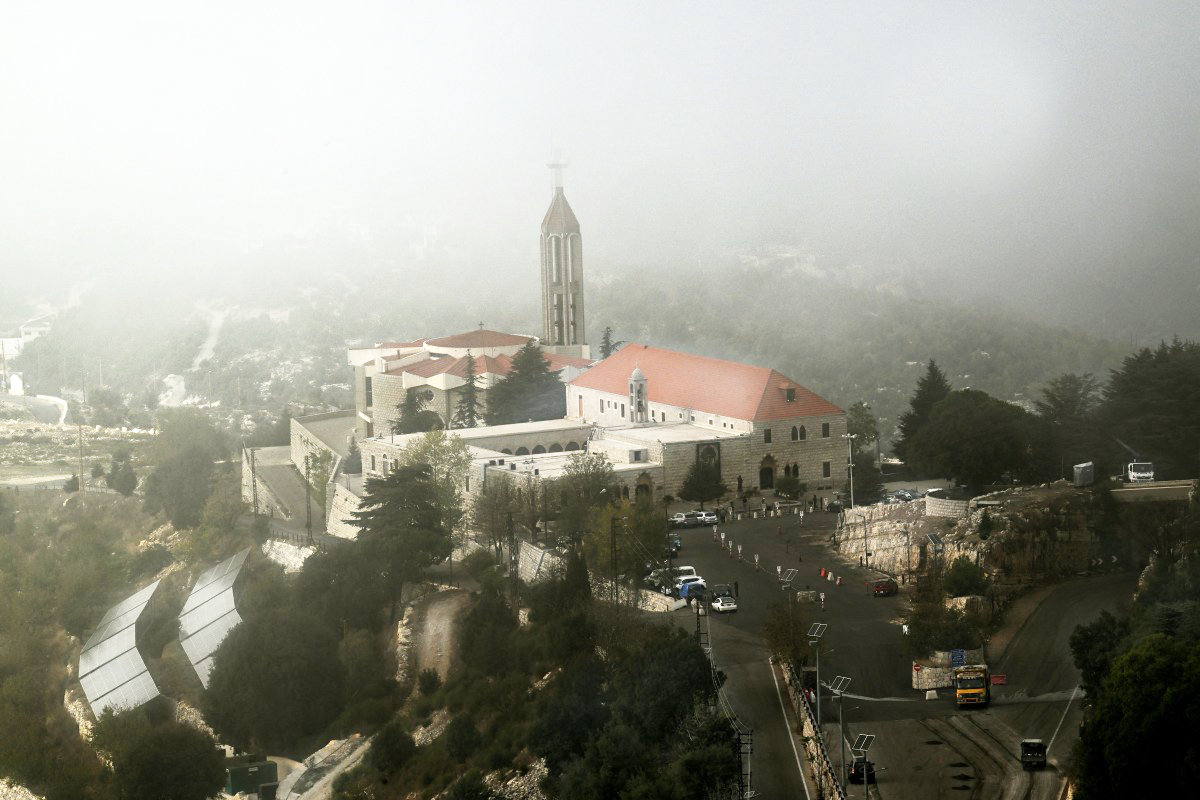
A photograph shows the Maronite monastery of Saint Maron, which houses the shrine of Saint Charbel, in the mountain village of Annaya. (AFP)
He will also visit the Sisters of the Cross Hospital in the Jal El-Dib area, hold a meeting with young people, and preside over a large mass at the Beirut waterfront, to be attended by leaders from various Christian and Muslim communities.
Leo’s visit to Lebanon conveys a message for the Lebanese in general, and Christians in particular, that the world cares about them and that the Vatican stands by them in times of ongoing crisis, offering hope and peace.
Leo preceded his first visit with a speech in which he said: “Lebanon has suffered enough.” It is no coincidence that the Pope chose the Christian teaching “Blessed are the peacemakers” as his message to the Lebanese.
In a statement, Maronite Patriarch of Antioch Bechara Boutros Al-Rahi described the Pope’s visit to Lebanon as “an opportunity to take a fresh look at the host country, in light of the lack of internal and external bridges of trust in Lebanon, which has been left alone to its fate.
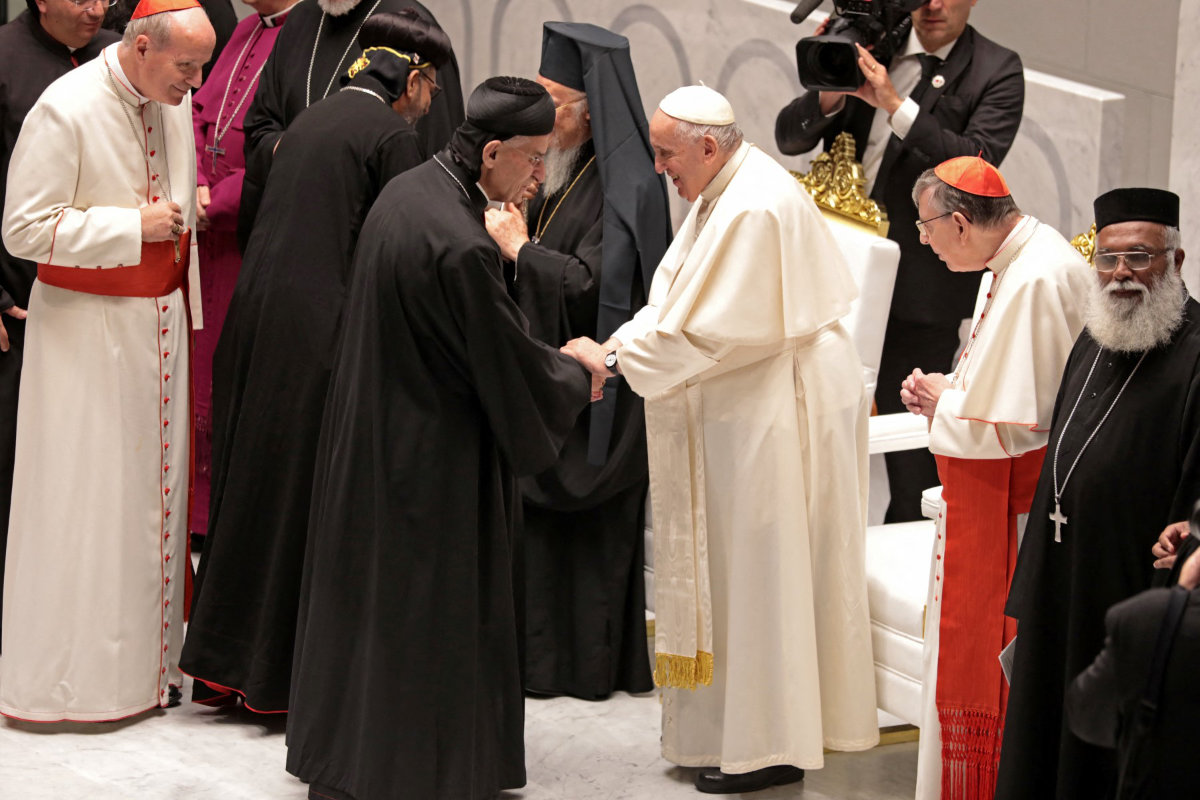
This photo taken on November 4, 2022, shows Lebanon's Maronite Patriarch Bechara al-Rahi shaking hands with Pope Francis following an ecumenical meeting and prayer for peace in Awali, south of the Bahraini capital Manama. (AFP file)
“This requires highlighting the messages that Pope Leo XIV will convey, confirming that he and the leaders of the Catholic Church stand with Lebanon, where the foundations of coexistence are valued.”
Leo will carry, according to Al-Rahi, “a message of peace and hope, which is urgently needed by the Lebanese people, who have forgotten the essence of their leading role in the Arab Levant region.”
This role, he said, is “centred on their model of coexistence and the value of our small, unique country in the hope that it will be accompanied locally by prayer and the taking of decisive national decisions to shoulder the full responsibility that the pope has placed before us.”
This will “complete a process that requires establishing Lebanon as a land of dialogue between cultures and civilizations, and of meetings and conferences on human rights and the rights of peoples, without neglecting the priority of embracing the principle of positive neutrality, without which the Lebanese cannot live and which is the fundamental gateway to reminding us of our role and mission, which is greater than narrow political and partisan calculations.”
FASTFACTS
• Pope Leo XIV’s trip marks the first papal visit to Lebanon since Pope Benedict XVI in 2012.
• It comes after a visit to Turkiye that began on Nov. 27.
Al-Rahi said he is counting on the pope’s meeting with young people, because “peace here is not only the end of military war, but also the end of the war within the hearts of an entire generation tired of collapse, emigration and futility, to assure them that they are peacemakers if they decide to stay in their homeland and engage positively with their reality, instead of fleeing from it.”
Mohammad Al-Sammak, secretary-general of the National Islamic-Christian Dialogue Committee in Lebanon, who is a member of the Board of Directors of the King Abdullah bin Abdulaziz Center for Interreligious and Intercultural Dialogue, highlighted the importance of the pope’s visit.
The visit “coincides with the Catholic Church’s commemoration of the publication of Nostra Aetate, which opened the Church through the Vatican Council to people of other faiths around the world and changed the image of Catholic Christianity and the essence and foundations of its relations with others, especially with Islam,” he said.
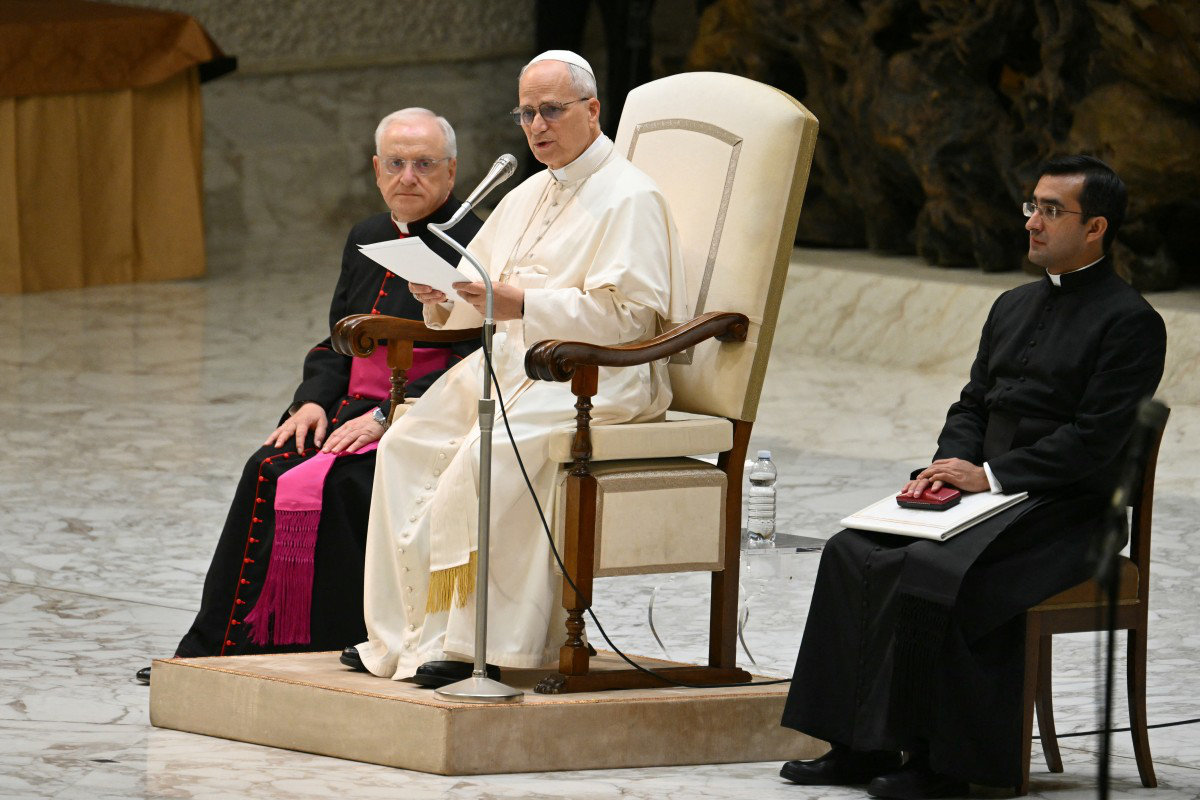
Pope Leo XIV attends the Commemoration of the Conciliar Declaration "Nostra Aetate" on the Church’s relations with non-Christian religions at Paul VI audience hall in The Vatican on October 28, 2025. (AFP)
“Christianity no longer meant the only path to salvation, as the Church recognized Islam as a message from God and limited the responsibility for the crucifixion of Christ to the perpetrators of the crime alone, and not to all Jews until the end of time.”
He added: “The pope’s visit will ring an internal bell in Lebanon to play its true role again as the country of the message. It lost this role during the crises it went through, but according to the Vatican, since 1965, it has been qualified to carry this message and has not lost hope in doing so.”
The visit of Pope Leo XIV is widely seen as a message of peace and hope as the war-weary country fears renewed escalation. (AFP)
Al-Sammak believes “Lebanon’s composition of various sects and denominations and its location in the Middle East qualify it to promote a culture of respect for pluralism and diversity, especially since it is part of the Arab world, as Vatican documents state. Unfortunately, however, for decades Lebanon has been raising slogans that it does not apply.
“Nevertheless, the Vatican is not giving up on Lebanon despite its stumbling blocks. We now hope that Pope Leo will give this reality a new impetus in this direction, as he is the spiritual son of Pope Francis, who appointed him to the position of pope after his positions in the US aligned with Pope Francis’s humanitarian policy.”
At the patriarchal headquarters, as in all monasteries and churches, preparations are continuing to welcome the pope.
Vatican and Lebanese media showed pictures of the pope displayed on the renovated roads leading to the Presidential Palace and other sites he will visit.
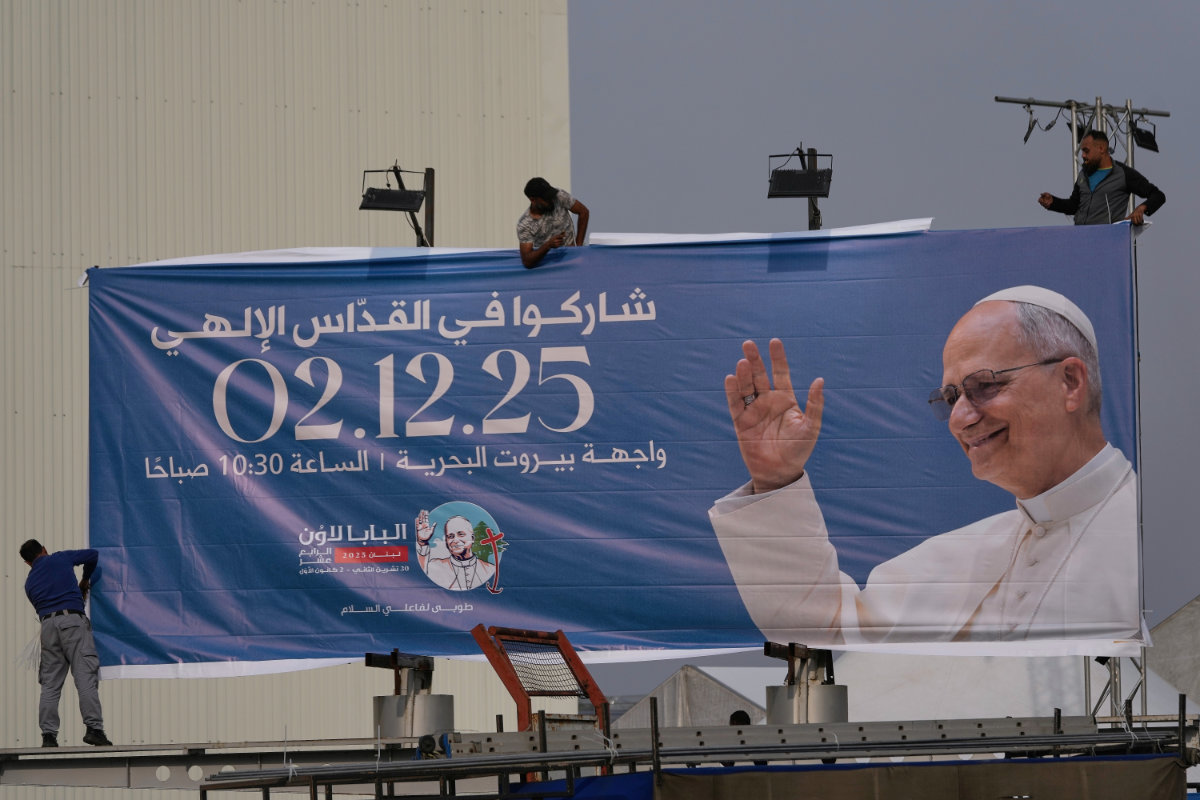
Caption
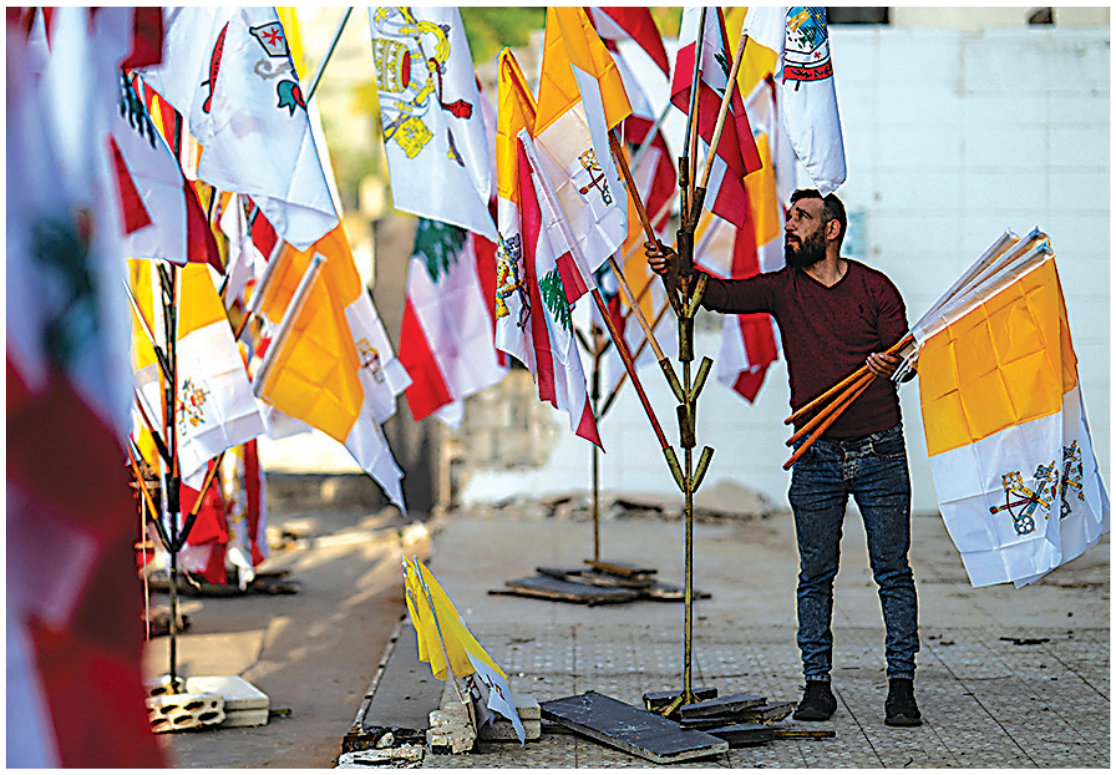
Calls were made to the Lebanese to welcome the pope with the Lebanese flag or the Vatican flag, and no others. According to the organizers, 120,000 Lebanese, including thousands of Muslims, registered to participate in the event.
Political parties representing Christians urged their followers “not to stay at home but to take to the streets and squares to welcome the pope, to show the whole world that Lebanon has an active Christian presence and a vibrant population.”
The leader of the Lebanese Kataeb Party, Sami Gemayel, said of the visit: “Lebanon must be ready, and all Christians and Lebanese must be present to send a message of openness, peace, love and stability.
“Lebanon’s goal is to live in peace, turn the page on bloodshed and tears, and build a homeland where the Lebanese people can enjoy life, so that Lebanon can once again become the Switzerland of the East and a model for the region.”
Ibrahim Kanaan, a former member of the Free Patriotic Movement, considers the pope’s visit “a historic opportunity and a gesture with many meanings in light of the critical phase that Lebanon and the region are going through, in which we need all the support we can get, and it is our duty to come together on a national level.”
T
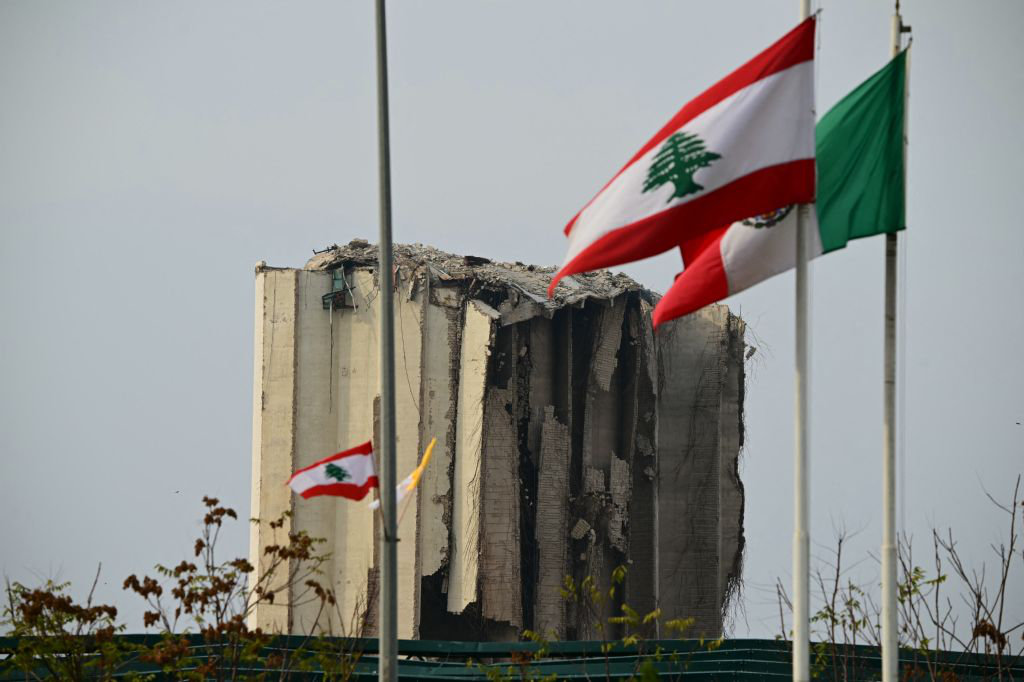
A street adorned with Lebanese and Vatican flags are seen in front of a building that was damaged in the catastrophic port explosion in 2020, in Beirut on November 29, 2025. (AFP)
he Syrian Social Nationalist Party, an ally of Hezbollah, said in a statement that the pope’s visit is “important at this time, as it represents a voice for truth in the face of falsehood, which is the result of the barbarism and criminality of the Zionist occupation.”
In a letter to the Vatican, MP Elias Jarada called on the pope to include a visit to southern Lebanon, considering that such a step “would constitute a message of human and spiritual solidarity with the people of the south who are suffering from continuous Israeli aggression.”
Jarada said the historic document signed by the late Pope Francis and the Grand Imam of Al-Azhar in 2019 in Abu Dhabi constitutes “a moral and spiritual framework for rejecting violence and intolerance and affirming the right of peoples to live in safety and dignity.”
Leo’s visit to Lebanon, which concludes on Dec. 2, includes various official, religious and popular stops.
The Republican Guard Brigade has been tasked with providing security for the pope and his accompanying delegation throughout the visit.
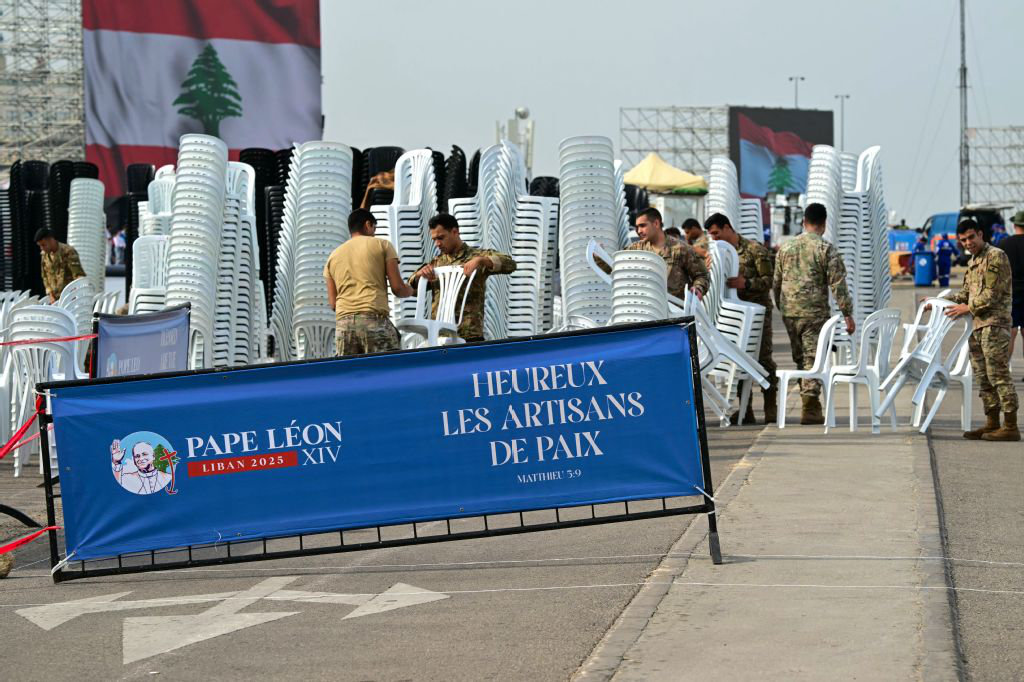
Lebanese soldiers carry chairs as they prepare the waterfront in Beirut on November 29, 2025, for a mass ahead of Pope Leo XIV's visit to Lebanon. (AFP)
The Ministry of Defense suspended the validity of weapons licences in the governorates of Beirut and Mount Lebanon. The official committee organizing Leo’s visit announced that 21 artillery shots would be fired upon his arrival on Sunday.
The chief of staff of the Republican Guard Brigade, Brigadier General Maroun Ibrahim, asked the public to “cooperate with the security services, refrain from bringing flammable materials, and refrain from using drones to take pictures in the area where the pope will be present.”
Ibrahim added: “There will be searches at all points surrounding the area where the pope will be present, as well as on the routes he will pass through, and participants in public places near the pope will be subject to searches.”
Rafiq Shalala, director of media at the Presidential Palace, said: “1,350 media professionals from Lebanon and around the world have registered to cover the pope’s visit, including editors, photographers and technicians from Lebanon, other Arab countries and abroad.”

Workers install Vatican and Lebanese flags along a highway in Zouk Mosbeh on the outskirts of Beirut on November 28, 2025, ahead of Pope Leo XIV’s visit to Lebanon. (AFP)
The Lebanese government has given employees, schools and universities Monday and Tuesday off as official holidays.
The Internal Security Forces designated the roads that would be closed to traffic and allocated hundreds of buses at specific points to transport people from the areas of Keserwan in Mount Lebanon, Chouf, Bekaa, Jbeil, Batroun, Beirut, Metn and the north and south.
According to the organizing committee, the altar on which mass will be celebrated will bear a special logo for the visit, symbolizing what Lebanon represents as a country of crafts, the alphabet, cedar trees, nature, family and resurrection.
Pierre Al-Achkar, president of the Lebanese Hotel Owners Association, told Arab News: “There has been an increase in occupancy rates at hotels in Beirut and along the coastline up to Jounieh, with reservations made by those wishing to accompany the pope’s visit.
“These reservations have not been affected by Israeli threats or the recent attack on the southern suburbs of Beirut.”
Al-Achkar added: “Those who made reservations and came to Lebanon include Syrian, Iraqi and Jordanian nationals, as well as foreign journalists, while monks and nuns from neighboring countries stayed as guests at monasteries in Lebanon.”