

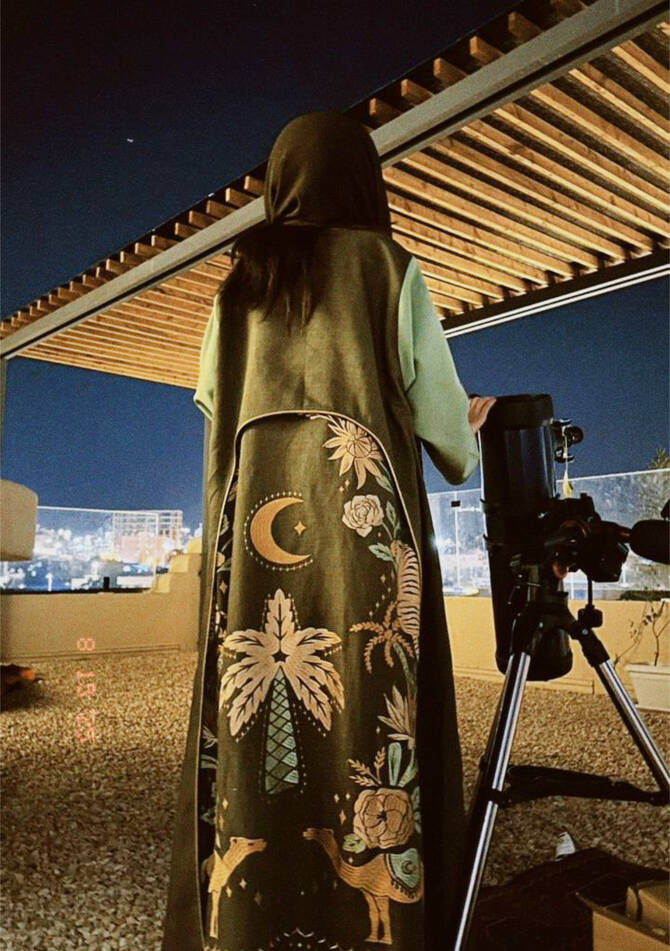

ALKHOBAR: Saudi innovator Manar Alhelali is helping redefine how science is taught, shared, and understood in Arabic, and how the next generation of Saudi scientists are shaping that future under Vision 2030.
An astronomy and planetary sciences student at Penn State University, Alhelali works at the intersection of space technology, environmental systems, and Arabic science communication. Her efforts combine scientific research, innovation, and accessibility, ensuring that the language of science speaks to everyone.
“Science doesn’t exist in isolation,” she told Arab News. “It must serve people, protect our planet, and expand our understanding of what humanity can achieve.”

Alhelali with Saudi officials and academics during a science outreach event promoting astronomy and innovation. (Supplied)
Her early research journey began through national innovation programs and mentorship initiatives supported by Saudi research incubators and industry experts.
Her projects have received guidance from engineers and scientists at leading national institutions, developed through programs supported by organizations such as the MISK Diwan of Innovation and project 1932.
Alhelali’s research spans several ongoing projects that tackle challenges in both space and environmental science.
HIGHLIGHTS
• Manar Alhelali’s early research journey began through national innovation programs and mentorship initiatives supported by Saudi research incubators.
• Her projects have received guidance from engineers and scientists at leading national institutions.
• Her research spans several ongoing projects that tackle challenges in both space and environmental science.
Her Ruqban Satellite Project, a dedicated research model for space safety and radiation protection, focuses on the development of innovative multi-layer shielding systems designed to reduce exposure to cosmic radiation and enhance spacecraft safety for future missions.

Manar Alhelali at a space exhibition in Saudi Arabia, where she trained under international experts in mission design and astrobiology. (Supplied)
Similarly, her District 7 project explores orbital debris management using robotics and predictive analytics. “The goal is to make these systems sustainable and smart, adaptable to the needs of future missions,” she said. “We’re still at the modeling and training level, but the results so far are promising.”
Her Saah initiative extends this research to Earth. Saah is an environmental innovation project dedicated to reducing greenhouse gas emissions and promoting sustainable industrial practices.
The system operates through integrated environmental monitoring and control mechanisms designed to improve efficiency and limit pollutant release.

Manar Alhelali. (Supplied)
After completing its theoretical validation phase and proving its feasibility, Saah is now entering the minimum viable product fabrication stage within laboratory environments under technical review.
Beyond her lab work, Alhelali leads Alsmout, a non-profit platform for Arabic science communication. Its flagship program, Ishara, uses AI to teach scientific concepts in Arabic Sign Language, an area previously lacking established vocabulary.
“Our model can already recognize Arabic sign letters and common words,” she explained. “Now we’re training it and the team is working on translating complex scientific terminology into accessible signs, effectively creating a dedicated scientific glossary for the deaf community.”
Working with linguists and the Wasl app, her team is creating what she calls a “new scientific dictionary” for the deaf community. “We’re giving them the language to talk about science in their own voice,” she said.
Through Alsmout, Alhelali also produces educational content, interactive workshops, and public campaigns that link astronomy, sustainability, and community learning. The initiative has participated in national innovation challenges and youth programs, helping to expand access to STEM education in Arabic.
Alhelali’s mentors, including innovation advisors from Aramco and MISK’s Diwan of Innovation, have played a key role in supporting her multidisciplinary projects. Their collaboration takes place through Saudi hackathons, research incubators, and national programs aimed at nurturing young innovators.
She credits her academic mentor, Badria Soltan, an assistant professor in nanotechnology at King Khalid University, for helping refine the scientific direction of her projects, especially in materials and energy-transition applications.
“These programs gave me access to real experts who treat us as equals,” she said.
Her work has been presented at the King Khalid University Scientific Forum, the Saudi Physical Society for Knowledge Advancement, and several national innovation competitions.
Both Ruqban and SAAH currently are in the prototype development stage and are currently under intellectual property review.
For Alhelali, the mission goes beyond personal achievement. Her vision is to create a new Arab model for science communication, one rooted in accessibility, collaboration, and cultural identity.
“It started with a simple realization,” she said. “Arabic lacked modern scientific content that spoke our language, culture, and identity. I wanted to change that.”
Her approach aligns with Saudi Arabia’s ongoing shift toward a knowledge-based economy, where science, language, and innovation converge. “We can’t separate scientific progress from cultural progress,” she said. “They must grow together.”
She continues to mentor students through outreach programs, emphasizing curiosity and collaboration. “Curiosity is the most powerful tool anyone can have,” she tells them, a line now repeated in classrooms and workshops across the region.
For Alhelali, the journey from Abha to space research is not just about discovery, but about reclaiming the Arab world’s historic relationship with science and pushing it toward the future.
“Science doesn’t remove identity,” she said. “It strengthens it.”


