NEW YORK: An immigration enforcement sweep targeting vendors on Manhattan’s famed Canal Street turned chaotic on Tuesday after droves of angry New Yorkers surrounded federal agents and attempted to block them from driving off, prompting arrests and fierce stand-offs along a bustling downtown corridor.
The confrontation began shortly after 4 p.m., as federal agents fanned out across a section of Chinatown that has long served as a not-so-underground market for knock-off designer handbags, watches, perfumes, electronics and other goods.
An Associated Press reporter observed dozens of agents as they detained a street vendor selling bedazzled smartphone cases, one of a number of arrests in the area.
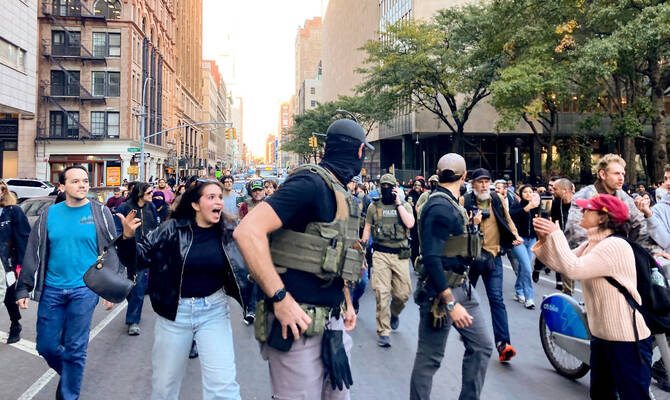
A contingent of protesters, many of whom appeared to be on their way home from work, then surrounded the masked officers, attempting to block their vehicle as they shouted “ICE out of New York” and called on other pedestrians to join them.
Agents from Immigration and Customs Enforcement, Border Patrol and other federal offices tried to clear the streets, in some cases shoving protesters to the ground and threatening them with pepper spray before detaining them.
As more New Yorkers joined the fray, some of the federal agents retreated on foot, followed by jeering protesters and honking vehicles.
Additional federal agents, armed with long guns and tactical gear, also arrived in a military tactical vehicle and made additional arrests.
Tricia McLaughlin, a spokesperson for the Department of Homeland Security, said the agents were conducting an enforcement operation against sellers of “counterfeit goods”
“During this law enforcement operation, rioters who were shouting obscenities, became violent and obstructed law enforcement duties including blocking vehicles and assaulting law enforcement,” she said.
At least one person was arrested for assaulting an officer, McLaughlin said. She did not respond to a request about how many vendors were detained.
The sweep came days after a conservative influencer shared video on X showing a group of men selling bags on the street, urging the official ICE account to “check this corner out.”
While clashes between immigration authorities and protesters have played out in Los Angeles and other cities, such scenes have been rarer on New York City streets, which Mayor Eric Adams has attributed in part to his working relationship with President Donald Trump’s administration.
President Donald Trump has paid close attention to the city’s mayor’s race, which is in two weeks, threatening to send federal troops to the city if Zohran Mamdani, a democratic socialist, wins.
In a statement, Mayor Eric Adams said the city had no involvement in the action and was still gathering details.
“Our administration has been clear that undocumented New Yorkers trying to pursue their American Dreams should not be the target of law enforcement, and resources should instead be focused on violent criminals,” he said.
Murad Awawdeh, president of the New York Immigration Coalition, accused the Trump administration of trying to get create a “violent spectacle” on the city’s streets.
“This operation had nothing to do with public safety and everything to do with terrorizing immigrant families and communities,” he said.

Immigration agents conducting sweep on NYC’s famed Canal Street confronted by protesters
https://arab.news/mwbzc
Immigration agents conducting sweep on NYC’s famed Canal Street confronted by protesters
- As more New Yorkers joined the fray, some of the federal agents retreated on foot, followed by jeering protesters and honking vehicles
8 in 10 British Muslims face ‘financial faith penalty’ when seeking home finance, survey finds
- Restricted choices plague potential buyers
LONDON: Eight in 10 British Muslims say their home finance choices are restricted because of their faith, according to a new national survey that highlighted what researchers describe as a growing “financial faith penalty” in the UK housing market.
The report, published by Islamic home finance fintech firm Offa, found that 80 percent of Muslim respondents believe their religious beliefs limit their access to suitable home finance, while those who do use Islamic products often face slower decisions, heavier paperwork and poorer customer experiences than in the conventional mortgage market.
Based on surveys of 1,000 British Muslims conducted by Muslim Census, and 2,000 non-Muslims carried out by OnePoll, the research calls on providers, brokers and policymakers to modernize Islamic home finance and improve access to Sharia-compliant products.
Among the 24.3 percent of British Muslims who have used Islamic home finance, just 5 percent said they had received a same-day decision.
Some 62 percent waited up to two weeks, while 33 percent waited more than 15 days, including 16 percent who waited over a month.
Long decision times were cited as the biggest challenge by 28 percent of respondents, followed by excessive paperwork (22.6 percent) and poor customer service (18.9 percent).
Islamic home finance differs from conventional mortgages by avoiding interest and steering investment away from sectors considered harmful to society, including gambling, alcohol, tobacco, arms trading and animal testing.
Sagheer Malik, chief commercial officer and managing director of home finance at Offa, said the findings showed British Muslims were being underserved by outdated systems.
Malik said: “Property is the asset class of choice for many of the UK’s 3.87 million Muslims, both as a route to generational wealth and as a long-term financial foundation, yet our insightful research report reveals that British Muslims are being underserved and deterred by slow, outdated and opaque Islamic home finance provision.
“This is not a niche concern. It goes to the heart of financial fairness and inclusion in modern Britain.”
He added that Muslims deserved Sharia-compliant products that matched mainstream standards on “price, speed and simplicity.”
Despite strong demand, uptake remains low.
Only 12.8 percent of British Muslims surveyed said they currently use Islamic home finance, with a further 11.5 percent having done so in the past. More than three quarters (75.7 percent) have never used it.
Faith plays a central role in financial decisions, with 94.2 percent saying it is important that their financial products align with their ethical or religious beliefs. Yet more than half of those using conventional mortgages said they felt unhappy or uneasy about doing so because of their faith.
The study also found that British Muslims share similar home ownership aspirations to the wider population, with 79.1 percent citing the desire to provide a stable home for their family, while 18.6 percent said building generational wealth was their main motivation. Only 2.2 percent said they did not want to own a home.
The report suggests Islamic finance could appeal beyond Muslim communities. While 64 percent of non-Muslim respondents had never heard of Islamic home finance, 63 percent said they favored its ethical principles once explained.
Younger generations were the most receptive, with 43 percent of Generation Z and 37 percent of millennials saying they would consider using Islamic home finance, compared with just 7 percent of baby boomers. More than three quarters of Gen Z and 72 percent of millennials also said it was important that their finance provider avoided investing in ethically harmful sectors.
Offa said the findings pointed to an opportunity to expand ethical finance in the UK, provided the industry can deliver faster, simpler and more transparent services.


