Pope Leo tells US bishops to address Trump’s immigration crackdown

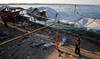
Federal immigration officers wait for respondents to depart from their hearings to conduct targeted detainments at US immigration court in Manhattan, in New York City on Oct. 7, 2025. (Reuters)
Short Url
Updated 08 October 2025
Follow

Pope Leo tells US bishops to address Trump’s immigration crackdown

  • Leo, the first US pope, was handed dozens of letters from immigrants describing their fears of deportation under the Trump administration
  • The pope questioned on Sept. 30 whether the Trump administration’s anti-immigration policies were in line with the Catholic Church’s pro-life teachings

VATICAN CITY: Pope Leo told US bishops visiting him at the Vatican on Wednesday that they should firmly address how immigrants are being treated by President Donald Trump’s hardline policies, attendees said, in the latest push by the pontiff on the issue.
Leo, the first US pope, was handed dozens of letters from immigrants describing their fears of deportation under the Trump administration’s policies during the meeting, which included bishops and social workers from the US-Mexico border.
“Our Holy Father … is very personally concerned about these matters,” El Paso Bishop Mark Seitz, who took part in the meeting, told Reuters. “He expressed his desire that the US Bishops’ Conference would speak strongly on this issue.”
“It means a lot to all of us to know of his personal desire that we continue to speak out,” said Seitz.
The Vatican did not immediately comment on the pope’s meeting.
Elected in May to replace the late Pope Francis, Leo has shown a much more reserved style than his predecessor, who frequently criticized the Trump administration and often spoke in surprise, off-the-cuff remarks.
But Leo has been ramping up his criticism in recent weeks.
The pope questioned on September 30 whether the Trump administration’s anti-immigration policies were in line with the Catholic Church’s pro-life teachings, in comments that drew heated backlash from some prominent conservative Catholics.
The White House has said Trump was elected based on his many promises, including to deport criminal illegal aliens.
One of the letters given to the pope on Wednesday, shared with Reuters, described a family with two members who did not have legal permission to stay in the US and who were afraid to leave the house for fear of deportation.
“I believe the Pope should speak out openly against the raids and the unfair treatment the community is experiencing,” read the letter, written in Spanish.
Leo also met privately with a group of about 100 American Catholics involved in ministry with migrants on Tuesday evening, thanking them for their work.


’We’ll bring him home’: Thai family’s long wait for Gaza hostage to end

Updated 1 sec ago
Follow

’We’ll bring him home’: Thai family’s long wait for Gaza hostage to end

NONG KHAI: Two years after Thai worker Sudthisak Rinthalak was killed by Hamas militants, his family in northeastern Thailand is preparing to welcome his remains home and hold a Buddhist ceremony they believe will bring his spirit peace.
Sudthisak was among 47 hostages whose bodies Hamas has returned under the current ceasefire agreement. The handover of deceased hostages was a key condition of the initial phase of the deal aimed at ending the war in Gaza.
Sudthisak’s elder brother Thepporn has spent the past two years fulfilling promises he made to his younger sibling, using compensation money to build a new house, buy pickup trucks for their elderly parents and expand their rubber farm.
But the 50-year-old farmer says none of it matters without Sudthisak there to see it.
“Everything is done but the person I did these things for is not here,” Thepporn said, walking through the rubber plantation in Nong Khai province near the Laos border.
Israel identified Sudthisak’s remains on Thursday after Hamas handed over his body as part of a ceasefire deal. The 44-year-old agricultural worker was captured by Hamas at an avocado farm during its October 7, 2023, attack on southern Israel and later killed at Kibbutz Be’eri.
The last image his family has of Sudthisak came from a video sent by friends that showed him lying face down with militants pointing guns at him.
“I feel sad because I couldn’t do anything to help him,” Thepporn said. “There was nothing I could do when I saw him with my own eyes. He was hiding behind a wooden frame and they were pointing the gun at him.”
For months, the family waited through multiple hostage releases, hoping Sudthisak would be among those freed alive. Each time brought disappointment.
“Whenever there was a hostage release, he was never included,” Thepporn said.
Sudthisak had gone to Israel to earn money to support his father, Thongma, 77, and mother, On, 80, who live in a farming community from which young people commonly go abroad for work.
His sister-in-law Boonma Butrasri wiped away tears as she spoke about the family’s loss.
“I don’t want war to happen. I don’t want this at all,” she said.
Before the conflict, approximately 30,000 Thai laborers worked in Israel’s agriculture sector, making them one of the largest migrant worker groups in the country.
Thepporn said his brother’s death serves as a warning to other Thai workers considering jobs abroad.
“I just want to tell the world that you’ve got to think very carefully when sending your family abroad,” he said.
“See which countries are at war or not, and think carefully.”