STOCKHOLM: A youth-led student group and a human-rights lawyer that took the issue of climate to the International Court of Justice (ICJ) received the Right Livelihood prize on Wednesday, dubbed an “alternative Nobel.”
The prize also honored Sudan’s humanitarian aid network Emergency Response Rooms, as well as a Burmese anti-corruption group and a Taiwanese champion of digital democracy.
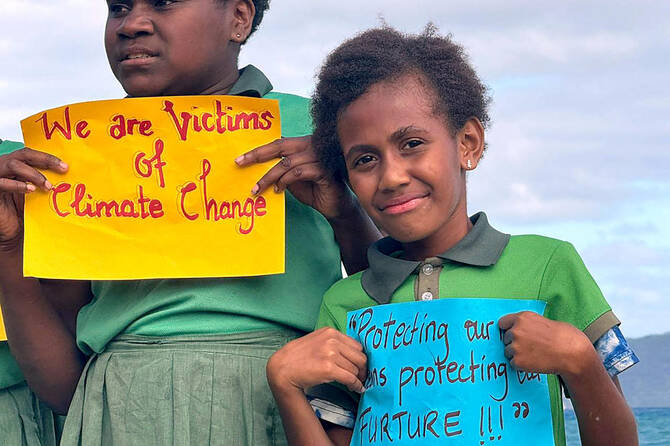
Frustrated by slow global efforts to tackle climate change, 27 law students at the University of the South Pacific in Vanuatu in 2019 decided to, in their words, “get the world’s biggest problem before the world’s highest court.”
The Pacific Islands Students Fighting Climate Change’s (PISFCC) campaigning culminated in the ICJ in July this year delivering an advisory opinion that states have legal obligations to address climate change.
While not legally binding, advisory opinions carry political and legal weight.
The prize jury hailed the group “for carrying the call for climate justice to the world’s highest court, turning survival into a matter of rights and climate action into a legal responsibility.”
Faced with the threat of rising sea levels and harsher weather patterns in places like the Pacific Ocean, island nations are particularly at risk from climate change.
“It’s an existential problem for young people in countries like Kiribati, in Tuvalu, in Marshall Islands. They’re witnessing the effects of climate change every high tide,” Vishal Prasad, director of PISFCC, said in July.
The group shared the prize with Julian Aguon, a human-rights lawyer from Guam, whose law firm, Blue Ocean Law, developed the legal strategy to carry the case.
The Sweden-based Right Livelihood Foundation also honored Emergency Response Rooms, a community-led grassroots network, for distributing aid during Sudan’s civil war.
The network was described as “the backbone of the country’s humanitarian response amid war, displacement and state collapse.”
Justice For Myanmar (JFM), a covert group of Burmese activists working to expose companies profiting from and propping up the country’s military junta, was also honored.
Taiwanese programmer and cyber ambassador Audrey Tang also received the award for “advancing the social use of digital technology to empower citizens, renew democracy and heal divides,” the jury said in a statement.
The Right Livelihood award was established in 1980, when Swedish-German stamp collector Jakob von Uexkull sold part of his collection to found it, after the foundation behind the Nobel Prizes refused to create new honors in the fields of environment and international development.


![]()

Pacific islands youth group wins prize for climate legal action
Short Url
https://arab.news/4y5ws
Pacific islands youth group wins prize for climate legal action
- Prize also honored Sudan’s humanitarian aid network Emergency Response Rooms
- Burmese anti-corruption group and a Taiwanese champion of digital democracy was feted as well


Latest updates


© 2026 SAUDI RESEARCH & PUBLISHING COMPANY, All Rights Reserved And subject to Terms of Use Agreement.