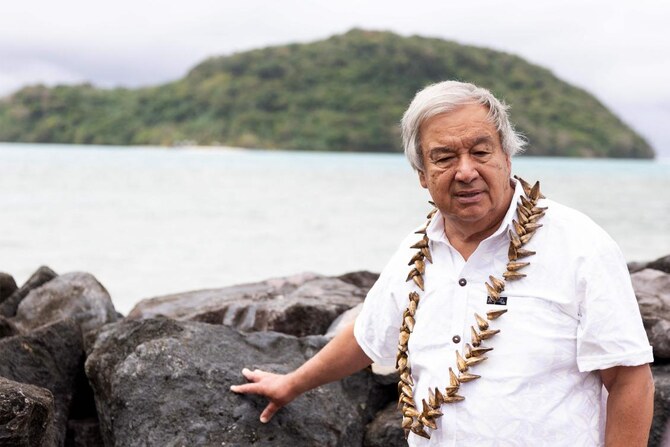
APIA, Samoa: UN chief Antonio Guterres warned Thursday that some Pacific territories face “annihilation” from climate-induced cyclones, ocean heatwaves and rising sea levels.
On a visit to Samoa, he said the fate of Pacific islands depended on limiting global warming to 1.5 degrees Celsius above pre-industrial levels.
Nearly 200 nations agreed to strive for that target in the 2015 Paris climate agreement, but UN estimates indicate that the world is not on track to achieve it.
“High and rising sea levels pose an enormous threat to Samoa, to the Pacific and to other small island developing states, and these challenges demand resolute international action,” Guterres said.
The Pacific region contributes just 0.02 percent of global carbon emissions, he noted.
“Yet you are on the front lines of the climate crisis, dealing with extreme weather events from raging tropical cyclones to record ocean heatwaves,” the UN secretary-general continued.
“Sea levels are rising even faster than the global average, posing an existential threat to millions of Pacific Islanders,” he added.
“People are suffering. Economies are being shattered. And entire territories face annihilation.”
Guterres urged richer nations to live up to their commitments to help pay for the consequences of climate change in developing countries.
He also called for international action to tackle the impact of climate change, overfishing and plastic pollution on the Pacific Ocean.
Guterres said major powers’ interest in the region was rising, an allusion to the jostling for power and influence in the Pacific between China and the United States and its allies.
“The Pacific is best managed by Pacific islanders,” the UN chief said. “It must never become a forum for geostrategic competition.”

UN chief says Pacific territories face climate ‘annihilation’
https://arab.news/vf387
UN chief says Pacific territories face climate ‘annihilation’
- UN chief: Fate of Pacific islands depended on limiting global warming to 1.5 degrees Celsius above pre-industrial levels
- The Pacific region contributes just 0.02 percent of global carbon emissions
UN peacekeepers defy South Sudan military’s order to leave opposition-held town
JUBA, South Sudan: The United Nations Mission in South Sudan said Monday that it would not comply with a government order to shut down its base in Akobo, an opposition stronghold near the Ethiopian border where tens of thousands of refugees have fled.
On Friday, the South Sudanese army ordered UN peacekeepers as well as NGOs and civilians to vacate the town ahead of a planned assault.
But the mission refused to leave and said it would provide “a protective presence for civilians” in the town, adding that the safety and security of its personnel “must be fully respected at all times.”
The UN Mission said it was engaging “intensively with national, state and local stakeholders” regarding this order. “Any military operations in and around Akobo gravely endanger the safety and security of civilians,” said mission chief Anita Kiki Gbeho.
The South Sudanese government has been fighting opposition forces since a 2018 peace deal broke down about a year ago.
A dramatic escalation took place in December 2025, when opposition forces seized several government outposts in northern Jonglei. A government counter-offensive repelled their forces a month later and displaced over 280,000 people. Tens of thousands have sought refuge in Akobo, where a small contingent of UN peacekeepers is stationed.
Fearing the looming government assault on Akobo, humanitarian workers were evacuated over the weekend, and a mass exodus of the population has also begun.
Local officials contacted by the The Associated Press said fleeing civilians faced danger and widespread shortages of essential supplies. Dual Diew, the Akobo County health director, who has fled to Ethiopia, said there were 84 wounded patients at the hospital. “We have most of them with us here now,” he said, adding that they lack medicine and basic nursing equipment.
Christophe Garnier, the leader of Doctors Without Borders in South Sudan said the organization had to evacuate its staff from Akobo on Saturday and learned of the subsequent looting of its hospital and the ransacking of its office.
“People in Akobo must now either flee without protection or remain at risk of being killed, while losing access to health care and other essential services,” he said.
The three Western governments that have played a major role in the peace process — the U.S, UK, and Norway — sent a letter to President Kiir on Monday urging that the army’s evacuation order be revoked and warning of “further deaths, displacement and suffering for the South Sudanese people” if the offensive on Akobo is implemented.


