Spain intensifies criticism of Israeli offensive in Gaza, Israel responds with travel bans

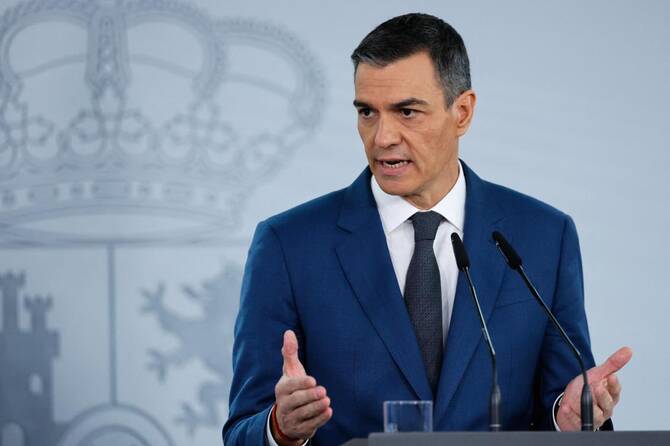
Spain's Prime Minister Pedro Sanchez gestures during a press conference following the cabinet meeting at the Moncloa Palace in Madrid, on November 5, 2024. (AFP)
Short Url
Updated 08 September 2025
Follow

Spain intensifies criticism of Israeli offensive in Gaza, Israel responds with travel bans

  • Sánchez announced a raft of measures he said his government was taking to pressure Netanyahu’s government to address humanitarian crisis in Gaza

MADRID: Spanish Prime Minister Pedro Sánchez on Monday ratcheted up his criticism of Israel’s actions in the 23-month Israel-Hamas war, to which Israel responded by banning two left-wing Spanish ministers from the country.
Sánchez made the comments while announcing a raft of measures he said his government was taking to pressure Israeli Prime Minister Benjamin Netanyahu’s government to address the humanitarian crisis caused by its military offensive in the Gaza Strip.
“This is not self-defense, it’s not even an attack — it’s the extermination of a defenseless people. It is a violation of all humanitarian laws, and despite that, the international community is failing to stop this tragedy,” Sánchez said.
Besides formalizing an arms embargo, which the Spanish government says has been de facto in effect since October 2023, Spain will ban ships carrying fuel for Israel’s armed forces from passing through Spanish ports, and increase its humanitarian aid toward Gaza in 2026 to reach 150 million euros ($176 million), he said.
The measures would need to be approved in Parliament.
Other steps included a pledge to increase aid for the UN agency for Palestinian refugees, known as UNRWA, and to impose an embargo on goods made in Israeli settlements in the occupied Palestinian territories.
Additionally, anyone who directly participates in what Sánchez termed the “genocide” in Gaza would not be allowed to enter Spanish territory, he said.
“We know that all these measures will not be enough to stop the invasion or the war crimes, but we hope that they will serve to add pressure on Prime Minister Netanyahu and his government to alleviate some of the suffering that the Palestinian population is enduring,” Sánchez said.
In response, Israeli Foreign Minister Gideon Saar said Sánchez was trying to divert attention from the corruption scandals affecting his Socialist Party, and characterized the Spanish government’s actions as “antisemitic.”
Saar said on X Israel had banned Spain’s Labor Minister Yolanda Díaz and Youth Minister Sira Rego from traveling to the country. Both belong to the government’s left-wing coalition partner Sumar. Saar said the ministers would be prohibited from entering Israel because they had made statements calling Israel a “genocidal state” and supported efforts to sanction or boycott Israel.
Spain’s government has been an outspoken critic of Israel’s war in Gaza, which began after Hamas-led militants killed around 1,200 people, mostly civilians, on Oct. 7, 2023, and abducted 251 hostages. Israel’s offensive has killed more than 64,000 Palestinians, according to the Gaza Health Ministry, which does not say how many were civilians or combatants.
Last year, Spain joined Norway and Ireland to formally recognize a Palestinian state and was the first European country to ask a UN court for permission to join South Africa’s case accusing Israel of genocide in Gaza.
On Monday, Saar downplayed the effect the Spanish government’s actions would have on Israel.
“If they want to hold or halt defense connections with Israel,” Saar told reporters, “who do you think will lose from that? We don’t need Spain to protect the land of Israel.”


How a Syrian refugee chef met Britain’s King Charles

Imad Alarnab, a chef and restaurant owner who fled Syria in 2015, works at one of his restaurants in central London. (AFP)
Updated 02 March 2026
Follow

How a Syrian refugee chef met Britain’s King Charles

  • Alarnab, 48, said he had asked the king to come to the popular eatery when he met him at Buckingham Palace

LONDON: Pots clanged and oil sizzled inside the London kitchen of Syrian chef Imad Alarnab, as the former refugee who fled his country’s civil war recalled hosting King Charles III.
When the chef left his war-torn homeland in 2015, he never imagined that one day he would watch as cameras flashed and wide-eyed crowds greeted the monarch arriving at his Soho restaurant last year.
Alarnab, 48, said he had asked the king to come to the popular eatery when he met him at Buckingham Palace before an event honoring humanitarian work in 2023.
“I told him ‘I would love for you to visit our restaurant one day’ and he said: ‘I would love to’... I was over the Moon to be honest.”
The chef has come a long way since he arrived in London after an arduous journey from Damascus with virtually no money in his pocket.
Fearing for his life, he had escaped Syria after his family was uprooted again and again by fighting.
His culinary empire — restaurants, cafes, and juice bars peppered across the Syrian capital — had been destroyed by bombing in just six days in 2013.
Alarnab spent three months crisscrossing Europe in the back of lorries, aboard trains, on foot and even on a bicycle before he reached the UK.
“When I left, I left with nothing,” he told AFP, as waiters whirled past carrying steaming plates of traditional Syrian fare.
Starving and exhausted, he spent the last of his money on a train ticket to Doncaster where his sister lived.
“Love letter from Syria”
To make a living, Alarnab initially picked up any odd jobs, such as washing and selling cars, saving enough to bring his wife and three daughters over after seven months.
His love of cooking never left him though. In France, while he was sleeping on the steps of a church, Alarnab had often cooked for hundreds of other refugees.
“I always dreamed of going back to cooking,” he said.
So it wasn’t long before he found himself back in the kitchen, cooking up a storm across London with his sold-out supper clubs, bustling pop-up cafes, and crowded lunchtime falafel bars.
Alarnab’s friends gave him the initial boost for his first pop-up in 2017, and profits from his new catering business then covered the costs of later events.
He now runs two restaurants in the city — one in Soho’s buzzing Kingly Court and another nestled in a corner of the vibrant Somerset House arts center.
“I was looking for a city to love when I found London,” Alarnab said, adding it had offered him “space to innovate” and add his own modern twist to classic Syrian dishes.
Far from home, Alarnab said his word-of-mouth success had grown into a “love letter from Syria to the world” that needs no translation.
“You don’t really need to speak Arabic or Syrian to know that this is the best falafel ever,” he said, pointing to a row of colorful plates.
“There is hope”
For Alarnab, spices frying, dough rising and cheese melting inside a kitchen offered an unlikely escape from the real world.
“All my problems, I leave them outside the kitchen and walk in fresh.”
When he fled Syria, Alarnab thought going back to Damascus was forever off the table.
Yet he returned for the first time in October, almost a year to the day after longtime leader Bashar Assad was toppled in a lightning rebel offensive — ending almost 14 years of brutal civil war.
He walked the familiar streets of his old home, where his late mother taught him to cook many years ago.
“To return to Damascus and for her not to be there, that was extremely difficult.”
Torn between the two cities, Alarnab said he longed to one day rebuild his home in Damascus.
“I wish I could go back and live there. But at the same time, I feel like London is now a part of me. I don’t know if I could ever go back and just be in Syria,” he said.
Although Syrians still bear the scars of war, Alarnab said he had seen “hope in people’s eyes which was missing when I left in 2015.”
“The road ahead is still very long, and yes this is only the beginning — but there is hope.”