LISBON: Portuguese authorities have delayed until Saturday the release of their initial findings on what caused the fatal derailment of one of Lisbon’s famous funicular trains, which killed 16 people.
The report was originally set to be made public on Friday. But a spokesman for the GPIAAF air and rail accident investigations bureau told Portugal’s Lusa news agency late on Friday: “It is not possible to publish the report today.”
It was now expected to be released “sometime Saturday afternoon,” the spokesman said.
The report was only to give very early findings on the circumstances of the accident, which struck on Wednesday, with a more detailed preliminary report due “probably within 45 days,” the chief police investigator, Nelson Oliveira, said on Thursday.
Eleven foreign nationals were among the 16 people killed when one of Lisbon’s popular funicular trains crashed.
Three Britons, two South Koreans, two Canadians, one Frenchwoman, one Swiss man, one American and one Ukrainian were killed alongside five Portuguese, police said.
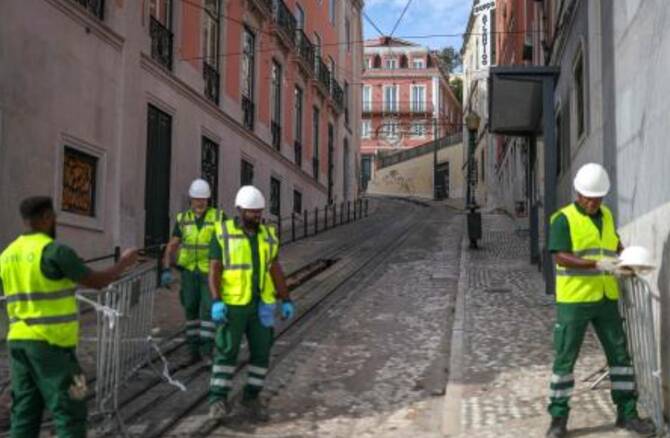
Eyewitness accounts described the wagon speeding down the steep street before derailing at a slight bend and crashing into a building at around 6:00 p.m. local time (5:00 p.m. GMT) on Wednesday.
In a Thursday press conference alongside Oliveira, judicial police chief Luis Neves had said the investigation was not ruling out any potential causes.
At least 11 foreigners were among the injured — two Germans, two Spaniards, a Frenchwoman, an Italian, a Swiss national, a Canadian, a South Korean, a Moroccan and a Cape Verdean, emergency services said.
Local media speculation about the cause of the accident has mentioned ruptured security cables and maintenance work overseen by Lisbon’s public transport operator Carris.
But a daily inspection conducted on the morning of the tragedy indicated a smoothly operating system.
The derailed wagon was removed from the street early on Friday.


Early official report on Lisbon funicular accident delayed
https://arab.news/m89qv
Early official report on Lisbon funicular accident delayed

- The report was originally set to be made public on Friday
- Eleven foreign nationals were among the 16 people killed when one of Lisbon’s popular funicular trains crashed


Bolivia and Israel to restore ties severed over the war in Gaza
- Paz's government eased visa restrictions on American and Israeli travelers last month
- The Bolivian foreign ministry said its top diplomat would meet his Israeli counterpart in Washington later Tuesday to discuss the revival of bilateral ties
LA PAZ, Bolivia: Bolivia's new right-wing government said Tuesday that it would restore diplomatic relations with Israel, the latest sign of the dramatic geopolitical realignment underway in the South American country that was once among the most vocal critics of Israeli policies toward Palestinians.
The Bolivian foreign ministry said its top diplomat would meet his Israeli counterpart in Washington later Tuesday to discuss the revival of bilateral ties, which Bolivia's previous left-wing government severed two years ago over Israel's devastating campaign against Hamas in Gaza.
Bolivia said the effort came as part of a new foreign policy strategy under conservative President Rodrigo Paz aimed at “rebuilding Bolivia's international prestige, opening new economic opportunities and strengthening alliances that directly benefit the country and our citizens abroad."
Bolivian Foreign Minister Fernando Aramayo is in the midst of a whirlwind trip to Washington for meetings with American officials as his government works to warm long-chilly relations with the United States and unravel nearly two decades of hard-line, anti-Western policies under the Movement Toward Socialism, or MAS, party that left Bolivia economically isolated and diplomatically allied with China, Russia and Venezuela.
Paz's government eased visa restrictions on American and Israeli travelers last month.
In announcing his expected meeting with Aramayo on Monday, Israeli Foreign Minister Gideon Saar thanked Bolivia for scrapping Israeli visa controls and said he spoke to Paz after the center-right senator's Oct. 19 election victory to express “Israel’s desire to open a new chapter” in relations with Bolivia.
Paz entered office last month, ending the dominance of the MAS party founded by Evo Morales, the charismatic former coca-growing union leader who became Bolivia's first Indigenous president in 2006. Not long after taking power, Morales sent Israel's ambassador packing and cozied up to Iran over their shared enmity toward the U.S. and Israel.
When protests over Morales' disputed 2019 reelection prompted him to resign under pressure from the military, a right-wing interim government took over and restored full diplomatic relations with the U.S. and Israel as it sought to undo many of Morales’ popular policies.
But 2020 elections brought the MAS party back to power with the presidency of Luis Arce, who in 2023 once again cut ties with Israel in protest over its military actions in Gaza.
Other left-wing Latin American countries, like Chile and Colombia, soon made similar moves, recalling their ambassadors and joining South Africa’s genocide case against Israel before the United Nations’ highest judicial body.


