

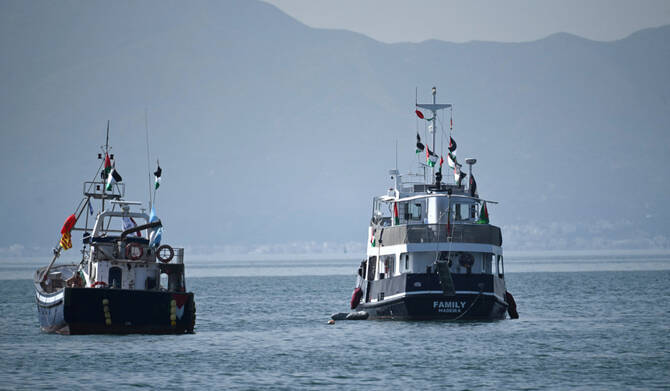

LONDON: Irish citizens who joined the international flotilla that attempted to deliver aid to Gaza between late August and early October this year, and were detained by Israeli authorities as their vessels approached the territory, are “exploring litigation” options. And on Tuesday, they urged politicians in Ireland to “hold Israel accountable” for its actions.
A number of those who were part of the flotilla have also lodged complaints with police in Ireland about their treatment at the hands of authorities in Israel, The Independent newspaper reported.
Some of the participants appeared at a joint meeting of the Irish parliament’s foreign affairs and EU committees on Tuesday, where they told politicians they were denied food, water and diabetes medication during their confinement in Israel, and some people “came home traumatized” by the ordeal.
Sixteen Irish citizens reportedly were among the hundreds detained when Israeli authorities intercepted the Global Sumud Flotilla on Oct. 1.
Karen Moynihan, the head of delegation for Ireland at the Global Movement to Gaza, and one of the flotilla organizers, asked the members of the committees: “If another country had kidnapped Irish citizens, what would we have done? I don’t think we would have just sat by and done absolutely nothing.”
Another flotilla demonstration is being planned, she added.
The participants told the politicians that their vessels had been targeted by drone attacks before the Israelis detained them and took them to Kestiot Prison, in the Negev desert.
Advocate Leigh Brosnan, who was on a vessel carrying legal observers, said lawyers were “exploring litigation” over the way Irish people who were part of the flotilla were treated.
Asked whether the Global Sumud Flotilla should have been escorted by an Irish Defence Forces vessel, she said “there were courses of action that could have been taken.”
She added: “The risks were extremely high, they were extremely plausible. There was very good ground to believe that serious harms could be done to the Irish citizens.”
Participant Sarah Clancy said detainees were strip searched and denied access to bathrooms. They were “threatened regularly” by their captors, she added, including “heavily armed tactical units of up to eight personnel” with automatic weapons, pistols, riot shields and Alsatian dogs.
Initially, the only food provided was raw vegetables pushed through small holes in cell doors, Clancy said, but the day before they were released the captors “started giving us loads of food.”
She confirmed claims by other participants that some drone attacks against flotilla vessels took place within EU waters off the coast of Crete, including “an attack on the boat that myself and (Sinn Fein Senator) Chris Andrews were on.”
Diarmuid Mac Dubhghlais, who was also on a flotilla vessel, said that those detained were denied legal representation, and all of his personal property was “stolen” and “denied to me.”
He added: “There are people that went on that trip that came home traumatized. A lot of people were shocked to find that when push came to shove, they were left in the middle of the Mediterranean and literally everybody ran away.”
Donna Schwarz said detainees were subjected to “invasive” searches and sleep deprivation, their personal belongings were confiscated, and they were interrogated without legal representation.
“For me the trauma was that nothing has changed,” she said, referring to the humanitarian situation in Gaza.
“Just after the drone strikes, we were told it could get worse. We all said we would continue on — I cried for about a day making my decision — and it’s going to be worth it: it’s going to create so much media attention that we’re going to open up this humanitarian corridor, there’s going to be food and aid allowed in.
“And still, people are starving there.”
Clancy said: “It was interesting to me that (Sinn Fein member of the Irish parliament) Sean Crowe asked us where we might hold Israel accountable, because we came here today to tell you that it’s your job to hold Israel accountable.
“We’ve done as much as private citizens (can), honestly. We’ve put ourselves (out) as far as we possibly can and I think most of us will probably do so again, and that’s what we’re asking you to do as well: to not leave a stone unturned.”
During the meeting, the chairperson of the EU committee, Fine Gael MP Barry Ward, asked the flotilla participants whether Ireland had been “the strongest pro-Palestinian voice in the Western world.”
This triggered heated exchanges between him and the witnesses about whether Irish authorities had done enough to help and support Palestinians. One person accused the Irish government of being “very strong on language, very poor on actions.”
Ward said he would not “disagree with you that we haven’t done enough” but had a problem with any suggestion of Irish “complicity” in genocide in Gaza.
“I just think the context is important because the suggestion from, I think, what every one of you said is that, ‘We can stop this,’” he said. “We can’t stop this.”
The flotilla participants said Ireland could end any connection it might have with the actions of Israel, and that “there’s absolutely no place for balance in a genocide.”
The chairperson of the foreign affairs committee, Fianna Fail MP John Lahart, told the flotilla witnesses: “We’re not your enemy in this” and “I hate that we divide on this.”


