

Florida’s CAIR vows lawsuit against DeSantis over ‘foreign terrorist’ label

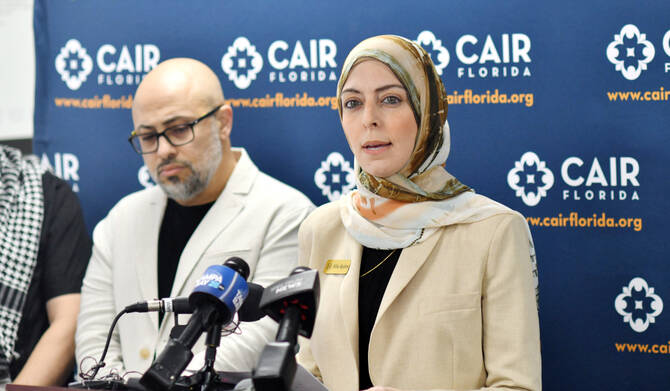
Hiba Rahim, interim executive director of CAIR-Florida, speaks during a press conference in response to Florida Governor Ron DeSantis designating the Council on American-Islamic Relations as a "foreign terror organization," at their headquarters in Tampa, Florida, U.S., December 9, 2025. (REUTERS)
Short Url
Updated 10 December 2025
Follow

Florida’s CAIR vows lawsuit against DeSantis over ‘foreign terrorist’ label

  • Questioned by reporters at a press event in North Miami Beach on Tuesday, DeSantis doubled down on his administration’s decision to label the Muslim civil rights group a “foreign terrorist organization”

ORLANDO, Florida: A day after Gov. Ron DeSantis designated a leading Muslim civil rights organization as a “foreign terrorist organization,” leaders of the group’s Florida chapter on Tuesday promised a lawsuit and said the state had no legal basis for such a declaration.
The governor’s executive order against the Council on American-Islamic Relations was an attack based on conspiracy theories, similar to those aimed in past decades at other minority groups like Jewish, Irish and Italian Americans that created fear and division, Hiba Rahim, the Florida chapter’s deputy executive director, said at a news conference in Tampa.
“We are very proud to defend the founding principles of our Constitution, to defend free speech,” Rahim said. “We are proud to defend democracy, and we are proud to be America first.”
Rahim blamed DeSantis’ support for Israel as a reason for the executive order because she said the group’s activism had caused “discomfort” to Israel. In October, the group played an active role in advocating for the release of a 16-year-old Palestinian-American from Florida who had been held in an Israeli prison for eight months. Mohammed Ibrahim was released last month.
Florida has an estimated 500,000 Muslim residents, according to the Council on American-Islamic Relations, also known as CAIR.
“We will not back down here,” said Rahim, vowing to sue.
The DeSantis order also gives the same “foreign terrorist” label to the Muslim Brotherhood. President Donald Trump last month issued an executive order that sets in motion a process to designate certain chapters of the Muslim Brotherhood as a foreign terrorist organization.
Questioned by reporters at a press event in North Miami Beach on Tuesday, DeSantis doubled down on his administration’s decision to label the Muslim civil rights group a “foreign terrorist organization.”
“I welcome the lawsuit,” DeSantis said, calling the designation “a long time coming.”
The governor also said he expects state lawmakers to push “follow-on legislation” on the issue during the regular session that starts in January.
“So I think our executive order is kind of the beginning,” he said.
The governor’s executive order instructs Florida agencies to prevent the two groups and those who have provided them material support from receiving contracts, employment and funds from a state executive or cabinet agency.
Founded in 1994, CAIR has 25 chapters around the country. Texas Gov. Greg Abbott has issued a similar proclamation in Texas. CAIR last month asked a federal judge to strike down Abbott’s proclamation, saying in a lawsuit that it was “not only contrary to the United States Constitution, but finds no support in any Texas law.”
Speaking at the Florida news conference Tuesday, Tampa attorney Miranda Margolis said the governor didn’t have any legal authority to unilaterally designate a nonprofit as a terrorist organization.
“This designation is without legal or factual basis and constitutes a dangerous escalation of anti-Muslim political rhetoric,” said Margolis, who was representing the National Lawyers Guild, a progressive legal group.


Bolivia and Israel to restore ties severed over the war in Gaza

Updated 5 sec ago
Follow

Bolivia and Israel to restore ties severed over the war in Gaza

  • Paz's government eased visa restrictions on American and Israeli travelers last month
  • The Bolivian foreign ministry said its top diplomat would meet his Israeli counterpart in Washington later Tuesday to discuss the revival of bilateral ties

LA PAZ, Bolivia: Bolivia's new right-wing government said Tuesday that it would restore diplomatic relations with Israel, the latest sign of the dramatic geopolitical realignment underway in the South American country that was once among the most vocal critics of Israeli policies toward Palestinians.
The Bolivian foreign ministry said its top diplomat would meet his Israeli counterpart in Washington later Tuesday to discuss the revival of bilateral ties, which Bolivia's previous left-wing government severed two years ago over Israel's devastating campaign against Hamas in Gaza.
Bolivia said the effort came as part of a new foreign policy strategy under conservative President Rodrigo Paz aimed at “rebuilding Bolivia's international prestige, opening new economic opportunities and strengthening alliances that directly benefit the country and our citizens abroad."
Bolivian Foreign Minister Fernando Aramayo is in the midst of a whirlwind trip to Washington for meetings with American officials as his government works to warm long-chilly relations with the United States and unravel nearly two decades of hard-line, anti-Western policies under the Movement Toward Socialism, or MAS, party that left Bolivia economically isolated and diplomatically allied with China, Russia and Venezuela.
Paz's government eased visa restrictions on American and Israeli travelers last month.
In announcing his expected meeting with Aramayo on Monday, Israeli Foreign Minister Gideon Saar thanked Bolivia for scrapping Israeli visa controls and said he spoke to Paz after the center-right senator's Oct. 19 election victory to express “Israel’s desire to open a new chapter” in relations with Bolivia.
Paz entered office last month, ending the dominance of the MAS party founded by Evo Morales, the charismatic former coca-growing union leader who became Bolivia's first Indigenous president in 2006. Not long after taking power, Morales sent Israel's ambassador packing and cozied up to Iran over their shared enmity toward the U.S. and Israel.
When protests over Morales' disputed 2019 reelection prompted him to resign under pressure from the military, a right-wing interim government took over and restored full diplomatic relations with the U.S. and Israel as it sought to undo many of Morales’ popular policies.
But 2020 elections brought the MAS party back to power with the presidency of Luis Arce, who in 2023 once again cut ties with Israel in protest over its military actions in Gaza.
Other left-wing Latin American countries, like Chile and Colombia, soon made similar moves, recalling their ambassadors and joining South Africa’s genocide case against Israel before the United Nations’ highest judicial body.