LISBON: An electric streetcar that is one of Lisbon’s landmarks and a big draw for tourists derailed Wednesday, killing 15 people and injuring 18 others, emergency services said.
Five of the injured are in serious condition, and a child is among the injured, the National Institute for Medical Emergencies said in a statement. An unknown number of the injured are foreigners, it said.
Authorities called it an accident, the worst in the city’s recent history.
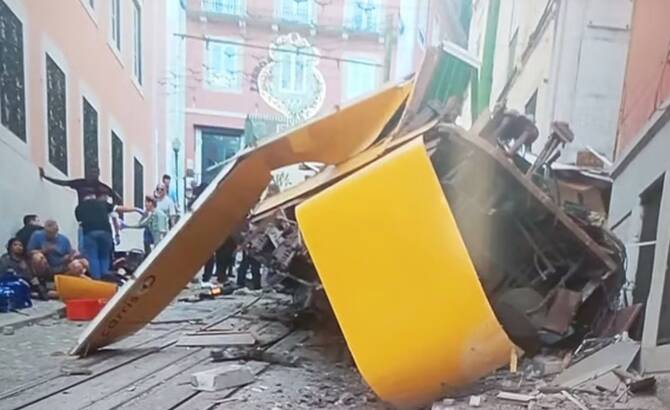
The yellow-and-white streetcar, which goes up and down a steep downtown hill in tandem with one going the opposite way, was lying on its side on the narrow road that it travels along, Portuguese television channels showed.
Its sides and top were partially crumpled, and it appeared to have crashed into a building where the road bends. Several dozen emergency workers were at the scene but most stood down after about two hours.
Eyewitnesses told local media that the streetcar careened down the hill, apparently out of control.
Lisbon Mayor Carlos Moedas told reporters at the scene that the city was in mourning. “This was a tragic accident … It’s a tragedy of the like we’ve never seen.”
President Marcelo Rebelo de Sousa offered his condolence to affected families.
European Commission President Ursula von der Leyen also sent her condolences. “It is with sadness that I learned of the derailment of the famous Elevador da Gloria,” she wrote in Portuguese on X.
The cause of the accident was not immediately known. It reportedly occurred at the start of the evening rush hour, around 6 p.m.
An investigation into the causes will begin once the rescue operation is over, the Portuguese government said in a statement.
The streetcar, known as Gloria, can carry more than 40 people, seated and standing. It is commonly used by Lisbon residents.
The streetcar, technically called a funicular, is known as Elevador da Gloria. Two streetcars run parallel to each other as they shuttle up and down the hill on a curved, traffic-free road for a few hundred meters (yards).
It is classified as a national monument.
Lisbon hosted around 8.5 million tourists last year, and the streetcar is a popular attraction. Long lines of tourists typically form for the brief ride on it.

Landmark streetcar in Lisbon derails, killing 15 people
Short Url
https://arab.news/mfgqq
Landmark streetcar in Lisbon derails, killing 15 people
- Five of the injured are in serious condition, and a child is among the injured
- Authorities called it an accident, the worst in the city’s recent history
Russia’s war footing may remain after Ukraine war, Latvia spy chief warns
MUNICH: Russia will not end the militarization of its economy after fighting in Ukraine ends, the head of Latvia’s intelligence agency told AFP on the sidelines of the Munich Security Conference which ends Sunday.
“The potential aggressiveness of Russia when the Ukraine war stops will depend of many factors: How the war ends, if it’s frozen or not, and if the sanctions remain,” Egils Zviedris, director of the Latvian intelligence service SAB, told AFP.
Some observers believe that Russia has so thoroughly embraced a war economy and full military mobilization that it will be difficult for it to reverse course, and that this could push Moscow to launch further offensives against European territories.
Zviedris said that lifting current sanctions “would allow Russia to develop its military capacities” more quickly.
He acknowledged that Russia has drawn up military plans to potentially attack Latvia and its Baltic neighbors, but also said that “Russia does not pose a military threat to Latvia at the moment.”
“The fact that Russia has made plans to invade the Baltics, as they have plans for many things, does not mean Russia is going to attack,” Zviedris told AFP.
However, the country is subject to other types of threats from Moscow, particularly cyberattacks, according to the agency he leads.
The SAB recently wrote in its 2025 annual report that Russia poses the main cyber threat to Latvia, because of broader strategic goals as well as Latvia’s staunch support of Ukraine.
The threat has “considerably increased” since Moscow’s full-scale invasion of Ukraine in 2022, it said.
The agency has also warned that Russia is seeking to exploit alleged grievances of Russian-speaking minorities in the Baltics — and in Latvia in particular.
Russia’s Ministry of Foreign Affairs has repeatedly claimed to be preparing cases against Latvia, Lithuania and Estonia at the UN International Court of Justice over the rights of their Russian-speaking minorities.
“The aim of litigation: to discredit Latvia on an international level and ensure long-term international pressure on Latvia to change its policy toward Russia and the Russian-speaking population,” the report said.
In 2025, approximately 23 percent of Latvia’s 1.8 million residents identified as being of Russian ethnicity, according to the national statistics office.
Following the Russian invasion of Ukraine in 2022, Latvian authorities decided to require Russian speakers residing in the country to take an exam to assess their knowledge of the Latvian language — with those failing at potential risk of deportation.
“The potential aggressiveness of Russia when the Ukraine war stops will depend of many factors: How the war ends, if it’s frozen or not, and if the sanctions remain,” Egils Zviedris, director of the Latvian intelligence service SAB, told AFP.
Some observers believe that Russia has so thoroughly embraced a war economy and full military mobilization that it will be difficult for it to reverse course, and that this could push Moscow to launch further offensives against European territories.
Zviedris said that lifting current sanctions “would allow Russia to develop its military capacities” more quickly.
He acknowledged that Russia has drawn up military plans to potentially attack Latvia and its Baltic neighbors, but also said that “Russia does not pose a military threat to Latvia at the moment.”
“The fact that Russia has made plans to invade the Baltics, as they have plans for many things, does not mean Russia is going to attack,” Zviedris told AFP.
However, the country is subject to other types of threats from Moscow, particularly cyberattacks, according to the agency he leads.
The SAB recently wrote in its 2025 annual report that Russia poses the main cyber threat to Latvia, because of broader strategic goals as well as Latvia’s staunch support of Ukraine.
The threat has “considerably increased” since Moscow’s full-scale invasion of Ukraine in 2022, it said.
The agency has also warned that Russia is seeking to exploit alleged grievances of Russian-speaking minorities in the Baltics — and in Latvia in particular.
Russia’s Ministry of Foreign Affairs has repeatedly claimed to be preparing cases against Latvia, Lithuania and Estonia at the UN International Court of Justice over the rights of their Russian-speaking minorities.
“The aim of litigation: to discredit Latvia on an international level and ensure long-term international pressure on Latvia to change its policy toward Russia and the Russian-speaking population,” the report said.
In 2025, approximately 23 percent of Latvia’s 1.8 million residents identified as being of Russian ethnicity, according to the national statistics office.
Following the Russian invasion of Ukraine in 2022, Latvian authorities decided to require Russian speakers residing in the country to take an exam to assess their knowledge of the Latvian language — with those failing at potential risk of deportation.
© 2026 SAUDI RESEARCH & PUBLISHING COMPANY, All Rights Reserved And subject to Terms of Use Agreement.


