Once a symbol of Najdi homes, Al-Roshen fades from view

Though most contemporary homes are no longer built with an Al-Roshen, the spirit behind it remains. (Supplied)
Short Url
Updated 13 July 2025
Follow

Once a symbol of Najdi homes, Al-Roshen fades from view

  • Today, Saudis continue to express hospitality in new ways — hosting events in gardens, villas, or special venues, while maintaining the warmth and generosity that have always defined social gatherings

RIYADH: As Saudi Arabia rapidly modernizes, some elements of its traditional architecture are becoming rarer, but not forgotten.

Once a hallmark of Najdi homes, Al-Roshen remains a cherished symbol of Saudi hospitality and social values, even as lifestyles and housing designs evolve.

“Al-Roshen is a room for special guests,” said Mohammad Alhouti, a resident of Riyadh’s Aldeerah neighborhood.


Though most contemporary homes are no longer built with an Al-Roshen, the spirit behind it remains. (Supplied)

“As soon as a person enters the house through the door, there is a ground-floor sitting room and a staircase. This staircase leads to Al-Roshen, separate so that the guest can go up as soon as they enter the house.”

Unlike the more common majlis, Al-Roshen offered a secluded space for important visitors.

According to Abdulrahman Alhouti, some people would add plaster to the walls of Al-Roshen, creating shapes and decorations that would make it stand out from the main majlis in the house.

FASTFACTS

• Once a hallmark of Najdi homes, Al-Roshen remains a cherished symbol of Saudi hospitality and social values, even as lifestyles and housing designs evolve.

• Unlike the more common majlis, Al-Roshen offered a secluded space for important visitors.

Though most contemporary homes are no longer built with an Al-Roshen, the spirit behind it remains.

Mohammad and Abdulrahman are a part of Thuluthiyyat Almasmak, a weekly cultural gathering held in front of Riyadh’s Al-Masmak Palace.


(From L to R) Abdulrahman Al-Houti, Fahad Al-Hidyyan and Mohammad Al-Houti, members of Thuluthiyyat Almasmak. (AN photo by Jaafer Alsaleh)

Their group includes Fahad Alhidyyan, helping document and share Riyadh’s history through stories of its neighborhoods, streets, schools and everyday life.

Their weekly gathering has reached its seventh year and the group has welcomed all types of visitors, from locals to international tourists coming to Riyadh, to discuss the past and present of the Kingdom’s capital.

“(The gathering) tells the story of the history of Riyadh, its old alleys, streets, schools, farms and everything old, from the time of King Abdulaziz until the beginning of the development,” Abdulrahman said.


Al-Roshan was similar to Almajlis, but with a separate seating area and cushions. It was a room on the second floor in the house where special guests are hosted. (Supplied)

Today, Saudis continue to express hospitality in new ways — hosting events in gardens, villas, or special venues, while maintaining the warmth and generosity that have always defined social gatherings.

“In the past, receiving guests was of great importance. The host would take great care in welcoming his guests, making every effort to provide them with the best he could,” Alhidyyan said.

“People now meet during Eid, weddings, or planned gatherings, though often outside the home. There is a difference, but the intention remains.”

Rather than fading away entirely, Al-Roshen now lives on through cultural forums and conversations that highlight the evolution of tradition in a rapidly changing society.

For those preserving these stories, the goal is not to resist change but to carry forward the values and meaning behind these cultural symbols.


‘Cake not hate’ campaign becomes ‘Dates not hate’ in Madinah

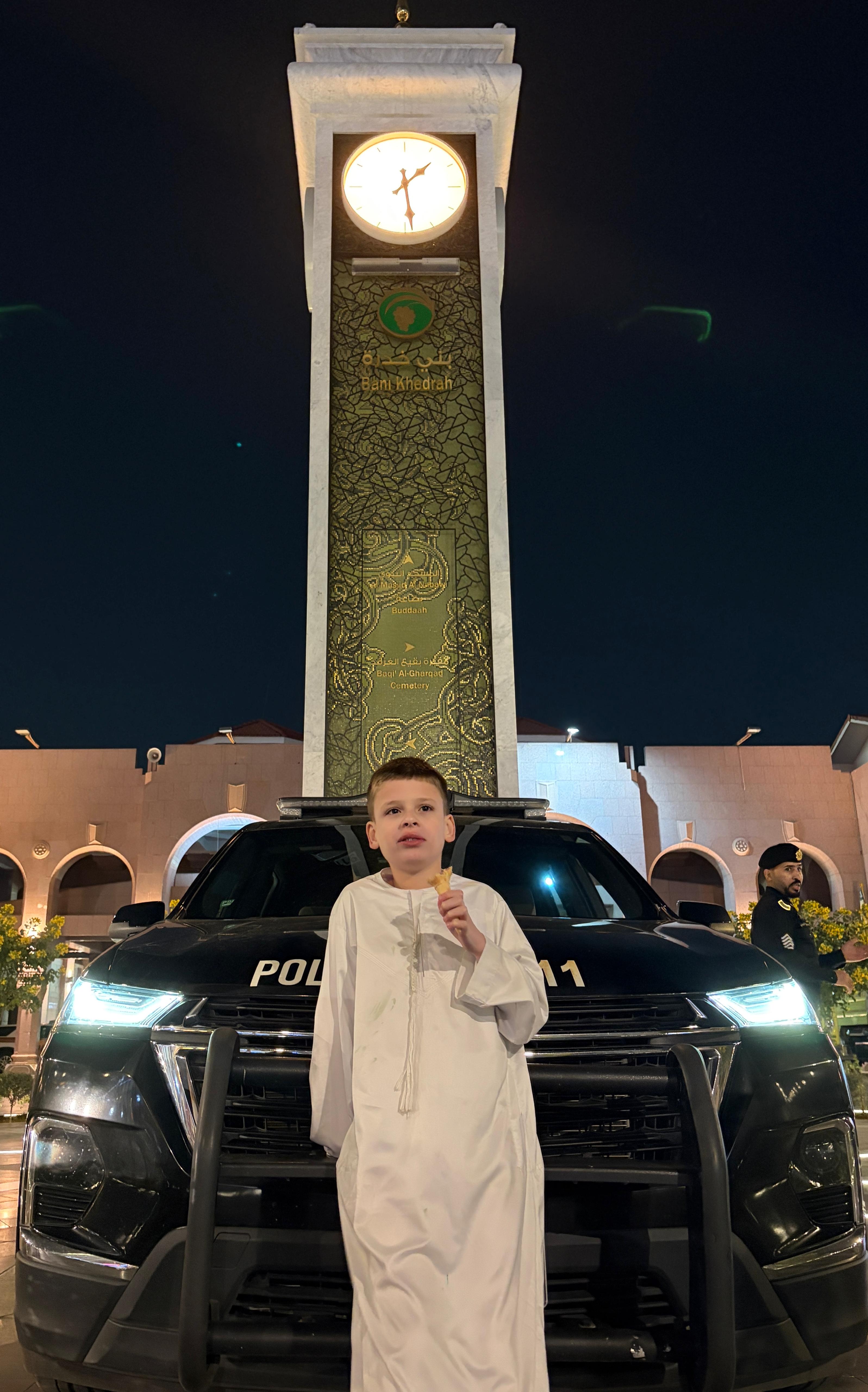
“The Joshie-Man” and his father Dan Harris in the courtyard of the Prophet’s Mosque in Madinah. (Supplied)
Updated 02 February 2026
Follow

‘Cake not hate’ campaign becomes ‘Dates not hate’ in Madinah

  • Dan said he was very impressed by Saudi hospitality and that his family was warmly welcomed
  • He said being in Madinah exposed him to the true diversity of Islam

LONDON: A British autistic and non-verbal boy who has been visiting UK mosques and distributing cakes to promote solidarity amid an increase in far-right support in the country has taken his message of love to Madinah.

Joshua Harris, or “The Joshie-Man” as the 12-year-old is known to his social media fans, has handed out hundreds of his baked goods to worshipers at mosques in major British cities over the last few months.

The “Cake not hate” campaign came about after an Islamophobic attack on a mosque in his home city of Peterborough in October 2025.

Harris and his father visited Masjid Darassalaam, the mosque that was targeted, with cakes that the boy had baked and distributed them to the congregation soon after the attack. Since then, Harris has visited dozens of mosques in the UK.

On a recent trip to the Middle East, he and his father visited Madinah. In a local twist that pays tribute to the holy city’s famous date varieties including ajwa and ambar, Harris handed out dates to people in the courtyard of the Prophet’s Mosque. The “Cake not hate” campaign became “Dates not hate” for Saudi Arabia.

“He was greeted really, really warmly. There were some really touching moments where people were kissing his hands and his head. It was really lovely,” his father, Dan Harris, said.

Dan, the founder of global charity Neurodiversity in Business, said being in Madinah exposed him to the true diversity of Islam.

“We met people from all around the world. It was amazing. It’s like the United Nations there, you get people from different countries and it just goes to show you that the Muslim community, or the Ummah more generally, is not a homogeneous group,” he said.

“We saw people from Tajikistan and Uzbekistan and it was really interesting for us.”

Dan said his visit to Madinah, considered the second holiest city in Islam after Makkah for Muslims, was “profound and life-changing.”

He added: “I would say it’s my favourite city in the world due to the peace and tranquillity I felt there.”

Dan added that he was very impressed by Saudi hospitality: “Everywhere we went, people were taking down my number and insisting that we come for dinner, insisting they pick us up from the location. They were extremely attentive to Joshie as well, making sure his needs were met. We felt a great sense of welcome, something Saudi Arabia is known for.”