

‘Cake not hate’ campaign becomes ‘Dates not hate’ in Madinah

“The Joshie-Man” and his father Dan Harris in the courtyard of the Prophet’s Mosque in Madinah. (Supplied)
Short Url
Updated 05 February 2026
Follow

‘Cake not hate’ campaign becomes ‘Dates not hate’ in Madinah

  • Dan said he was very impressed by Saudi hospitality and that his family was warmly welcomed
  • He said being in Madinah exposed him to the true diversity of Islam

LONDON: A British autistic and non-verbal boy who has been visiting UK mosques and distributing cakes to promote solidarity amid an increase in far-right support in the country has taken his message of love to Madinah.

Joshua Harris, or “The Joshie-Man” as the 12-year-old is known to his social media fans, has handed out hundreds of his baked goods to worshipers at mosques in major British cities over the last few months.

The “Cake not hate” campaign came about after an Islamophobic attack on a mosque in his home city of Peterborough in October 2025.

Harris and his father visited Masjid Darassalaam, the mosque that was targeted, with cakes that the boy had baked and distributed them to the congregation soon after the attack. Since then, Harris has visited dozens of mosques in the UK.

On a recent trip to the Middle East, he and his father visited Madinah. In a local twist that pays tribute to the holy city’s famous date varieties including ajwa and ambar, Harris handed out dates to people in the courtyard of the Prophet’s Mosque. The “Cake not hate” campaign became “Dates not hate” for Saudi Arabia.
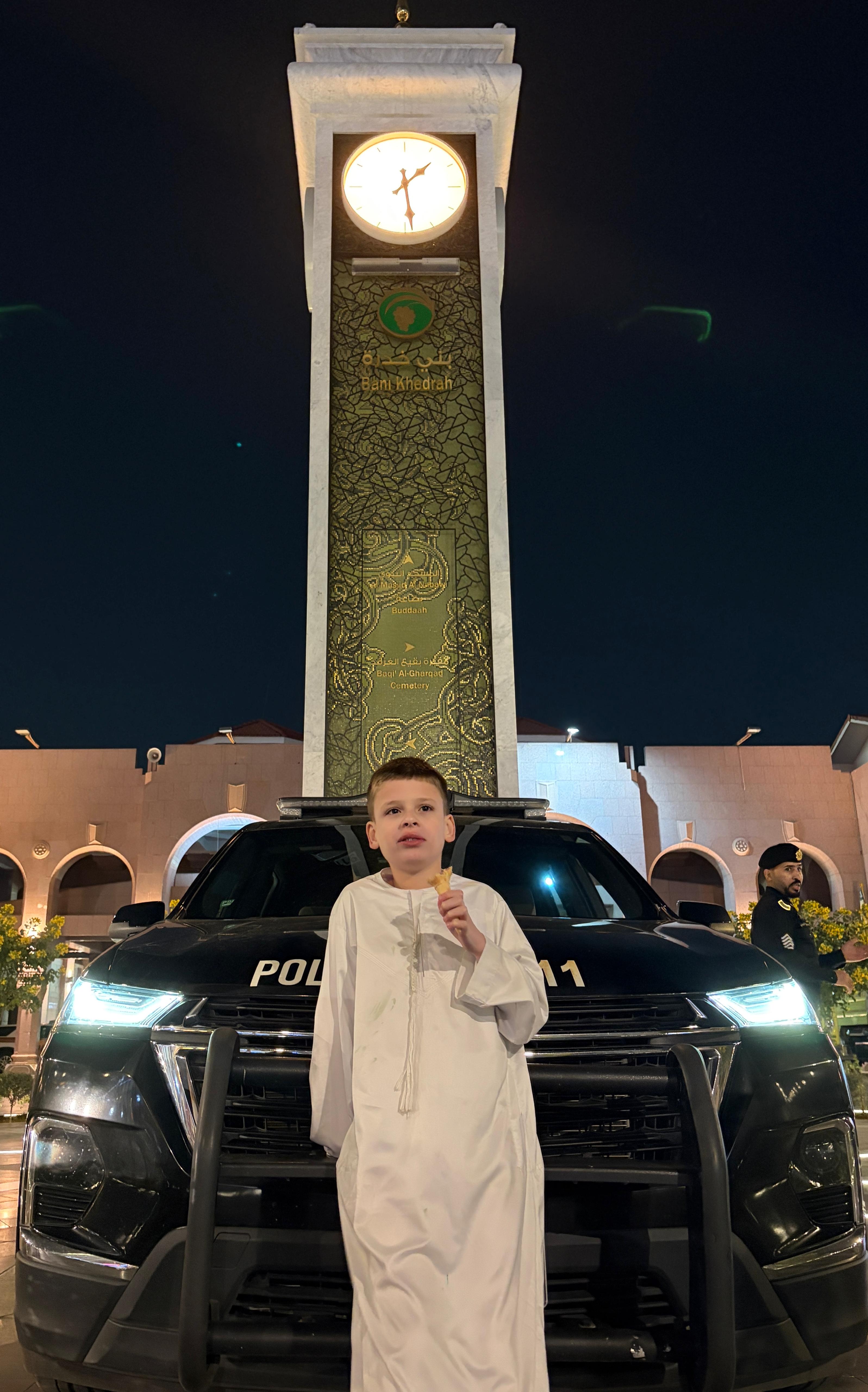
“He was greeted really, really warmly. There were some really touching moments where people were kissing his hands and his head. It was really lovely,” his father, Dan Harris, said.

“A very learned Islamic scholar named Shaykh Zulfiker Ibrahim Memon kindly invited us to have a look around the mosque and he showed us downstairs, upstairs and the rooftop. The rooftop was phenomenal,” he added.

Dan, the founder of global charity Neurodiversity in Business, said being in Madinah exposed him to the true diversity of Islam.

“We met people from all around the world. It was amazing. It’s like the United Nations there, you get people from different countries and it just goes to show you that the Muslim community, or the Ummah more generally, is not a homogeneous group,” he said.

“We saw people from Tajikistan and Uzbekistan and it was really interesting for us.”

Dan said his visit to Madinah, considered the second holiest city in Islam after Makkah for Muslims, was “profound and life-changing.”

He added: “I would say it’s my favourite city in the world due to the peace and tranquillity I felt there.”

Dan added that he was very impressed by Saudi hospitality: “Everywhere we went, people were taking down my number and insisting that we come for dinner, insisting they pick us up from the location. They were extremely attentive to Joshie as well, making sure his needs were met. We felt a great sense of welcome, something Saudi Arabia is known for.”

Decoder

Who is “The Joshie-Man”?

It’s a name given by social media fans to Joshua Harris, a 12-year-old autistic and non-verbal Briton, who has been visiting UK mosques and distributing cakes to promote solidarity amid an increase in far-right support in the country. On a recent trip to Madinah with his father, “The Joshie-Man” turned his ‘Cake not hate’ campaign to ‘Dates not hate’ by handing out the holy city’s famous ajwa and ambar dates people in the courtyard of the Prophet’s Mosque.


Saudi Arabia, Estonia strengthen cyber defense cooperation

Updated 09 February 2026
Follow

Saudi Arabia, Estonia strengthen cyber defense cooperation

  • Renowned for its leadership in digital governance, Estonia sees cybersecurity as central to its partnership potential with Saudi Arabia, building on years of regional engagement through its technology firms

RIYADH: Estonia aims to deepen defense, cybersecurity, and artificial intelligence cooperation with Saudi Arabia as both nations look to advance technology‑driven defense and cybersecurity capabilities.

Hanno Pevkur, Estonia’s minister of defense, told Arab News at the World Defense Show in Riyadh on Monday that Estonia’s defense industry is eager to contribute to the Kingdom’s fast‑growing defense ecosystem.

“In the modern world, cooperation built on trust and technology is the best defense,” he said. “It is important for us to be here because we clearly see there is a possibility to increase cooperation, not only bilaterally between Saudi Arabia and Estonia, but across the region.”

At Estonia’s pavilion, a cooperation agreement was signed between an Estonian company and a Saudi firm during the show, he noted.

Pevkur also said Estonia’s defense sector has expanded rapidly in recent years, driven by technological innovation and partnership.

“Our defense industry is growing very rapidly, and we continue to see strong momentum,” he said.

He said Estonia’s strengths lie in digital and smart‑system integration rather than large‑scale weapons production.

“We will not build airplanes or tanks, but what we can do is integrate robotics, automation and drones to make existing systems smarter,” he said.

The minister said effective defense collaboration must link businesses and governments to achieve meaningful results.

“When we want to have real cooperation, we need it on all levels,” he said. “The biggest client for any defense company is the government, so we must treat this as one ecosystem where the public and private sectors work hand in hand.”

Renowned for its leadership in digital governance, Estonia sees cybersecurity as central to its partnership potential with Saudi Arabia, building on years of regional engagement through its technology firms.

Pevkur said several Estonian companies, including Nortal, have already assisted Gulf governments in developing open IT and digital‑service systems.

“As the most digitalized nation in the world, almost every service in Estonia can be done online, except getting married,” he said. “But with such digitalization, we also need strong cyberdefense.”

He said data protection and digital resilience are treated as matters of national sovereignty in Tallinn, the capital of Estonia.

“Data is what we own. When someone steals that data, it becomes a serious threat,” he added. “That is why cyberdefense is not just about technology, it is about trust, sovereignty and protection.”

Pevkur said Saudi Arabia’s advances in AI offer promising opportunities for collaboration.

“I know that Saudi Arabia is doing great work when it comes to AI,” he said. “For us, as a small country with limited human resources, AI is essential not just for defense but for everyday life.”

Pevkur added that Estonia has launched a national AI strategy to promote responsible development and closer coordination between government and industry. One Estonian company, he said, has developed a system that allows a single operator to control hundreds of drones through AI.

“It is quite easy to put a weapon into the hands of a robot, but we also need to define who is accountable for its actions,” he said.

“The big question for the future is whether we can allow a war to be fought entirely by AI, or if humans must always make the final ethical decisions.”

He said in his conclusion that governments must reach a common understanding on how AI will be used and regulated on the battlefield.