

Germany eyes lasers, spy satellites in military space spending splurge

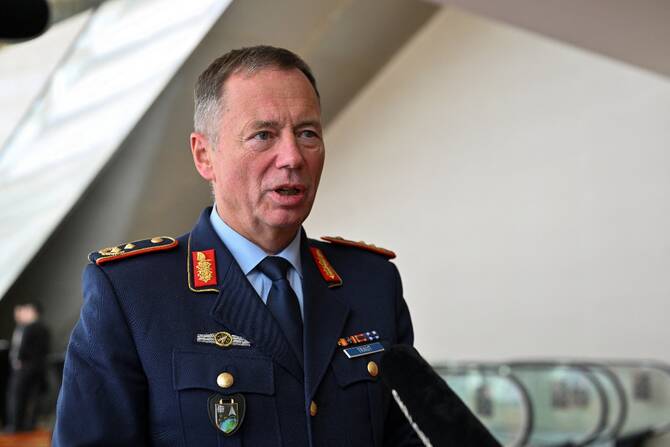
Major General Michael Traut, Commander of German Space Command, in an interview with Reuters at the Changi Aviation Summit at Sands Expo and Convention Centre in Singapore. (Reuters)
Short Url
Updated 03 February 2026
Follow

Germany eyes lasers, spy satellites in military space spending splurge

  • Germany will channel funding into intelligence-gathering satellites, sensors and systems designed to ​disrupt adversary spacecraft

SINGAPORE: Germany is weighing investments ranging from spy ​satellites and space planes to offensive lasers under a 35 billion euro ($41 billion) military space spending plan aimed at countering growing threats from Russia and China in orbit, the country’s space commander said.
Germany will build an encrypted military constellation of more than 100 satellites, known as SATCOM Stage 4, over the next few years, the head of German Space Command Michael Traut told Reuters on the sidelines of a space event ahead of the Singapore Airshow.
He said the network ‌would mirror the ‌model used by the US Space Development Agency, ‌a ⁠Pentagon ​unit that ‌deploys low-Earth-orbit satellites for communications and missile tracking.
Rheinmetall is in talks with German satellite maker OHB about a joint bid for an unnamed German military satellite project, Reuters reported last week.
The potential deal comes as Europe’s top three space firms — Airbus, Thales and Leonardo — are seeking to build a European satellite communications alternative to Elon Musk’s Starlink.
Traut said Germany’s investment in military space architecture reflected a sharply more contested space environment since Russia’s ⁠full-scale invasion of Ukraine in 2022. Berlin and its European allies, he said, needed to bolster their deterrence ‌posture by investing not only in secure communications but ‍also in capabilities that could ‍hinder or disable hostile space systems.
“(We need to) improve our deterrence posture in ‍space, since space has become an operational or even warfighting domain, and we are perfectly aware that our systems, our space capabilities, need to be protected and defended,” Traut said.

INSPECTOR SATELLITES AND LASERS
Germany will channel funding into intelligence-gathering satellites, sensors and systems designed to ​disrupt adversary spacecraft, including lasers and equipment capable of targeting ground-based infrastructure, Traut said.
He added that Germany would prioritize small and large domestic and ⁠European suppliers for the program.
Traut emphasized Germany would not field destructive weapons in orbit that could generate debris, but said a range of non-kinetic options existed to disrupt hostile satellites, including jamming, lasers and actions against ground control stations.
He also pointed to so-called inspector satellites — small spacecraft capable of maneuvering close to other satellites — which he said Russia and China had already deployed.
“There is a broad range of possible effects in the electromagnetic spectrum, in the optical, in the laser spectrum, and even some active physical things like inspector satellites,” he said.
“You could even go after ground segments of a space system in order to deny that system to your adversary ‌or to tell him, ‘If you do something to us in space, we might do something to you in other domains as well.’”


Zelensky says Ukrainian air force needs to improve as Russian drone barrages take a toll

Updated 9 sec ago
Follow

Zelensky says Ukrainian air force needs to improve as Russian drone barrages take a toll

  • Zelensky said Friday he had discussed with his defense minister and the air force commander what new air defense measures Ukraine needs to counter the Russian barrages
  • Russia fired 328 drones and seven missiles at Ukraine overnight and in the early morning

KYIV: Ukrainian President Volodymyr Zelensky on Friday described the performance of the air force in parts of the country as “unsatisfactory,” and said that steps are being taken to improve the response to large-scale Russian drone barrages of civilian areas.
The repeated Russian aerial assaults have in recent months focused on Ukraine’s power grid, causing blackouts and disrupting the heating and water supply for families during a bitterly cold winter.
With the war about to enter its fifth year later this month following Russia’s all-out invasion of its neighbor, there is no sign of a breakthrough in US-led peace efforts following the latest talks this week.
Further US-brokered meetings between Russian and Ukrainian delegations are planned “in the near future, likely in the United States,” Zelensky said.
Zelensky said Friday he had discussed with his defense minister and the air force commander what new air defense measures Ukraine needs to counter the Russian barrages. He didn’t elaborate on what would be done.
Russia fired 328 drones and seven missiles at Ukraine overnight and in the early morning, the air force said, claiming that air defenses shot down 297 drones.
One person was killed and two others were injured in an overnight Russian attack using drones and powerful glide bombs on the central Dnipropetrovsk region, according to the head of the regional military administration, Oleksandr Hanzha.
A Russian aerial attack on the southern Zaporizhzhia region during early daylight hours injured eight people and damaged 18 apartment blocks, according to regional military administration head Ivan Fedorov.
A dog shelter in the regional capital was also struck, killing 13 dogs, Zaporizhzhia City Council Secretary Rehina Kharchenko said.
Some dogs were rushed to a veterinary clinic, but they could not be saved, she said. Seven other animals were injured and are receiving treatment.
Amid icy conditions in Kyiv, more than 1,200 residential buildings in multiple districts of the capital have had no heating for days due to the Russian bombardment of the power grid, according to Zelensky.
The UK defense ministry said Friday that Ukraine’s electricity network “is experiencing its most acute crisis of the winter.”
Mykola Tromza, an 81-year-old pensioner in Kyiv, said he has had his power restored, but recently went without heating and water at home for a week.
“I touched my nose and by God, it was like an icicle,” Tromza said. He said he ran up and down to keep warm.
Russia’s Defense Ministry said that air defenses downed 38 Ukrainian drones overnight, including 26 over the Bryansk region.
Bryansk Gov. Alexander Bogomaz said the attack briefly cut power to several villages in the region.
Another Ukrainian nighttime strike damaged power facilities in the Russian city of Belgorod, disrupting electricity distribution, Gov. Vyacheslav Gladkov said.
Local reports said that Ukrainian missiles hit a power plant and an electrical substation, cutting power to parts of the city.
Fierce fighting has also continued on the front line despite the frigid temperatures.
Ukraine’s Commander in Chief, Col. Gen. Oleksandr Syrskyi, said the front line now measures about 1,200 kilometers (750 miles) in length along eastern and southern parts of Ukraine.
The increasing technological improvements to drones on both sides mean that the so-called “kill zone” where troops are in greatest danger is now up to 20 kilometers (12 miles) deep, he told reporters on Thursday in comments embargoed until Friday.