

Over 7,000 migrants detained in Greece as Crete struggles with Libya arrivals

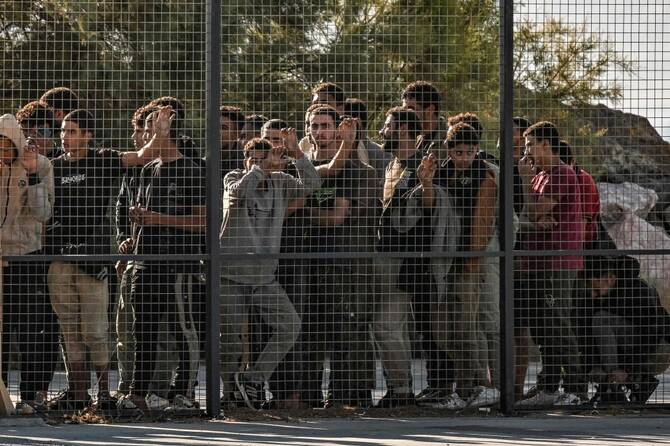
Migrants stand behind a fence as they are gathered by Greek coast guard officers after disembarking from a cargo ship, in the port of Lavrio, south of Athens, July 10, 2025. (AFP)
Short Url
Updated 10 July 2025
Follow

Over 7,000 migrants detained in Greece as Crete struggles with Libya arrivals

  • Greece implements emergency measures to address a surge in Mediterranean crossings from Libya as authorities detained over 7,000 migrants in the past 10 days
  • Prime minister announced that Greece would suspend asylum processing for migrants arriving by sea from North Africa for three months

LAVRIO: More than 500 migrants arrived at the port of Lavrio near Athens on Thursday after being intercepted south of the island of Crete, as Greece implements emergency measures to address a surge in Mediterranean crossings from Libya.
The migrants, consisting mostly of young men, were transferred overnight aboard a bulk carrier after their fishing trawler was intercepted by Greek authorities. Service vessels helped bring them ashore at the mainland port. They will be sent to detention facilities near the capital.
More than 200 migrants were brought to the port of Piraeus, also near Athens, in separate transfers from Crete. The transfers to the mainland were ordered because makeshift reception centers on Crete have reached capacity, with around 500 new arrivals per day on the Mediterranean island since the weekend.

We can no longer accept migration flows from North Africa. People there need to think twice before deciding to pay a large sum of money to come to our country

Manos Logothetis, ministry of migration

Prime Minister Kyriakos Mitsotakis announced Wednesday that Greece would suspend asylum processing for migrants arriving by sea from North Africa for three months. The new measures are due to be voted on in parliament on Thursday as an emergency amendment.
“This is an extreme and urgent situation, and we are taking extraordinary steps, ones that are difficult, tough, and strict. But they send a clear message,” Manos Logothetis, secretary-general at the ministry of migration, told state-run television.
“These measures are a clear statement from the Greek government — and by extension, from Europe — that we can no longer accept migration flows from North Africa,” he said. “People there need to think twice before deciding to pay a large sum of money to come to our country.”
Logothetis said that Greece backed EU initiatives linking financial aid to African countries to their willingness to receive their citizens deported or agreeing to voluntary repatriation from Europe.
Greece says more than 7,000 migrants have been detained over the past 10 days after traveling from Libya to Crete — a surge that occurred despite an overall drop in illegal migration to Europe. The European Union’s border protection agency, Frontex, on Thursday reported that irregular crossings into the EU dropped by 20 percent in first half of 2025 on an annual basis though increases were recorded in parts of the Mediterranean.
The crisis on Crete coincided with a diplomatic spat between the European Union and Libya over migration cooperation. EU officials earlier this week were turned away from eastern Libya following an apparent disagreement on the format of talks planned on curbing crossings.
Authorities on Crete are struggling to provide basic services, using temporary facilities to house migrants, primarily from Somalia, Sudan, Egypt and Morocco, according to island officials. The New York-based aid organization International Rescue Committee criticized asylum pause in Greece. “Seeking refuge is a human right; preventing people from doing so is both illegal and inhumane,” the group’s Martha Roussou said. “People fleeing conflict and disaster must be treated with dignity and provided fair and lawful access to asylum procedures — not detained or turned away.”


Culture being strangled by Kosovo’s political crisis

Updated 1 sec ago
Follow

Culture being strangled by Kosovo’s political crisis

PRIZREN: Kosovo’s oldest cinema has been dark and silent for years as the famous theater slowly disintegrates under a leaky roof.
Signs warn passers-by in the historic city of Prizren that parts of the Lumbardhi’s crumbling facade could fall while it waits for its long-promised refurbishment.
“The city deserves to have the cinema renovated and preserved. Only junkies gathering there benefit from it now,” nextdoor neighbor butcher Arsim Futko, 62, told AFP.
For seven years, it waited for a European Union-funded revamp, only for the money to be suddenly withdrawn with little explanation.
Now it awaits similar repairs promised by the national government that has since been paralyzed by inconclusive elections in February.
And it is anyone’s guess whether the new government that will come out of Sunday’s snap election will keep the promise.

- ‘Collateral damage’ -

Cinema director Ares Shporta said the cinema has become “collateral damage” in a broader geopolitical game after the EU hit his country with sanctions in 2023.
The delayed repairs “affected our morale, it affected our lives, it affected the trust of the community in us,” Shporta said.
Brussels slapped Kosovo with sanctions over heightened tensions between the government and the ethnic Serb minority that live in parts of the country as Pristina pushed to exert more control over areas still tightly linked to Belgrade.
Cultural institutions have been among the hardest-hit sectors, as international funding dried up and local decisions were stalled by the parliamentary crisis.
According to an analysis by the Kosovo think tank, the GAP Institute for Advanced Studies, sanctions have resulted in around 613 million euros ($719 million) being suspended or paused, with the cultural sector taking a hit of 15-million-euro hit.

- ‘Ground zero’ -

With political stalemate threatening to drag on into another year, there are warnings that further funding from abroad could also be in jeopardy.
Since February’s election when outgoing premier Albin Kurti topped the polls but failed to win a majority, his caretaker government has been deadlocked with opposition lawmakers.
Months of delays, spent mostly without a parliament, meant little legislative work could be done.
Ahead of the snap election on Sunday, the government said that more than 200 million euros ($235 million) will be lost forever due to a failure to ratify international agreements.
Once the top beneficiary of the EU Growth Plan in the Balkans, Europe’s youngest country now trails most of its neighbors, the NGO Group for Legal and Political Studies’ executive director Njomza Arifi told AFP.
“While some of the countries in the region have already received the second tranches, Kosovo still remains at ground zero.”
Although there have been some enthusiastic signs of easing a half of EU sanctions by January, Kurti’s continued push against Serbian institutions and influence in the country’s north continues to draw criticism from both Washington and Brussels.

- ‘On the edge’ -

Across the river from the Lumbardhi, the funding cuts have also been felt at Dokufest, a documentary and short film festival that draws people to the region.
“The festival has had to make staff cuts. Unfortunately, there is a risk of further cuts if things don’t change,” Dokufest artistic director Veton Nurkollari said.
“Fortunately, we don’t depend on just one source because we could end up in a situation where, when the tap is turned off, everything is turned off.”
He said that many in the cultural sector were desperate for the upcoming government to get the sanctions lifted by ratification of the agreements that would allow EU funds to flow again.
“Kosovo is the only one left on the edge and without these funds.”