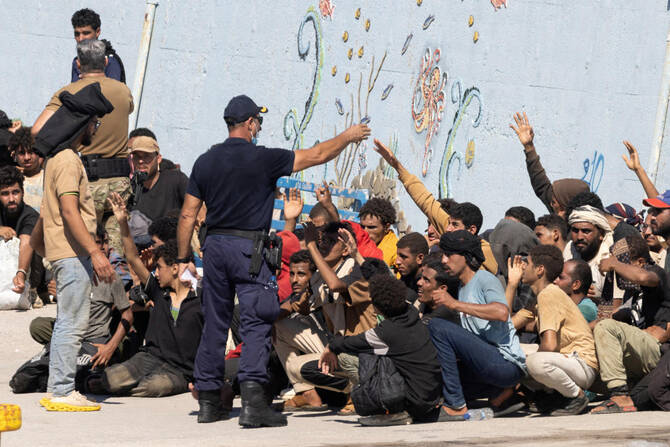

ATHENS: Greece will suspend all asylum hearings for migrants arriving on boats from North Africa for three months, the prime minister said Wednesday following a rise in migrant arrivals from Libya.
The move came after more than 2,000 migrants landed on Crete in recent days, sparking anger among local authorities and tourism operators. Crete is one of Greece’s top travel destinations, and premier Kyriakos Mitsotakis’ home island.
Greece had hoped to stem the arrivals by reaching out to the authorities in Benghazi, eastern Libya, and the UN-recognized government in Tripoli — but that failed.
“The road to Greece is closing... any migrants entering illegally will be arrested and detained,” Prime Minister Kyriakos Mitsotakis told parliament.
The conservative leader said legislation would be put to a vote in the chamber on Thursday, and that Athens was keeping the EU informed on the issue.
The measure was a “necessary temporary reaction” and a message “to smugglers and their potential clients,” said Mitsotakis.
Greece took similar steps in 2020 during a migration surge at its land border with Turkiye, which Athens accused Ankara of facilitating.
Another group of some 520 people were rescued near Crete early Wednesday, and will be rerouted to the Athens port of Lavrio, the coast guard said.
“The flows are very high,” government spokesman Pavlos Marinakis told Action 24 channel late Tuesday, adding that the wave was “growing and ongoing.”
On Sunday, the Greek coast guard rescued more than 600 asylum seekers in various operations in the area.
AFP pictures showed some of them landing near Agia Galini beach on the south of Crete, where many tourists were bathing.
Migration Minister Thanos Plevris — a former member of Greek far-right party Laos — posted on X that the country was taking “immediate actions to counter the invasion from North Africa.”
“Clear message: Stay where you are, we do not accept you,” he wrote.
According to the coast guard, 7,300 asylum seekers have reached Crete and the nearby island of Gavdos this year, up from fewer than 5,000 last year.
More than 2,500 arrivals have been recorded since June alone.
To manage the influx, the government could reopen camps built in the mainland after the 2015 migration crisis, Marinakis said.
Mitsotakis told parliament that a camp would also be built on Crete, with a second one also possible.
Greece had hoped arrivals could be reduced with the help of the authorities in eastern Libya in Benghazi, and the UN-recognized government in Tripoli.
But a visit Tuesday by the EU’s migration commissioner and the migration ministers of Greece, Italy and Malta was unsuccessful.
Accusing the bloc’s delegation of a “flagrant breach of diplomatic norms,” the authorities who hold sway over eastern Libya said they had canceled the visit and told the EU officials to “leave Libyan territory immediately.”
The diplomatic breakdown has sparked concern in Greece of thousands of additional migrant arrivals from Libya.
“The other side is not cooperating,” Marinakis said, referring to the authorities in Benghazi.
Mitsotakis on Wednesday said Greece’s navy and coast guard were willing to work with Libyan authorities to keep migrant boats from leaving the country’s territorial waters, or to turn them back before entering Greek waters.
Libya has been gripped by conflict since the 2011 overthrow and killing of longtime ruler Muammar Qaddafi in a NATO-backed uprising.
Greece had reached out to eastern Libyan commander Khalifa Haftar before the botched EU visit, sending Foreign Minister George Gerapetritis on Sunday.
Gerapetritis is also scheduled to hold talks with the UN-recognized government in Tripoli on July 15.