

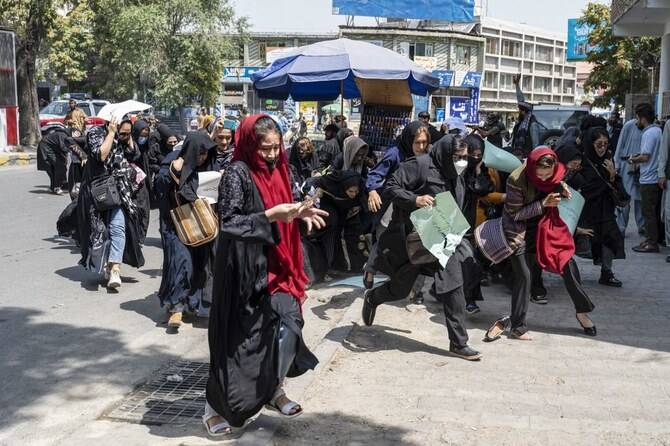
Afghan women UN staff forced to work from home after threats

Afghan women working for the United Nations in Kabul have been threatened by unidentified men because of their jobs, the organisation and several women told AFP on Thursday. (AFP/File)
Short Url
Updated 05 June 2025
Follow

Afghan women UN staff forced to work from home after threats

  • UNAMA confirmed that UN staff had been threatened
  • “Several United Nations female national staff members in the Afghan capital Kabul have been subjected to threats,” it said

KABUL: Afghan women working for the United Nations in Kabul have been threatened by unidentified men because of their jobs, the organization and several women told AFP on Thursday.

Multiple women working for various UN agencies told AFP on condition of anonymity they had been threatened on the street and over the phone by men warning them to “stay home.”

UN staffer Huda — not her real name — said that for weeks she has been bombarded with messages abusing her for “working with foreigners.”

“The messages keep coming and they are always harassing us... saying, ‘Don’t let me see you again, or else’,” the young woman told AFP.

She said her office had advised her to work from home until further notice.

The United Nations Assistance Mission in Afghanistan (UNAMA) confirmed that UN staff had been threatened.

“Several United Nations female national staff members in the Afghan capital Kabul have been subjected to threats by unidentified individuals related to their work with the UN,” it said in a statement.

Considering the threats “extremely serious,” the UN has taken “interim” measures “to ensure the safety and security of staff members,” it added.

The Taliban government, accused by the UN of imposing a “gender apartheid” against women since returning to power in 2021, has denied any involvement.

Interior ministry spokesman Abdul Mateen Qani said such threats were a “crime” and that police would take action.

UNAMA said the authorities had opened an investigation.

Since seizing power in 2021, the Taliban authorities have severely restricted Afghan women from working and it is the only country in the world where women are banned from education beyond primary school.

The government in 2022 banned women from working for domestic and international NGOs, which was extended to include the UN’s offices in the country the following year.

The policy has some exceptions including for women working in health care and education, and has not been consistently enforced.

The UN has previously called the policy “deeply discriminatory.”

Selsela, in her 30s, said while returning from the office last week she was approached by unknown men who told her she should be “ashamed” and that she must “stay home.”

“They said, ‘We told you nicely this time, but next time you’ll have another thing coming’,” she told AFP.

“I was very scared,” she said, explaining how she struggles to work efficiently from home in a country where electricity and Internet are unreliable.

“The situation for women is getting worse every day.”

Another woman, Rahila, said she and two other women colleagues were stopped by men while traveling home in a UN vehicle and told not to go to the office anymore.

“They said, ‘Don’t you know that you are not allowed?’,” Rahila said, adding that she has also received threatening messages from unknown numbers.

“I am very worried, I need my job and my salary,” she said.

Three-quarters of Afghanistan’s population of some 45 million people struggle to meet their daily needs, according to the UN, with the country facing one of the world’s worst humanitarian crises.


Four cops killed as separatist militants launch ‘coordinated’ attacks in Pakistan’s southwest — police

Updated 6 sec ago
Follow

Four cops killed as separatist militants launch ‘coordinated’ attacks in Pakistan’s southwest — police

  • The attacks began in Balochistan’s capital of Quetta at around 6am with a powerful explosion, followed by intense gunfire

QUETTA: Separatist militants, affiliated with the Balochistan Liberation Army (BLA), have launched “coordinated” attacks in several cities of Pakistan’s southwestern Balochistan province and killed at least four policemen, officials said early Saturday.

The attacks in the provincial capital of Quetta began at around 6am with a powerful explosion, followed by intense gunfire that lasted for two hours along with multiple explosions.

Residents of Dalbandin and Nuhski said they heard explosions and gunfire in the districts early Saturday morning, while there were reports of similar attacks in Mastung, Gwadar, Pasni and Turbat.

A senior police official, who requested anonymity, told Arab News that the militants attempted to enter the provincial capital of Quetta but police and other law enforcement agencies stopped them.

“The terrorists attacked a police mobile at Sariab road which resulted in the killing of two policemen,” he said. “Police and other law enforcement agencies denied space to the terrorists in Quetta city and a clearance operation is still going on.”

Balochistan, which borders Iran and Afghanistan, is the site of a decades-long insurgency waged by Baloch separatist groups who often attack security forces and foreigners, and kidnap government officials.

Shahid Rind, the Balochistan chief minister’s aide for media and political affairs, said police and paramilitary Frontier Corps (FC) had foiled the attacks and were chasing the assailants.

“After the killing of more than 70 terrorists at different places in Balochistan in the last two days, terrorists have attempted to attack at a few places in Balochistan, which have been foiled by timely action by the police and FC,” he said on X.

“At present, the pursuit of the fleeing terrorists is underway. More details will be revealed very soon.”

In a statement issued on Saturday, BLA said the group had launched ‘Operation Herof 2.0,’ which included a series of attacks in multiple cities of Balochistan.

Saturday’s attacks follow coordinated attacks carried out by the group in Aug. 2024 in various districts of Balochistan which killed dozens of people.

The separatists accuse the central government of stealing the region’s resources to fund development elsewhere in the country. The Pakistani government denies the allegations and says it is working for the uplift of local communities in Balochistan.

Pakistan Railways has suspended train service from Balochistan to other parts of the country for a day, following Saturday’s attacks.

“Quetta-Peshawar bound Jaffar Express, and Quetta-Chaman passenger trains have been canceled due to the prevailing security situation in Balochistan,” Muhammad Kashif, the railways controller in Quetta division, told Arab News.

At least four police officials in as many districts confirmed to AFP the situation was not completely under control yet.
“At least four policemen were killed in Quetta alone,” he added, speaking on condition of anonymity as he was not authorized to speak to the media.
A senior military official based in Islamabad confirmed the attacks, adding they were “coordinated but poorly executed.”