

Gaza civil defense says Israeli strikes kill 32

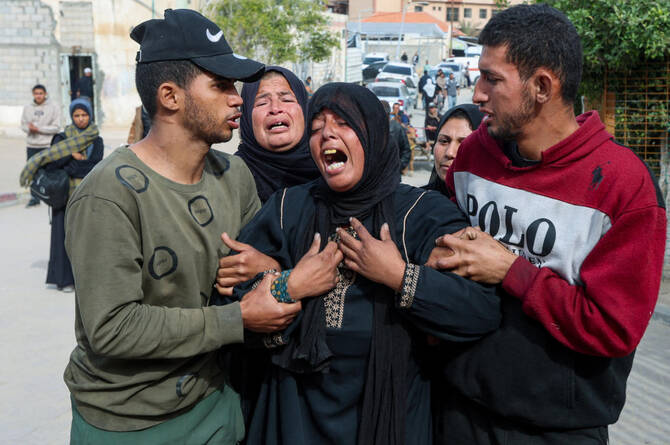
Mourners during the funeral of Palestinians, who were earlier killed by Israeli gunfire in Khan Younis, in the southern Gaza Strip on Jan. 29, 2026. (Reuters)
Short Url
Updated 01 February 2026
Follow

Gaza civil defense says Israeli strikes kill 32

  • “The death toll since dawn today has risen to 32, most of them children and women,” said the civil defense agency
  • Residential apartments, tents, shelters and a police station were targeted

GAZA CITY, Palestinian Territories: Israeli air strikes killed 32 people including children in Gaza on Saturday, according to the Palestinian territory’s civil defense agency, as the military said it had attacked in response to a Hamas ceasefire violation.
Despite a US-brokered truce entering its second phase earlier this month, violence in the Palestinian territory has continued, with both Israel and Hamas accusing each other of violating the agreement.
The latest bloodshed comes after Israel announced it would reopen the crucial Rafah crossing between Gaza and Egypt on Sunday for the “limited movement of people.”
“The death toll since dawn today has risen to 32, most of them children and women,” said the civil defense agency, a rescue force operating under the Hamas authority, updating an earlier toll of 28.
“Residential apartments, tents, shelters and a police station were targeted,” agency spokesman Mahmud Bassal said in the statement.
A unit in an apartment building of Gaza City’s Rimal neighborhood was left entirely destroyed, and blood spatters were visible on the street below, an AFP journalist reported.
“Three girls died while they were sleeping. We found their bodies in the street,” Samer Al-Atbash, a relative of the family, told AFP.
“What truce are you talking about? Everyone is deceiving everyone else,” added Nael Al-Atbash, another relative.
One strike hit the police station in the Sheikh Radwan district of Gaza City, the territory’s largest urban center.
Gaza’s general police directorate said seven people were killed in that attack, while Bassal said the dead included four female police officers.

- Ceasefire violations -

About a dozen first responders rushed to the devastated building and pulled bodies from the rubble, an AFP journalist reported.
Another Israeli attack hit a shelter in Al-Mawasi, an area of south Gaza where tens of thousands of displaced Gazans live in tents and makeshift shelters, an AFP journalist reported.
Large plumes of smoke rose above the thousands of densely pitched tents.
The number of casualties from this strike was still not known.
Although people have been killed almost daily in Gaza since the start of the ceasefire on October 10, Saturday’s toll was particularly high.
Israel’s military said that the air strikes were retaliation for an incident on Friday in which eight Palestinian fighters exited a tunnel in the city of Rafah, in southern Gaza, which it said violated the fragile ceasefire.
It said forces “struck four commanders and additional terrorists from the Hamas and Islamic Jihad terrorist organizations across the Gaza Strip.”
Hamas political bureau member Suhail Al-Hindi rejected the military’s claims.
“What happened today is a fully fledged crime committed by a criminal enemy that does not abide by agreements or respect any commitments,” he told AFP.
The health ministry, which operates under the Hamas authority, has said Israeli attacks have killed at least 509 people in Gaza since the ceasefire came into effect.
Israel’s military says four soldiers have been killed in the same period in Gaza in suspected militant attacks.

- Rafah reopening -

Media restrictions and limited access in Gaza have meant that AFP has been unable to independently verify casualty figures or freely cover the violence.
Key mediators Egypt and Qatar condemned what they said were Israeli violations of the ceasefire.
Egypt demanded that all parties “exercise the utmost restraint” ahead of Sunday’s reopening of Rafah crossing, while Qatar said it denounced the “repeated Israeli violations of the ceasefire.”
The violence was a “dangerous escalation that will inflame the situation and undermine regional and international efforts aimed at consolidating the truce,” the Qatari foreign ministry said.
Israel has said reopening of the Rafah crossing will only allow the “limited movement of people.”
The reopening is a key element in the second phase of the Gaza ceasefire agreement.
Israel had previously expressed its unwillingness to reopen the gateway until it received the remains of Ran Gvili, the last hostage to be held in Gaza, who was recovered earlier this week and laid to rest in Israel on Wednesday.
The Gaza war was sparked by Hamas’s October 7, 2023 attack on Israel, which resulted in the deaths of 1,221 people, according to an AFP tally based on official Israeli figures.
Israel’s retaliation flattened much of Gaza, which was already suffering from previous rounds of fighting and from an Israeli blockade imposed since 2007.
The two-year war has left at least 71,769 people dead in Gaza, according to the health ministry, whose figures are considered reliable by the United Nations.


Tourism on hold as Middle East war casts uncertainty

Updated 58 min 39 sec ago
Follow

Tourism on hold as Middle East war casts uncertainty

  • Cancelled flights, postponed trips and a great deal of uncertainty: the war in the Middle East is casting a long shadow over the tourism outlook for the region

PARIS: Cancelled flights, postponed trips and a great deal of uncertainty: the war in the Middle East is casting a long shadow over the tourism outlook for a region that has become a prized destination for travelers worldwide.
“My last group of tourists left three days ago, and all the other groups planned for March have been canceled,” said Nazih Rawashdeh, a tour guide near Irbid, in northern Jordan.
“This is the start of the high season here. It’s catastrophic,” he told AFP.
“And yet there’s no problem in Jordan. It’s perfectly safe.”
Across the world, tour operators are scrambling to find solutions for clients stranded in the region or who had trips planned there.
“The priority is getting those already there back home,” said Alain Capestan, president of the French tour operator Comptoir des Voyages.
He said however that the war was also affecting customers who have traveled to other parts of the world, as the Gulf region is home to several major aviation hubs — Dubai, Abu Dhabi and Doha.
Like other companies, the German tour operators surveyed by AFP — Alltours, Dertour, Schauinsland-Reisen — announced they would cover the cost of extra nights for clients stranded in the Middle East. They also canceled trips to the UAE and Oman until at least March 7.
Swiss operator MSC Cruises, which has a ship stranded in Dubai, told AFP on Thursday it was sending five charter flights to airlift nearly 1,000 passengers.
The firm said it expected the passengers to be out of the region by Saturday, without specifying the destinations of the flights or the nationalities of the holidaymakers.
The British travel industry association ABTA said agencies “would not be sending customers to the region for as long as the British Foreign Office advises against all non-essential travel.”
Customers whose holidays were canceled in recent days will be able to rebook or receive a refund, it said.
- Economic impact -
The war is disrupting a sector that had been booming in the region.
According to UN Tourism, in 2025 around 100 million tourists visited the Middle East — nearly seven percent of all international tourists recorded worldwide. That figure had grown three percent year-on-year and 39 percent compared to the pre-pandemic period.
Depending on the destination, Europeans make up a large share of visitors, followed by tourists from South Asia, the Americas, and other Middle Eastern countries.
For example, nearby markets accounted for 26 percent of total visitors to Dubai in 2025, according to its Ministry of Tourism and Economy.
Against this backdrop analysts Oxford Economics warns that “a decline in tourist flows to the region will deal a more severe economic blow than in the past, as tourism’s share of GDP has grown, as has employment in the sector.”
“We estimate inbound arrivals to the Middle East could decline 11-27 percent year-on-year in 2026 due to the conflict, compared to our December forecast that projected 13 percent growth,” said Director of Global Forecasting Helen McDermott.
That would translate, according to the firm, to between 23 and 38 million fewer international visitors compared to the prior scenario, and a loss of $34 to $56 billion in tourist spending.
After Covid and then the conflict in Gaza, tourists had been coming back, said Rawashdeh, the Jordanian tour guide.
“For the past six months, people working in tourism here had hope. And now there’s a war. This is going to be terrible for the economy,” he said.
“We’ve definitely noticed an understandable slowdown in new bookings from our partners right now, but we fully expect that to bounce back as soon as things settle down and travelers feel more confident,” said Ibrahim Mohamed, marketing director of Middle East Travel Alliance, which offers direct tours to American and British operators.
He remains optimistic: “The Middle East has always been an incredibly resilient market, and demand always bounces back fast once stability returns.”