

How Western aid cuts deepen Afghan women’s crisis

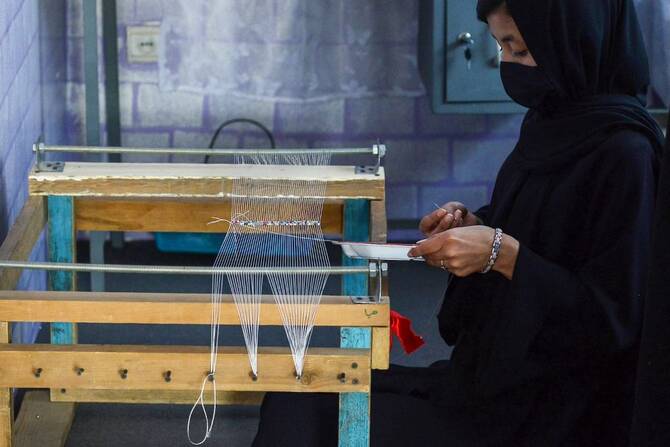
An Afghan woman manufactures beads jewelry at a workshop in Kabul, Nov. 10, 2024. (AFP)
Short Url
Updated 14 May 2025
Follow

How Western aid cuts deepen Afghan women’s crisis

  • Foreign aid empowers Afghan women through funding, training, market access
  • Entrepreneurs say sudden cuts force women-led businesses to close

KABUL: Afghan women entrepreneurs who have carved out spaces of independence for themselves and others, despite sweeping Taliban restrictions, are facing the collapse of their businesses as Western donors abruptly cut the aid they once pledged.

The rights of Afghan women have been curtailed since the Taliban took control of Afghanistan in 2021.

Barred from secondary schools and higher education, restricted in public places and not allowed to take up most of the jobs, women have been turning to private entrepreneurship to empower themselves and others.

Aid from Western countries, which have been pressuring the Taliban to uphold women’s rights, has been especially vital in sustaining these female-led initiatives.

The sudden reduction in funding, which started with massive US aid cuts since January, has already affected Afghan healthcare and essential services and is now taking a toll on the very group the West once vowed to support.

“Women’s economic activities have been severely affected by the reduction in international aid. Reduced financial support has led to fewer training and development opportunities, and in some cases international partners that previously provided resources or markets have suspended or ceased their activities,” Behnaz Saljoqi, head of the Women’s Chamber of Commerce and Industries in Herat, told Arab News.

International humanitarian aid has played a key role in empowering women entrepreneurs by providing not only direct support but also training, networking opportunities, microfinance, access to foreign markets, and sponsorship for exhibitions.

“This support not only helped women acquire technical and managerial skills, but also gain greater confidence to participate in the labor market and society. Without this support, many women would not even consider starting a business,” Saljoqi said.

“If the situation continues or worsens, the working environment for women will become increasingly difficult … The empowerment process that began in previous years will be reversed.”

Bahar Anwari, who runs Bahar Canvas Art Gallery in Kabul, is already observing a decline in her business as her usual customers — women — are no longer placing orders.

“With the reduction of development projects, things changed in the country,” she said.

“The purchasing power of people, especially women, has become very low. Employment opportunities became scarce, and most women lost their jobs, and poverty is growing every day. We will have to shut down our workshops and sit at home doing nothing.”

For Afghan women entrepreneurs, doing business means not only helping to sustain their own households but also contributing to society and creating opportunities for others like them.

International support has played a key role in making it possible.

“Women in Afghanistan largely depend on financial support from family and international organizations. While establishing my company, I also received some funds from a development organization, without which it would have been very difficult to set up the business,” said Parisa Elhami, director of fashion brand Watan Collection.

“Being in business as a woman gave me the strength and confidence to maintain my social standing despite the limitations. Business allowed me to be independent and provide employment opportunities for other women.”

The foreign aid cuts, especially from Afghanistan’s main donor, the US — which invaded the country in 2001 and spent billions of dollars on two decades of military and development operations — have already disrupted basic services such as healthcare, education, and food distribution.

Women, whose social role US humanitarian agencies earlier promoted, face losing their place in society, together with the collapsing businesses.

“The presence of women in economic and social spheres is vital. It not only contributes to economic growth, but also contributes to social justice and the overall progress of society,” Elhami told Arab News.

“The decline in international aid, especially from the US, has forced many women-run companies to close or reduce their staff … If the economic situation and global aid levels continue at the same pace or worse, the future of women’s business will be seriously threatened. Many businesses will disappear and women’s access to economic, health and educational opportunities will be severely limited.”


US vaccine advisers say not all babies need a hepatitis B shot at birth

Updated 06 December 2025
Follow

US vaccine advisers say not all babies need a hepatitis B shot at birth

  • Vaccine advisers named by Kennedy reverse decades-long recommendation
  • Kennedy’s advisory committee decided to recommend the birth dose only for babies whose mothers test positive
  • President Donald Trump posted a message calling the vote a “very good decision”

NEW YORK: A federal vaccine advisory committee voted on Friday to end the longstanding recommendation that all US babies get the hepatitis B vaccine on the day they’re born.
A loud chorus of medical and public health leaders decried the actions of the panel, whose current members were all appointed by US Health Secretary Robert F. Kennedy Jr. — a leading anti-vaccine activist before this year becoming the nation’s top health official.
“This is the group that can’t shoot straight,” said Dr. William Schaffner, a Vanderbilt University vaccine expert who for decades has been involved with ACIP and its workgroups.
Several medical societies and state health departments said they would continue to recommend them. While people may have to check their policies, the trade group AHIP, formerly known as America’s Health Insurance Plans, said its members still will cover the birth dose of the hepatitis B vaccine.
For decades, the government has advised that all babies be vaccinated against the liver infection right after birth. The shots are widely considered to be a public health success for preventing thousands of illnesses.
But Kennedy’s Advisory Committee on Immunization Practices decided to recommend the birth dose only for babies whose mothers test positive, and in cases where the mom wasn’t tested.
For other babies, it will be up to the parents and their doctors to decide if a birth dose is appropriate. The committee voted 8-3 to suggest that when a family elects to wait, then the vaccination series should begin when the child is 2 months old.
President Donald Trump posted a message late Friday calling the vote a “very good decision.”

The acting director of the Centers for Disease Control and Prevention, Jim O’Neill, is expected to decide later whether to accept the committee’s recommendation.
The decision marks a return to a health strategy abandoned more than three decades ago
Asked why the newly-appointed committee moved quickly to reexamine the recommendation, committee member Vicky Pebsworth on Thursday cited “pressure from stakeholder groups,” without naming them.
Committee members said the risk of infection for most babies is very low and that earlier research that found the shots were safe for infants was inadequate.
They also worried that in many cases, doctors and nurses don’t have full conversations with parents about the pros and cons of the birth-dose vaccination.
The committee members voiced interest in hearing the input from public health and medical professionals, but chose to ignore the experts’ repeated pleas to leave the recommendations alone.
The committee gives advice to the director of the Centers for Disease Control and Prevention on how approved vaccines should be used. CDC directors almost always adopted the committee’s recommendations, which were widely heeded by doctors and guide vaccination programs. But the agency currently has no director, leaving acting director O’Neill to decide.
In June, Kennedy fired the entire 17-member panel earlier this year and replaced it with a group that includes several anti-vaccine voices.
Hepatitis B and delaying birth doses
Hepatitis B is a serious liver infection that, for most people, lasts less than six months. But for some, especially infants and children, it can become a long-lasting problem that can lead to liver failure, liver cancer and scarring called cirrhosis.
In adults, the virus is spread through sex or through sharing needles during injection drug use. But it can also be passed from an infected mother to a baby.
In 1991, the committee recommended an initial dose of hepatitis B vaccine at birth. Experts say quick immunization is crucial to prevent infection from taking root. And, indeed, cases in children have plummeted.
Still, several members of Kennedy’s committee voiced discomfort with vaccinating all newborns. They argued that past safety studies of the vaccine in newborns were limited and it’s possible that larger, long-term studies could uncover a problem with the birth dose.
But two members said they saw no documented evidence of harm from the birth doses and suggested concern was based on speculation.
Three panel members asked about the scientific basis for saying that the first dose could be delayed for two months for many babies.
“This is unconscionable,” said committee member Dr. Joseph Hibbeln, who repeatedly voiced opposition to the proposal during the sometimes-heated two-day meeting.
The committee’s chair, Dr. Kirk Milhoan, said two months was chosen as a point where infants had matured beyond the neonatal stage. Hibbeln countered that there was no data presented that two months is an appropriate cut-off.
Dr. Cody Meissner also questioned a second proposal — which passed 6-4 — that said parents consider talking to pediatricians about blood tests meant to measure whether hep B shots have created protective antibodies.
Such testing is not standard pediatric practice after vaccination. Proponents said it could be a new way to see if fewer shots are adequate.
A CDC hepatitis expert, Adam Langer, said results could vary from child to child and would be an erratic way to assess if fewer doses work. He also noted there’s no good evidence that three shots pose harm to kids.
Meissner attacked the proposal, saying the language “is kind of making things up.”
Health experts say this could ‘make America sicker’
Health experts have noted Kennedy’s hand-picked committee is focused on the pros and cons of shots for the individual getting vaccinated, and has turned away from seeing vaccinations as a way to stop the spread of preventable diseases among the public.
The second proposal “is right at the center of this paradox,” said committee member Dr. Robert Malone.
Some observers criticized the meeting, noting recent changes in how they are conducted. CDC scientists no longer present vaccine safety and effectiveness data to the committee. Instead, people who have been prominent voices in anti-vaccine circles were given those slots.
The committee “is no longer a legitimate scientific body,” said Elizabeth Jacobs, a member of Defend Public Health, an advocacy group of researchers and others that has opposed Trump administration health policies. She described the meeting this week as “an epidemiological crime scene.”
Republican Sen. Bill Cassidy, a liver doctor who chairs the Senate health committee, called the committee’s vote on the hepatitis B vaccine “a mistake.”
“This makes America sicker,” he said, in a post on social media.
The committee heard a 90-minute presentation from Aaron Siri, a lawyer who has worked with Kennedy on vaccine litigation. He ended by saying that he believes there should no ACIP vaccine recommendations at all.
In a lengthy response, Meissner said, “What you have said is a terrible, terrible distortion of all the facts.” He ended by saying Siri should not have been invited.
The meeting’s organizers said they invited Siri as well as a few vaccine researchers — who have been vocal defenders of immunizations — to discuss the vaccine schedule. They named two: Dr. Peter Hotez, who said he declined, and Dr. Paul Offit, who said he didn’t remember being asked but would have declined anyway.
Hotez, of the Texas Children’s Hospital in Houston, declined to present before the group “because ACIP appears to have shifted its mission away from science and evidence-based medicine,” he said in an email to The Associated Press.