

Ten security officials, 37 militants killed as militants launch ‘coordinated’ attacks in Pakistan’s southwest

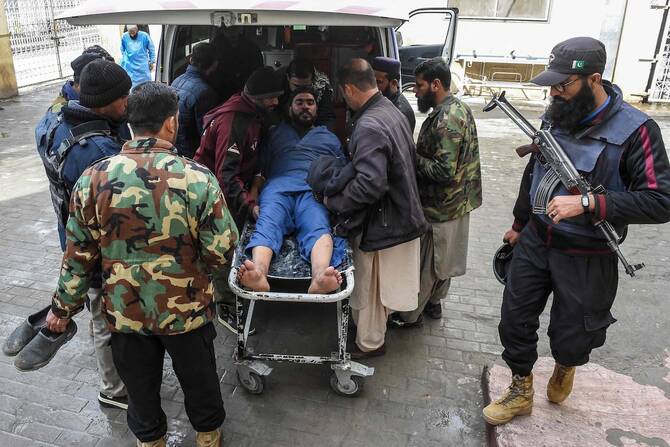
Security personnel transfer an injured man at a hospital in Quetta on Jan. 31, 2026, following an attack by Baloch separatists. (AFP)
Short Url
Updated 31 January 2026
Follow

Ten security officials, 37 militants killed as militants launch ‘coordinated’ attacks in Pakistan’s southwest

  • The attacks in the provincial capital of Quetta began at around 6 a.m. with a powerful explosion

QUETTA: At least 10 security officials and 37 militants were killed as “coordinated” attacks were launched by separatist militants, affiliated with the Balochistan Liberation Army (BLA), across several cities of Pakistan’s southwestern Balochistan province, an official quoted by AFP said Saturday.

The attacks in the provincial capital of Quetta began at around 6 a.m. with a powerful explosion, followed by intense gunfire that lasted for two hours along with multiple explosions.

Residents of Dalbandin and Nuhski said they heard explosions and gunfire in the districts early Saturday morning, while there were reports of similar attacks in Mastung, Gwadar, Pasni and Turbat.

A senior police official, who requested anonymity, told Arab News that the militants attempted to enter the provincial capital of Quetta but police and other law enforcement agencies stopped them.

“The terrorists attacked a police mobile at Sariab road which resulted in the killing of two policemen,” he said. “Police and other law enforcement agencies denied space to the terrorists in Quetta city and a clearance operation is still going on.”

Balochistan, which borders Iran and Afghanistan, is the site of a decades-long insurgency waged by Baloch separatist groups who often attack security forces and foreigners, and kidnap government officials.

Shahid Rind, the Balochistan chief minister’s aide for media and political affairs, said police and paramilitary Frontier Corps (FC) had foiled the attacks and were chasing the assailants.

“After the killing of more than 70 terrorists at different places in Balochistan in the last two days, terrorists have attempted to attack at a few places in Balochistan, which have been foiled by timely action by the police and FC,” he said on X.

“At present, the pursuit of the fleeing terrorists is underway. More details will be revealed very soon.”

In a statement issued on Saturday, BLA said the group had launched ‘Operation Herof 2.0,’ which included a series of attacks in multiple cities of Balochistan.

Saturday’s attacks follow coordinated attacks carried out by the group in Aug. 2024 in various districts of Balochistan which killed dozens of people.

The separatists accuse the central government of stealing the region’s resources to fund development elsewhere in the country. The Pakistani government denies the allegations and says it is working for the uplift of local communities in Balochistan.

Pakistan Railways has suspended train service from Balochistan to other parts of the country for a day, following Saturday’s attacks.

“Quetta-Peshawar bound Jaffar Express, and Quetta-Chaman passenger trains have been canceled due to the prevailing security situation in Balochistan,” Muhammad Kashif, the railways controller in Quetta division, told Arab News.

At least four police officials in as many districts confirmed to AFP the situation was not completely under control yet.
“At least four policemen were killed in Quetta alone,” he added, speaking on condition of anonymity as he was not authorized to speak to the media.
A senior military official based in Islamabad confirmed the attacks, adding they were “coordinated but poorly executed.”


Abiy’s vision of Ethiopia includes a seaport in Eritrea. Some see a looming conflict

Updated 8 sec ago
Follow

Abiy’s vision of Ethiopia includes a seaport in Eritrea. Some see a looming conflict

KAMPALA: To his supporters, Ethiopia’s prime minister is a renaissance man trying to reimagine the old greatness of his country.
To some others, Abiy Ahmed is a provocateur who could light a fire in the restive Horn of Africa region as he pushes for sovereign access to the sea via an unfriendly neighbor.
In a stadium in southern Ethiopia last Sunday, Abiy staged a provocative parade of Ethiopia’s special forces as they demonstrated maneuvers in a spectacle widely seen as intended for neighboring Eritrea to see. A banner proclaimed Ethiopia would not remain landlocked whether “you like it or not,” with imagery showing a soldier breaking a door while aiming for the port of Assab.
Assab has been part of Eritrea since 1993, when it broke away from Ethiopia after decades of guerrilla warfare. Most of Ethiopia’s trade goes through the port of Djibouti, incurring high fees to the tune of $1.5 billion per year, a sum until recently greater than the country’s entire foreign exchange reserves, according to the London-based Africa Practice consulting firm.
It’s one reason Abiy sought a controversial deal for sea access with Somaliland two years ago. That deal angered Somalia, which claims authority over the semiautonomous Somaliland, and raised regional tensions.
Abiy has his eye on the seaport
While the Somaliland dispute has cooled, Abiy’s stance over Assab raises genuine fears of an outbreak of war that would pit him against Eritrean President Isaias Afwerki and his allies, possibly including the rebellious leaders of the northern Ethiopian region of Tigray.
Although such “a catastrophic turn of events is by no means inevitable,” without international intervention the belligerents “could find themselves party to a new regional war that would prove difficult to contain or end,” the International Crisis Group concluded in its most recent assessment.
At the center of tensions is Abiy, who as a 41-year-old rose from relative obscurity to power in 2018 as a reform-minded pragmatist.
Ties with Eritrea had been cold since the 1990s, and his efforts to repair relations with Afwerki helped him win the 2019 Nobel Peace Prize. A year later, he confounded expectations by launching a military operation against the rebellious leaders of Tigray in what eventually became a brutal civil war.
Ethiopia’s military and its allies, including Eritrea, teamed up against the Tigray People’s Liberation Front, or TPLF, the group that administers the region. That conflict, marked by sexual violence and other crimes by both sides, ended with a peace agreement in 2022.
This time, Abiy’s ambition over sovereign access to Assab has provoked a military buildup along the border with Eritrea, according to analysts.
Tigray’s rebellious leaders and Eritrea are apparently “coordinating” against Ethiopian forces, according to Kjetil Tronvoll, a professor of peace and conflict studies at Oslo New University College.
United Nations Secretary-General António Guterres has urged Eritrea and Ethiopia to respect the border treaty signed 25 years ago. Others in the region have called for talks.
Meantime, there is a war of words as well as sporadic clashes within Ethiopian territory.
Tigrayan officials accuse the Ethiopian federal forces of carrying out drone attacks. Ethiopia claims Eritrea is “actively preparing to wage war against it” and that its forces are in Tigray, which shares a border with Eritrea. Eritrea warns that Ethiopia has a “long-brewing war agenda” to seize Assab, an allegation that Abiy seemed to confirm with the military parade in Hawassa that was witnessed by top government and military officials.
The prime minister’s ambitious agenda
After Abiy took office, he saw himself as a philosopher of Ethiopia’s renewal. With his theory of “medemer,” an Amharic word that refers to strength in unity, the Ethiopian prime minister spoke of the “beautiful symphony of progress.”
As the leader of the ruling Prosperity Party, Abiy wanted the timely completion of the mega power dam on the Nile that is strongly opposed by Egypt over concerns about water volumes going north. He wanted to turn Addis Ababa, the federal capital, into a beautiful city, with verdant patches and stylish blocks. There are plans for a nuclear power program and 1.5 million housing units. And earlier this year, he launched the construction of what would be Africa’s largest airport, a project worth $10 billion, outside Addis Ababa.
Restoring Ethiopia’s access to the sea
But he has two big problems: Ethiopia, with more than 130 million people, is the world’s most populous landlocked nation. There is also ethnic discord, with conflicts ongoing in the regions of Amhara and Oromia, where federal troops are battling militants.
Going to war over a seaport would set back Abiy’s ambitious infrastructure goals by committing troops and resources to yet another armed conflict with Eritrea, whose officials dismiss Abiy as foolish.
They say Abiy’s public provocations mask his own internal problems and that his infrastructure projects are at odds with reports of hunger in parts of Ethiopia. Yemane Gebremeskel, the Eritrean government spokesman, routinely describes Abiy’s Prosperity Party as the “Potemkin party.”
That party “continues to spew and ramp up, at almost every public occasion, toxic and provocative vitriol against the sovereignty and territorial integrity” of neighboring nations, he charged in a statement Monday.