MINNEAPOLIS: Thousands of protesters took to the streets in Minneapolis and students across the United States staged walkouts on Friday to demand the withdrawal of federal immigration agents from Minnesota following the fatal shootings of two US citizens.
Students and teachers abandoned classes from California to New York on a national day of protest, which came amid mixed messages from the Trump administration about whether it would de-escalate Operation Metro Surge.
Under a national immigration crackdown, President Donald Trump has sent 3,000 federal officers to the Minneapolis area who are patrolling the streets in tactical gear, a force five times the size of the Minneapolis Police Department.
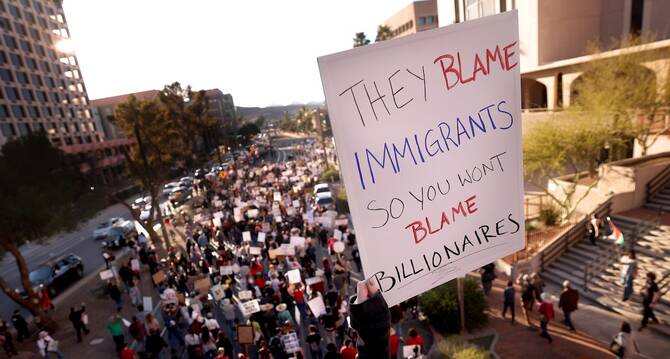
Protesting the surge and the tactics used by US Immigration and Customs Enforcement, several thousand people gathered in downtown Minneapolis in sub-freezing temperatures, including families with small kids, elderly couples and young activists.
Katia Kagan, wearing a “No ICE” sweatshirt and holding a sign demanding the agency leave the city, said she was the daughter of Russian Jews who immigrated to America seeking safety and a better life.
“I’m out here because I’m going to fight for the American dream that my parents came here for,” Kagan said.
Kim, a 65-year-old meditation coach who asked that her last name not be used, called the surge a “full-on fascist attack of our federal government on citizens.”
In a Minneapolis neighborhood near the sites where Alex Pretti and Renee Good, two US citizens, were fatally shot this month by federal immigration agents, about 50 teachers and staff members from local schools turned out to march.
Rock star Bruce Springsteen lent his voice to the protest, taking the stage at a fundraiser for Good and Pretti in downtown Minneapolis and playing his new song “Streets of Minneapolis.”
Protests stretched well beyond Minnesota as organizers forecast 250 demonstrations across 46 states and in major cities such as New York, Los Angeles, Chicago and Washington under the slogan, “No work. No school. No shopping. Stop funding ICE.”
Trump in turn offered a vote of confidence for Homeland Security Secretary Kristi Noem, whose department oversees ICE. Critics have called for her resignation but Trump said on social media that Noem “has done a really GREAT JOB!,” asserting that “The Border disaster that I inherited is fixed.”
Local FBI chief forced out
Meanwhile, events in Minneapolis reverberated through the federal government.
The acting head of the Minneapolis FBI field office, Jarrad Smith, was removed from his post, according to two sources familiar with the move. Smith was reassigned to FBI headquarters in Washington, according to one of the sources.
The Minneapolis field office has been involved in the federal surge as well as investigations into the Pretti shooting and a church protest that led to charges against former CNN anchor Don Lemon.
The FBI arrested Lemon on Friday and the Justice Department charged him with violating federal law during a protest inside a St. Paul, Minnesota, church earlier this month in what his lawyer called an attack on press freedom.
After pleading not guilty, Lemon told reporters, “I will not be silenced. I look forward to my day in court.”
The New York Times, citing an internal ICE memo it reviewed, reported on Friday that federal agents were told this week they have broader power to arrest people without a warrant, expanding the ability of lower-level ICE agents to carry out sweeps rounding up suspected undocumented immigrants they encounter.
Backlash against the administration’s immigration policy also threatened to spark a partial US government shutdown as Democrats in Congress opposed funding for the Department of Homeland Security, which oversees ICE.
Public opinion shifts
Weeks of viral videos showing the aggressive tactics of heavily armed and masked agents on the streets of Minneapolis have driven public approval of Trump’s immigration policy to the lowest level of his second term, a recent Reuters/Ipsos poll showed.
As uproar over the ICE operation grew, Trump’s border czar, Tom Homan, was dispatched to Minneapolis, saying his officers would return to more targeted operations, rather than the broad street sweeps that have led to clashes with protesters.
Echoing protesters’ sentiments, Minnesota’s Democratic Governor Tim Walz on Friday questioned whether that would happen and said more drastic changes were needed.
“The only way to ensure the safety of the people of Minnesota is for the federal government to draw down their forces and end this campaign of brutality,” Walz said on X.
Trump said earlier this week he wanted to “de-escalate a bit,” but when asked by reporters on Thursday if he was pulling back, Trump said: “Not at all.”
In Aurora, Colorado, public schools closed on Friday due to large, anticipated teacher and student absences. The Denver suburb saw intense immigration raids last year after Trump claimed it was a “war zone” overrun by Venezuelan gangs.
In Tucson, Arizona, at least 20 schools canceled classes in anticipation of mass absences.
At DePaul University in Chicago, protest signs read “sanctuary campus” and “fascists not welcome here.”
High school students bearing anti-ICE signs staged a walkout in Long Beach, California. In Brooklyn, a long parade of high-school-age protesters marched and chanted anti-ICE obscenities.


![]()

‘No ICE’: Thousands protest in Minnesota and across US against immigration crackdown
Short Url
https://arab.news/vuwfz
‘No ICE’: Thousands protest in Minnesota and across US against immigration crackdown
- Protesters brave freezing cold to demonstrate in Minneapolis
- ICE given broader power to arrest people without a warrant — NYT


Latest updates


© 2026 SAUDI RESEARCH & PUBLISHING COMPANY, All Rights Reserved And subject to Terms of Use Agreement.