

Oil Updates — crude slips on US stockpile build, Saudi Arabia price cuts

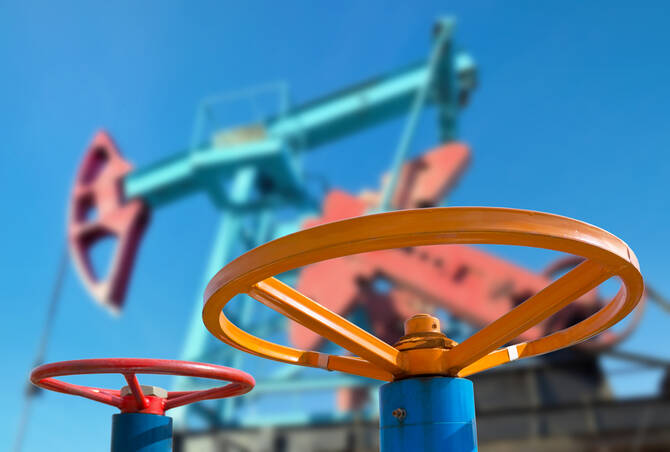
Brent crude futures fell 1 cent to $64.85 a barrel at 9:30 a.m. Saudi time. Shutterstock
Short Url
Updated 05 June 2025
Follow

Oil Updates — crude slips on US stockpile build, Saudi Arabia price cuts

TOKYO/SINGAPORE: Oil edged lower on Thursday after a build in US gasoline and diesel inventories and cuts to Saudi Arabia’s July prices for Asian crude buyers, with global economic uncertainty weighing on prices as well.

Brent crude futures fell 1 cent to $64.85 a barrel at 9:30 a.m. Saudi time. US West Texas Intermediate crude lost 11 cents, or 0.2 percent, dropping to $62.74 a barrel.

Oil prices closed around 1 percent lower on Wednesday after official data showed that US gasoline and distillate stockpiles grew more than expected, reflecting weaker demand in the world’s top economy.

Saudi Arabia, the world’s biggest oil exporter, cut its July prices for Asian crude buyers to nearly the lowest in four years.

“While the (Saudi) decrease was smaller than anticipated, it suggests demand is soft despite entering the peak demand period,” said ANZ analysts in a note.

The price cut by Saudi Arabia follows the OPEC+ move over the weekend to increase output by 411,000 barrels per day for July. OPEC+ is made up of members of the Organization of the Petroleum Exporting Countries and allies such as Russia.

Weak US economic data and ongoing developments in US-China trade relations also weighed on oil prices, said independent market analyst Tina Teng.

“Simply put, a gloomy global economic trajectory dimmed the demand outlook,” she said.

“Markets are cautiously watching for any progress in trade talks between the world’s two top economies.”

Data on Wednesday showed that the US services sector contracted for the first time in nearly a year in May while businesses paid higher prices for inputs, indicating the American economy remains in danger of slow growth and high inflation.

On the trade front, US President Donald Trump said on Wednesday that China’s Xi Jinping was tough and “extremely hard to make a deal with,” exposing friction between Beijing and Washington after the White House had raised expectations for a long-awaited Xi-Trump phone call this week.

Meanwhile, Canada prepared possible reprisals and the EU reported progress in trade talks as new US metals tariffs triggered more disruption in the global economy and added urgency to negotiations with Washington.

“Uncertainty fueled by President Trump’s shifting stance on tariffs has intensified fears of a global economic slowdown,” analyst Ole Hansen at Saxo Bank said in a note. 


Egypt’s non-oil exports rise 17% as trade deficit narrows

Updated 9 sec ago
Follow

Egypt’s non-oil exports rise 17% as trade deficit narrows

RIYADH: Egyptian non-oil exports increased by over 17 percent year on year in 2025, reaching approximately $48.6 billion, new figures showed.

Latest foreign trade indicators released by the country’s Ministry of Investment and Foreign Trade revealed the trade deficit narrowed by 9 percent over the 12 months, reaching around $34.4 billion, according to a statement.

This supports Egypt’s ambition to enter the global top 50 in trade performance, boost exports to $145 billion a year, and narrow the trade deficit.

It also aligns with the country’s efforts to streamline procedures, maximize the benefits of trade agreements, and protect local industry in line with international agreements.

The newly released data said: “Egyptian gold exports also saw a substantial increase, reaching $7.6 billion in 2025 compared to $3.2 billion in 2024, an increase of $4.4 billion.”

It further indicated that the largest markets for Egyptian non-oil exports in 2025 included the UAE, Turkiye, and Saudi Arabia, as well as Italy and the US. 

The most important export sectors included building materials at $14.9 billion, chemicals and fertilizers at $9.4 billion, and food industries at $6.8 billion.

In October, Egypt’s credit rating was raised by S&P Global to “B” from “B-,” while Fitch reaffirmed its “B” rating, citing reform progress and macroeconomic stability.

S&P said at the time that the upgrade reflects reforms implemented over the past period by the country, including the liberalization of the foreign exchange regime, which boosted competitiveness and fueled a rebound in growth.

Prime Minister Mostafa Madbouly also said at that time that both rating agencies’ decisions signal confidence in the government’s reform agenda and its expected returns.

In September, Egypt’s Ministry of Planning, Economic Development and International Cooperation reported that the economy expanded 4.4 percent in fiscal year 2024/25, driven by a strong fourth quarter when gross domestic product growth hit a three-year high of 5 percent.

This reflects the impact of the more flexible exchange rate regime adopted since March 2024, which has helped stabilize the balance of payments and restore investor confidence.