

PM Sharif pledges to preserve peace in Pakistan’s restive northwestern province ‘at all costs’

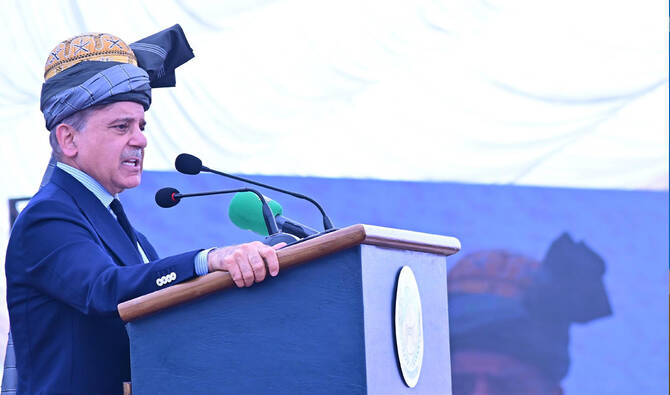
In this handout photo released by Government of Pakistan, country's Prime Miniter Shehbaz Sharif addressing a jirga at Peshawar, Pakistan, on June 3, 2025.
Short Url
Updated 04 June 2025
Follow

PM Sharif pledges to preserve peace in Pakistan’s restive northwestern province ‘at all costs’

  • The prime minister addresses a jirga in Peshawar, praising the sacrifices of Khyber Pakhtunkhwa’s people in the fight against militancy
  • He says a committee has been formed to address the province’s financial concerns, with its first meeting scheduled for August

ISLAMABAD: Prime Minister Shehbaz Sharif on Tuesday vowed to preserve peace in Pakistan’s northwestern Khyber Pakhtunkhwa province “at all costs,” praising the sacrifices of its people and calling for unity against what he described as Indian-backed militant threats.

Sharif made the remarks during a visit to Peshawar, where he addressed a Grand Jirga of tribal elders alongside the country’s army chief and top federal ministers. The visit took place amid a resurgence in militant attacks in the region bordering Afghanistan and growing concern over cross-border threats.

“The sacrifices rendered by the people of Khyber Pakhtunkhwa are indelibly inscribed in the annals of our national history,” the prime minister said during his address. “The entire nation salutes your courage, resolve and unwavering commitment.”

He urged tribal elders to stand firm against what he called the “Indian-sponsored Fitna-ul-Khawarij,” a term used by Pakistani authorities for Tehreek-e-Taliban Pakistan (TTP) militants who they believe are ideologically extremist and backed by foreign actors.

“Peace in Khyber Pakhtunkhwa shall be preserved at all costs,” he said. “The Pakistan Army, in unison with all security institutions and the valiant people of the province, stands firmly united against the Fitna-ul-Khawarij and its foreign abettors.”

Sharif also called for improved bilateral cooperation with Afghanistan and said Afghan soil must not be used by Indian proxies to carry out terrorist activities in Pakistan.

During the jirga, Sharif also addressed financial concerns raised by provincial authorities regarding development funding. He confirmed that a committee had already been formed to review the National Finance Commission (NFC) Award, a constitutional mechanism for the distribution of financial resources between the federal government and provinces.

“The chief minister of Khyber Pakhtunkhwa had raised the matter of revisiting the NFC around six weeks ago in Islamabad,” Sharif said. “We immediately formed a committee and provincial nominees have been finalized. The first meeting will be held in August.”

Sharif also praised the youth of the province, calling them a vital national asset and encouraging them to contribute to peace and national cohesion.


Pakistan terms climate change, demographic pressures as ‘pressing existential risks’

Updated 4 sec ago
Follow

Pakistan terms climate change, demographic pressures as ‘pressing existential risks’

  • Pakistan has suffered frequent climate change-induced disasters, including floods this year that killed over 1,000
  • Pakistan finmin highlights stabilization measures at Doha Forum, discusses economic cooperation with Qatar 

ISLAMABAD: Pakistan’s Finance Minister Muhammad Aurangzeb on Saturday described climate change and demographic pressures as “pressing existential risks” facing the country, calling for urgent climate financing. 

The finance minister was speaking as a member of a high-level panel at the 23rd edition of the Doha Forum, which is being held from Dec. 6–7 in the Qatari capital. Aurangzeb was invited as a speaker on the discussion titled: ‘Global Trade Tensions: Economic Impact and Policy Responses in MENA.’

“He reaffirmed that while Pakistan remained vigilant in the face of geopolitical uncertainty, the more pressing existential risks were climate change and demographic pressures,” the Finance Division said. 

Pakistan has suffered repeated climate disasters in recent years, most notably the 2022 super-floods that submerged one-third of the country, displaced millions and caused an estimated $30 billion in losses. 

This year’s floods killed over 1,000 people and caused at least $2.9 billion in damages to agriculture and infrastructure. Scientists say Pakistan remains among the world’s most climate-vulnerable nations despite contributing less than 1 percent of global greenhouse-gas emissions.

Aurangzeb has previously said climate change and Pakistan’s fast-rising population are the only two factors that can hinder the South Asian country’s efforts to become a $3 trillion economy in the future. 

The finance minister noted that this year’s floods in Pakistan had shaved at least 0.5 percent off GDP growth, calling for urgent climate financing and investment in resilient infrastructure. 

When asked about Pakistan’s fiscal resilience and capability to absorb external shocks, Aurangzeb said Islamabad had rebuilt fiscal buffers. He pointed out that both the primary fiscal balance and current account had returned to surplus, supported significantly by strong remittance inflows of $18–20 billion annually from the Middle East and North Africa (MENA) and Gulf Cooperation Council (GCC) regions. 

Separately, Aurangzeb met his Qatari counterpart Ali Bin Ahmed Al Kuwari to discuss bilateral cooperation. 

“Both sides reaffirmed their commitment to strengthening economic ties, particularly by maximizing opportunities created through the newly concluded GCC–Pakistan Free Trade Agreement, expanding trade flows, and deepening energy cooperation, including long-term LNG collaboration,” the finance ministry said. 

The two also discussed collaboration on digital infrastructure, skills development and regulatory reform. They agreed to establish structured mechanisms to continue joint work in trade diversification, technology, climate resilience, and investment facilitation, the finance ministry said.