

Syria’s Sharaa confirms indirect talks with Israel to ease tensions

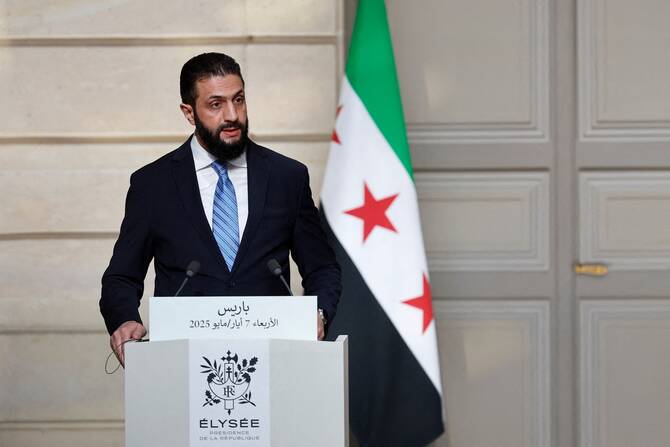
Syrian President Ahmed al-Sharaa speaks during a joint press conference with French President after a meeting at the Elysee Palace in Paris, May 7, 2025. (AFP)
Short Url
Updated 08 May 2025
Follow

Syria’s Sharaa confirms indirect talks with Israel to ease tensions

  • Ahmed Al-Sharaa said random Israeli interventions have violated the 1974 armistice agreement
  • He called on the United Nations Disengagement Observer Force to return to the Blue Line of separation

PARIS: President Ahmed Al-Sharaa said Wednesday that Syria was holding “indirect talks” with Israel to calm tensions between the two countries, following Israeli strikes and threats against Syria since Bashar Assad’s ouster.

“There are indirect talks (with Israel) taking place through mediators to calm the situation and try to contain the situation so it does not reach the point where it escapes the control of both sides,” Sharaa told a press conference in Paris alongside French President Emmanuel Macron.

“Random Israeli interventions... have violated the 1974” armistice, Sharaa said, adding that “since we arrived in Damascus, we have told all relevant parties that Syria is committed to the 1974 agreement.”

Israel has carried out hundreds of strikes on the country since Assad’s December ouster and has said it wants to prevent advanced weapons from falling into the hands of the new authorities, whom it considers jihadists.

Israeli troops have also entered the UN-patrolled buffer zone along the 1974 armistice line on the Golan Heights and carried out incursions deeper into southern Syria.

Sharaa said the United Nations Disengagement Observer Force must “return to the Blue Line of separation,” adding that UNDOF had made a number of visits to Damascus.

Macron condemned Israeli strikes on Syria, saying they would not guarantee “Israel’s long-term security.”

“As for bombings and incursions, I think it’s bad practice. You don’t ensure your country’s security by violating the territorial integrity of your neighbors,” Macron said.

Sharaa said that “we are trying to speak with all countries that are in contact with the Israeli side to pressure them to stop interfering in Syria’s affairs, violating its airspace and bombing some of its facilities.”

Sharaa said he and Macron discussed “the ongoing Israeli threats,” adding that “Israel has bombed Syria more than 20 times in the past week alone... under the pretext of protecting minorities.”

Israel’s military said it launched strikes near Damascus’s presidential palace early Friday after the country’s defense minister threatened intervention if Syrian authorities failed to protect the Druze minority, after sectarian clashes in Druze areas last.

Israeli Prime Minister Benjamin Netanyahu and Defense Minister Israel Katz said the move was a “clear message” to Syria’s new rulers.

The clashes came after a wave of massacres in March in Syria’s Alawite heartland on the Mediterranean coast.


Algeria inaugurates strategic railway to giant Sahara mine

President Tebboune attended an inauguration ceremony in Bechar. (AFP file photo)
Updated 02 February 2026
Follow

Algeria inaugurates strategic railway to giant Sahara mine

  • The mine is expected to produce 4 million tons per year during the initial phase, with production projected to triple to 12 million tons per year by 2030
  • The project is financed by the Algerian state and partly built by a Chinese consortium

ALGEIRS: Algerian President Abdelmadjid Tebboune on Sunday inaugurated a nearly 1,000-kilometer (621-mile) desert railway to transport iron ore from a giant mine, a project he called one of the biggest in the country’s history.
The line will bring iron ore from the Gara Djebilet deposit in the south to the city of Bechar located 950 kilometers north, to be taken to a steel production plant near Oran further north.
The project is financed by the Algerian state and partly built by a Chinese consortium.
During the inauguration, Tebboune described it as “one of the largest strategic projects in the history of independent Algeria.”
This project aims to increase Algeria’s iron ore extraction capacity, as the country aspires to become one of Africa’s leading steel producers.
The iron ore deposit is also seen as a key driver of Algeria’s economic diversification as it seeks to reduce its reliance on hydrocarbons, according to experts.
President Tebboune attended an inauguration ceremony in Bechar, welcoming the first passenger train from Tindouf in southern Algeria and sending toward the north a first charge of iron ore, according to footage broadcast on national television.
The mine is expected to produce 4 million tons per year during the initial phase, with production projected to triple to 12 million tons per year by 2030, according to estimates by the state-owned Feraal Group, which manages the site.
It is then expected to reach 50 million tons per year in the long term, it said.
The start of operations at the mine will allow Algeria to drastically reduce its iron ore imports and save $1.2 billion per year, according to Algerian media.