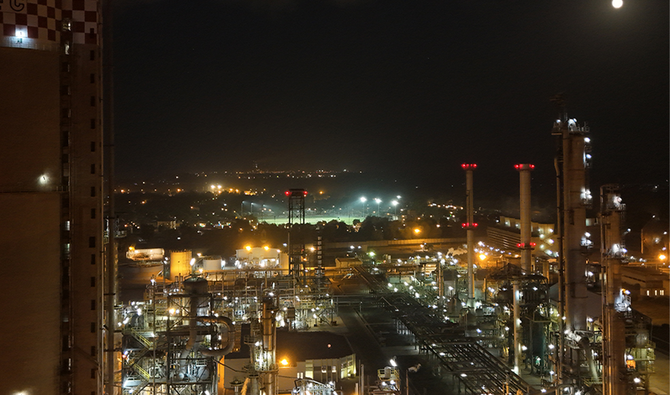

KARACHI: Pakistan’s government has increased gas supply for the Fauji Fertilizer Company (FFC) by 24 percent to boost production of Diammonium Phosphate (DAP), an official said on Wednesday, stressing that the move was necessary to avoid a shortage of fertilizers amid disruptions to the Strait of Hormuz.
The move signals Islamabad’s efforts to shield its agriculture sector from potential supply shocks, amid ongoing tensions around the Strait of Hormuz that threaten to disrupt global fertilizer trade. Iran has virtually shut the strait, where a large part of the world’s oil, gas and fertilizers pass through via ships, since February since its conflict with the US and Israel began.
Islamabad decided to provide an additional 12 mmcfd of gas, a 24 percent increase, to FFC this year amid disruptions in the strait, an official of the energy ministry told Arab News.
“They (FFC) require 62 mmcfd of gas, which we are providing,” the official said on condition of anonymity as he was not authorized to speak to the media.
“Normally the FFC plant receives between 45 mmcfd and 50 mmcfd of gas.”
The FFC is owned by Pakistan’s military and operates the country’s only DAP manufacturing plant in Karachi. DAP is a critical agricultural input essential for plant growth and crop productivity.
Energy-deficient Pakistan, which relies mostly on fuel from the Middle East, has imported two contracted LNG cargoes from Qatar for power generation this month. One shipment has already arrived at Karachi’s Port Qasim after a gap of nearly two months, while the second is expected to pass through the Strait of Hormuz shortly.
“We have received one LNG (liquefied natural gas) cargo from Qatar, which will supply 150 mmcfd of gas for 30 days,” the official said.
The official noted that authorities have increased the supply of gas to the manufacturer to ensure the uninterrupted availability of fertilizers. DAP is particularly important for crop growth during the ongoing Kharif season, which runs from April to October and features the growth of crops such as cotton, rice, maize and sugarcane.
DAP SHORTFALL
Data from Pakistan’s National Fertilizer Development Center (NFDC) shows that while the country is expected to produce a surplus of 183,000 tons of urea this season, it could face a shortfall of 31,000 tons of DAP.
The NFDC has projected urea demand at around 3.364 million tons, which is produced locally. Total urea availability has been estimated at 3.847 million tons, including 3.044 million tons of domestic production and 803,000 tons of carryover stock, the NFDC figures said.
“Operation of all urea manufacturing plants at full capacity during the Kharif season is crucial for ensuring smooth supply and maintaining price stability in the domestic market,” the NFDC said in its latest Kharif outlook report.
DAP fertilizers, which rely on imports, totaled 271,000 tons during the Rabi season from October 2025 to March 2026, compared to 381,000 tons that were produced locally.
This Kharif season, Pakistan is expected to require around 686,000 tons of DAP, including 214,000 tons of opening stock, while 441,000 tons are projected to be produced locally at the FFC’s plant, official data pointed out.
“Smooth gas supply to the local DAP manufacturing plant throughout the Kharif season is indispensable for strengthening national inventory levels,” the NFDC said.
Commodity analyst Minhal Ali said gas should continue to be diverted to FFC’s DAP plant, which has the capacity to produce 650,000 tons, but can produce more.
“It is essential to ensure that FFC’s plant receives sufficient gas so it can operate at full capacity,” said Ali, an analyst at the Karachi-based Insight Securities Limited.
He noted that demand for DAP is currently subdued.
“Major demand for DAP emerges toward the end of the third quarter and during the fourth quarter (2026),” he told Arab News.
“If the current conflict situation persists and our import routes remain disrupted, we could face a shortage of DAP.”
Even if Pakistan’s fertilizer shipments pass through the Strait of Hormuz, import costs would likely rise due to higher prices of phosphate-related assets, the analyst noted.
“That will place additional pressure on Pakistan’s import bill,” he observed.
Pakistan seeks to increase its exports and curb imports to avert a balance of payments crisis.
However, Pakistani exports declined 6.3 percent to $25.2 billion during the current fiscal year till April, while imports rose 7 percent to $57.2 billion, according to official data.
“Ensuring gas supply to FFC is important given Pakistan’s balance-of-payments position,” Ali said.