

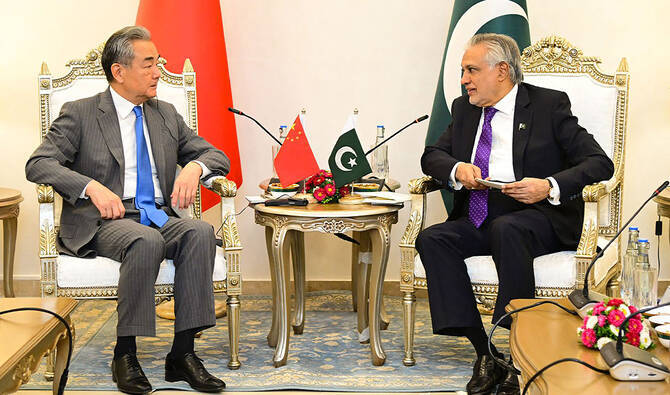

ISLAMABAD: Pakistan’s Deputy Prime Minister Ishaq Dar announced on Wednesday that around 30 percent of Islamabad’s memoranda of understanding (MoUs) with China, under various sectors amounting to over $10 billion, have been translated into potential projects.
The Pakistani deputy premier was speaking at the launch of the IBI Pakistan Digital Economic Center in Islamabad. Set up by IBI Guolian Gufan, a Chinese company focused on industrial e-commerce and digital supply chains, the initiative seeks to advance digital trade, industrial connectivity and supply chain integration between the two countries.
Pakistan and China have highlighted digital cooperation as the next phase of their multi-billion-dollar China–Pakistan Economic Corridor (CPEC) project. Beijing refers to this cooperation initiative with countries as “The Digital Silk Road.”
The Digital Silk Road is a component of China’s Belt and Road Initiative. It finances and supports digital connectivity infrastructure to support Beijing’s technology companies, goods and services. Pakistan hopes aligning with this digital track will help modernize its local industry and support its aim to become a regional digital transit and services hub.
“We can see the difference that 30 percent of the almost over $10 billion of MoUs signed have already been translated into real, potential projects which are being virtually finalized,” Dar told participants of the ceremony in Islamabad.
He said the launch of the IBI Pakistan Digital Economic Center in Islamabad marks the beginning of the Digital Silk Road in Pakistan. Dar noted that cooperation between Pakistan and China in artificial intelligence and emerging technologies is also expanding rapidly, with both sides strengthening collaboration in the IT sector as well.
Dar appreciated the IBI’s entry into Pakistan, noting that it was a platform serving millions of enterprises across over 100 industrial sectors in China.
“And that reflects strong confidence in our economy and future potential,” he said.
Speaking at the ceremony earlier, IT Minister Shaza Fatima Khawaja said Pakistan passed the Digital Nation Pakistan Act last year to transform the country into a digital society, economy and governance model.
She said the digitization of Pakistan’s industry can alone unlock anywhere between five to seven percent of the GDP, stressing that it would mean additional $20-30 billion added to the economy by 2030.


