

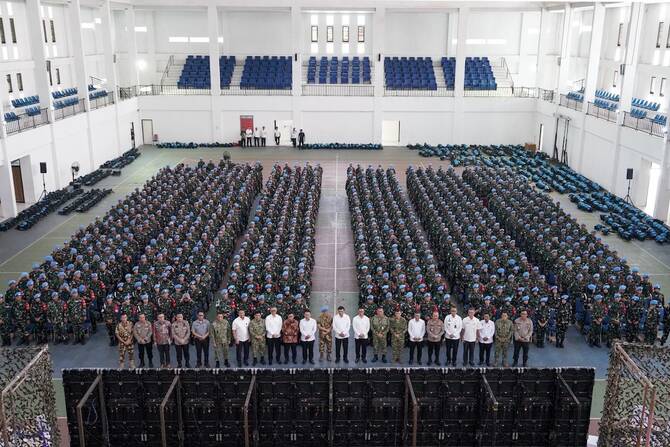

JAKARTA: The Indonesian military will deploy more than 700 peacekeepers later this month to serve in the UN Interim Force in Lebanon, less than two months after its peacekeeping soldiers were killed by Israeli attacks in the region.
Indonesia has contributed troops to UNIFIL since 2006, after the operation’s mandate was expanded by the UN Security Council following the Second Lebanon War to help the Lebanese Army keep control over the south of the country, which borders Israel.
The new batch of Indonesian soldiers, comprising at least 742 soldiers, will replace the group currently serving in the country’s Garuda Contingent and are scheduled to depart on May 22.
“As one of the largest contributors to UN Peacekeeping Missions, Indonesia continues to uphold its constitutional mandate and independent and active foreign policy in supporting world peace, including through the assignment of the Garuda Contingent Task Force to UNIFIL,” Minister of Foreign Affairs Sugiono said in a statement after participating at a coordination meeting with the soldiers earlier this week.
As of May 1 2026, UNIFIL consists of some 7,400 peacekeepers from 47 troop-contributing countries, with Indonesia contributing the largest number of personnel, with 748 soldiers.
Six UN peacekeepers have been killed amid Israel’s escalating offensive on Lebanon in recent months, four of whom were Indonesians, leading Jakarta to demand a “thorough investigation” into the incidents.
Indonesia will “consider early troops withdrawal” if the force’s mandate is no longer able to provide protection for its personnel, Honi Hovana, spokesperson at the Coordinating Ministry for Political and Security Affairs, said this week.
Deploying a new batch of peacekeepers is a “tough dilemma” for Indonesia, said Aisha Kusumasomantri, defense analyst and a director at the Jakarta-based think-tank Indo-Pacific Strategic Intelligence.
“From one side, I think Indonesia is committed to contributing to international security, especially because Indonesia realises that (the Lebanese Armed Forces) doesn't have the capacity to stand on their own without the international community's help,” she told Arab News.
“But on the other side, I think the UN peacekeeping operation doesn't have much capacity to defend itself in South Lebanon.”
Israeli troops have attacked peacekeeping forces multiple times since their 2024 invasion of southern Lebanon. In October of that year, two Indonesian soldiers were among those wounded when Israeli tanks entered the village of Naqoura, home to UNIFIL headquarters, and fired on peacekeepers.
Israel has been targeting UN peacekeepers in south Lebanon because Tel Aviv partly blames UNIFIL for “allowing Hezbollah to grow to what they are right now, one of the strongest militias in the Middle East,” said Aisha Kusumasomantri, defense analyst and a director at the Jakarta-based think-tank Indo-Pacific Strategic Intelligence.
She also pointed to how Israel has been trying to control south Lebanon by destroying “infrastructure in the area, rebuilding it, (and) removing the indigenous populations … and replacing it with settlers,” she added.
“By doing so, I think Israel will conduct a number of humanitarian law violations, which is quite interesting because UNIFIL in that sense would have been witness to what happened in South Lebanon and they can testify … if Israel is charged with those violations,” Kusumasomantri told Arab News.
UNIFIL peacekeepers, which have been deployed in Lebanon’s south since 1978, will see their mandate concluding at the end of 2026, after which personnel are expected to gradually withdraw.
But while the mandate was initially aimed at ensuring stability in a post-conflict area, the peacekeepers are now “stuck in an active combat war zone,” Kusumasomantri said.
While there is a possibility that a new mandate will be published by the UN Security Council, the chance is low because a “real ceasefire” must first be achieved, one that “will be enforced by the international community, and not only a ceasefire that is enforced by one side but constantly being violated by the other,” she added.
The Israeli military has continued to launch daily strikes amid clashes with armed groups fighting them in southern Lebanon, despite a US-mediated ceasefire reached last month and meant to last until May 17.


