

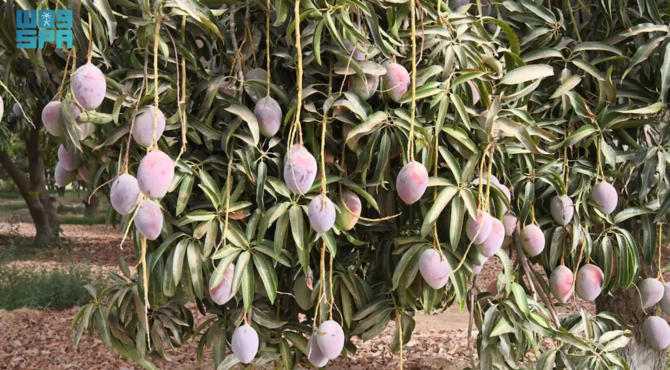
Mango and Tropical Fruits Festival to start this week in Jazan

1 / 2
Jazan is set to open its 21st annual Mango and Tropical Fruits Festival next Wednesday at Sabya Front. (SPA)
2 / 2
Jazan is set to open its 21st annual Mango and Tropical Fruits Festival next Wednesday at Sabya Front. (SPA)
Short Url
Updated 04 May 2025
Follow

Mango and Tropical Fruits Festival to start this week in Jazan

  • Region’s oldest agricultural festival is organized by the local branch of MEWA in cooperation with Sabya
  • Over the past 20 years, the festival has made significant contributions to increasing interest in the cultivation and expansion of mangoes and tropical fruits

RIYADH: Jazan is set to open its 21st annual Mango and Tropical Fruits Festival next Wednesday at Sabya Front where farmers will showcase more than 60 varieties of mangoes native to the region and other tropical fruits.

Mohammed Al-Atif, director general of the Ministry of Environment, Water, and Agriculture’s Jazan branch, said that the festival is an ideal annual opportunity for farmers and entrepreneurs to market their crops and products and expand their marketing base.

He pointed out that the region is home to more than 3.36 million trees of the six most popular tropical fruits: mango, fig, banana, guava, papaya and custard apple. From this the area produces of 123,311 tons of fruit annually, SPA reported.

The region’s oldest agricultural festival, which began in May 2005, the Mango and Tropical Fruits Festival is organized by the local branch of MEWA in cooperation with Sabya, a subdivision of the Jazan region, and other partners.

Al-Atif described the festival as one of the drivers that has helped develop the cultivation of mangoes and tropical fruits, leading to an increase in the number of farmers, farms, trees, and production quantities.

Over the past 20 years, the festival has made significant contributions to increasing interest in the cultivation and expansion of mangoes and tropical fruits, investing in farmers’ efforts, and translating government plans aimed at boosting social and economic development.

The cultivation of mangoes and tropical fruits in Jazan has made notable progress, according to the National Center for Research and Development of Sustainable Agriculture, known as Estidamah. More than 70 varieties of mangoes and tropical fruits — including guava, papaya, pineapple, and banana — have been cultivated and evaluated in the center’s research fields.

Dr. Khalid Al-Rohily, the acting director general of Estidamah, said: “We believe in the importance of research and development in strengthening the agricultural sector, especially in the cultivation of mangoes and tropical fruits, which represent a major economic asset for the Jazan region.

“We are committed to supporting farmers by transferring knowledge and modern technologies, enabling them to improve productivity and enhance economic growth for beneficiaries.”

The center’s farm fields span over 40 hectares, where they conduct experiments to improve production quality and, later, transfer research results.

These initiatives are part of the center’s vision to support farmers and promote the use of modern agricultural technologies and practices, contributing to sustainable development in the agricultural sector.

These efforts are expected to boost productivity and improve farmers’ incomes, further strengthening Jazan’s position as a leading agricultural hub in the Kingdom.


Rare sighting of critically endangered leatherback turtle in Red Sea

Updated 05 February 2026
Follow

Rare sighting of critically endangered leatherback turtle in Red Sea

  • Turtles travel thousands of kilometers to Red Sea
  • Nesting 6,500km away in India’s Andaman Islands

RIYADH: Saudi Arabia’s National Center for Wildlife has documented a rare sighting of a leatherback sea turtle in the Red Sea, marking a significant biological record for one of the planet’s most critically endangered marine species.

The sighting occurred approximately 30 km off the coast of Al-Qunfudhah within the Blue Holes Protected Area, a newly established marine reserve, according to a recent report from the Saudi Press Agency.

The NCW said the presence of a leatherback in these waters was an exceptional event.

Recognized as the largest turtle species on Earth, the leatherback can weigh up to 900 kilograms. It has a unique leathery, black carapace — distinguished by five longitudinal ridges rather than a hard bony shell — and able to dive to depths exceeding 1,000 meters.

Shutterstock image

Noting the species’ migratory nature, the center explained that leatherbacks travel thousands of kilometers foraging for jellyfish. The specimen likely navigated through the Bab Al-Mandeb Strait in search of food.

This is considered a remarkable journey, the NCW said, noting that the nearest known populations reside in the Indian Ocean, spanning waters from South Africa to Sri Lanka (roughly 7,000 to 8,000 km away).

The closest known nesting grounds are located in India’s Andaman Islands, approximately 6,500 kilometers away. No nesting activity has been recorded in the Red Sea.

According to the Red List of the International Union for Conservation of Nature, the leatherback is Critically Endangered in the Indian Ocean.

While data for the Red Sea and Arabian Gulf is scarce, recent isolated sightings include a juvenile recorded in Jordan in December 2025 and another off Djibouti in 2019.

The NCW emphasized that these rare appearances highlight the ecological importance of the Kingdom's marine conservation efforts in the Red Sea.

The center pointed to the Farasan Islands Marine Protected Area, along with the new Blue Holes and Ras Hatiba reserves, as critical sanctuaries that could support the expansion in range of such endangered species.