

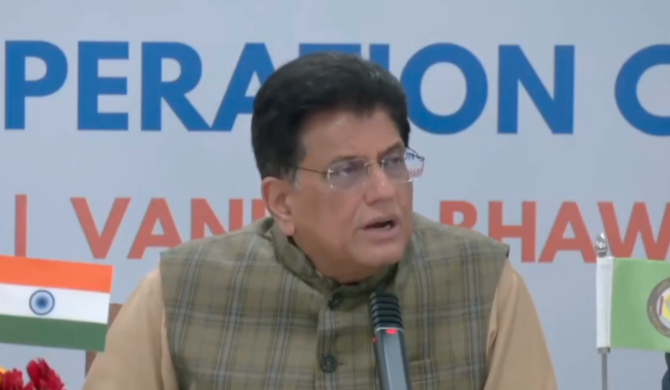

RIYADH: India and the six-nation Gulf Cooperation Council have agreed on the terms to start negotiations for a free trade agreement, India’s trade minister Piyush Goyal has confirmed.
The official stated that Indian industries, particularly petrochemicals and information and communication technology, stand to benefit significantly, with ICT companies gaining new opportunities in the expanding GCC market.
He added that the partnership would also see the establishment of a foundation to jointly develop infrastructure in both India and the six countries that are members of the Gulf organization.
India was the GCC’s second-largest merchandise trade partner in 2024 with $157.9 billion in bilateral trade, according to the bloc’s November trade bulletin, and the negotiations come as the Gulf organization pursues new trade agreements with major economies, including the UK, the EU, and China.
Addressing the gathering at the signing ceremony of the Terms of Reference with the GCC on Feb. 5, Goyal said: “It is most appropriate that we now enter into a much stronger and robust trading arrangement, which will enable a greater free flow of goods and services, bring stability to policy, help encourage a greater degree of investments, and take our bilateral relations between the six nations, the GCC group and India to greater heights.”
Goyal went on to say: “The agreement with the GCC group of six countries will further strengthen our relations, both on geopolitical and trading elements, and will help draw greater amounts of investments and create job opportunities for Indians, both in the GCC nations and in India.”
He noted that the step will encourage food security and energy security of both the GCC and his country. “As I believe, as the GCC and India come closer together, we will become a force multiplier for global good,” the top official said.
The minister stated that India’s free trade agreements with developed economies provide significant benefits. He argued that these pacts help modernize the country, create opportunities for farmers, fishermen, and businesses, and support the goal of making India a developed nation by 2047.
“Sectors like food processing will help our farmers and fishermen in a very big way, giving them bigger opportunities for value-added products, which are already exported to the GCC nations in substantial measure and will get a big boost with elimination of duties, tariffs, and non-tariff barriers,” Goyal explained.
In a press release Raja Al-Marzouqi, general coordinator for negotiations and head of the GCC’s negotiating team, stressed that the signing reflects the organization’s commitment to strengthening the strategic partnership with India, a key regional trading partner.
The Indian minister’s statement comes days after New Delhi’s latest trade pact with Washington, where US President Donald Trump announced a reduction of tariffs on Indian goods from 25 percent to 18 percent, following Prime Minister Narendra Modi’s agreement to stop buying Russian oil.
Trump declared that India would also work to reduce tariffs and non-tariff barriers against the US to zero, and purchase over $500 billion worth of energy, technology, agriculture, coal, and many other American products.
This follows a historic trade agreement last month with the EU after two decades of negotiations, the fourth such deal for Modi since May, following pacts with the UK, Oman, and New Zealand.


