

The last US-Russia nuclear pact expires, prompting fears of a new arms race

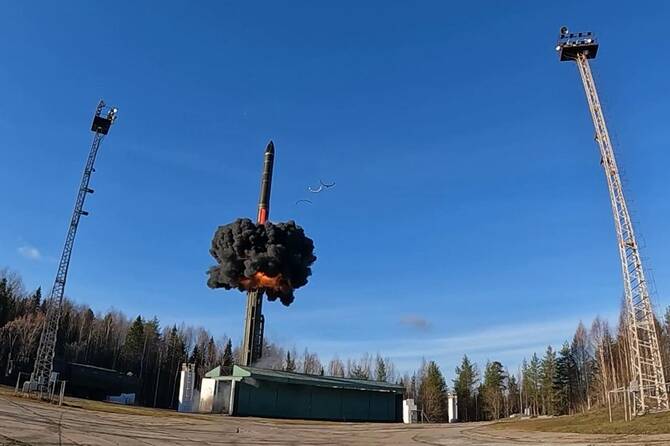
The termination of the New START Treaty could set the stage for what many fear could be an unconstrained nuclear arms race. (FILE/AFP)
Short Url
Updated 05 February 2026
Follow

The last US-Russia nuclear pact expires, prompting fears of a new arms race

  • China says expiration of US-Russia nuclear arms treaty regrettable

MOSCOW: The last remaining nuclear arms pact between Russia and the United States expired Thursday, removing any caps on the two largest atomic arsenals for the first time in more than a half-century.
The termination of the New START Treaty could set the stage for what many fear could be an unconstrained nuclear arms race.
Russian President Vladimir Putin last year declared readiness to stick to the treaty’s limits for another year if Washington follows suit, but US President Donald Trump has been noncommittal about extending it.
Putin discussed the pact’s expiration with Chinese leader Xi Jinping on Wednesday, Kremlin adviser Yuri Ushakov said, noting Washington hasn’t responded to his proposed extension.
Russia “will act in a balanced and responsible manner based on thorough analysis of the security situation,” Ushakov said.
Russia’s Foreign Ministry on Wednesday night said in a statement that “under the current circumstances, we assume that the parties to the New START Treaty are no longer bound by any obligations or symmetrical declarations within the context of the Treaty, including its core provisions, and are fundamentally free to choose their next steps.”
New START, signed in 2010 by then-President Barack Obama and his Russian counterpart, Dmitry Medvedev, restricted each side to no more than 1,550 nuclear warheads on no more than 700 missiles and bombers — deployed and ready for use. It was originally supposed to expire in 2021 but was extended for five more years.
The pact envisioned sweeping on-site inspections to verify compliance, although they stopped in 2020 because of the COVID-19 pandemic and never resumed.
In February 2023, Putin suspended Moscow’s participation, saying Russia couldn’t allow US inspections of its nuclear sites at a time when Washington and its NATO allies have openly declared Moscow’s defeat in Ukraine as their goal. At the same time, the Kremlin emphasized it wasn’t withdrawing from the pact altogether, pledging to respect its caps on nuclear weapons.
In offering in September to abide by New START’s limits for a year to buy time for both sides to negotiate a successor agreement, Putin said the pact’s expiration would be destabilizing and could fuel nuclear proliferation.
New START followed a long succession of US-Russian nuclear arms reduction pacts. Those have been terminated, as well.

China says expiration of US-Russia arms treaty regrettable

The Chinese foreign ministry said on Thursday that the expiration of the US-Russia arms treaty was regrettable, and urged the US to resume dialogue with Russia on “strategic stability.”

“China regrets ‌the ⁠expiration ​of ‌the New START Treaty, as the treaty is of great significance to maintaining global strategic stability,” Chinese foreign ministry spokesperson Lin Jian said.

“The international community is generally concerned that the expiration of the treaty will have a negative impact on the international nuclear arms control system and the global nuclear order.”

“China calls on ‌the United States to respond positively, handle ‍the treaty’s follow-up arrangements responsibly, ‍and resume strategic stability dialogue with Russia as soon as possible. This ‍is also the general expectation of the international community,” Lin said.

The Chinese foreign ministry reiterated that it adheres strictly to a self-defense nuclear strategy.

“China has consistently adhered to a self-defense nuclear strategy, abided by the policy of ​no first use of nuclear weapons and has made unconditional commitments not to use or threaten to use nuclear ⁠weapons against non-nuclear-weapon states or nuclear-weapon-free zones,” Lin said, adding that China keeps its arsenal at the minimum level needed for national security.

Lin added that its nuclear forces are far smaller than those of Washington and Moscow and reiterated it would not join their bilateral arms-reduction talks.

“China’s nuclear forces are not on the same level as those of the United States and Russia, and China will not participate in disarmament negotiations at this stage,” Lin said.


Modi’s rooftop solar push slowed by reluctant lenders, states

Updated 5 sec ago
Follow

Modi’s rooftop solar push slowed by reluctant lenders, states

  • The shortfalls represent the latest challenge to India’s efforts to nearly double clean energy capacity to 500 gigawatts by 2030

SINGAPORE/MUMBAI/BHUBANESWAR, India: Indian Prime Minister Narendra Modi’s push to accelerate the rollout of rooftop solar power is falling short of targets despite ​heavy subsidies due to loan delays and limited support from state utilities, vendors and analysts say.
The shortfalls represent the latest challenge to India’s efforts to nearly double clean energy capacity to 500 gigawatts by 2030, and come as the government plans to suspend clean energy tendering targets amid a mounting backlog of awarded projects yet to be built.
Challenges to plans to increase solar uptake may mean India maintains its reliance on coal-fired power.
India’s Ministry for New and Renewable Energy created its subsidy program for residential solar panel installations in February 2024, covering up to 40 percent of the costs.
But residential installations at 2.36 million are well below the ministry’s target of 4 ‌million by March, ‌according to data from the program’s website.
“Banks’ reluctance to lend and states’ ​hesitance ‌to ⁠promote the schemes ​could ⁠derail India’s efforts to transition away from coal,” said Shreya Jai, the lead energy analyst at research firm Climate Trends in New Delhi.
Roughly three in five rooftop solar applications filed on the scheme’s website are yet to be approved while about 7 percent have been rejected, according to government data on the program, known as the PM Surya Ghar.
In a statement to Reuters about the pending applications, the renewable energy ministry pointed to accelerating installations which have benefited over 3 million households, and said the scheme enables state-owned utilities to reduce subsidy payouts to keep residential power bills in ⁠check.
“The loan rejection rate varies across states,” the statement said.
Under PM Surya Ghar, ‌consumers apply and select a vendor who handles paperwork and arranges bank ‌financing for solar panels. After loan approval and installation, the vendor ​submits proof, after which the government subsidy is credited ‌to the bank.

BANK DELAYS
However, banks have been rejecting or delaying loans for numerous reasons including lack of ‌documentation, which they say is necessary to protect public funds.
“We are working with the government to push for some standard documentation, because it is necessary to avoid bad loans. Currently if loans go bad, banks can take away these panels but what will we do with these panels?” said a senior official at a major government-owned bank.
Chamrulal Mishra, a solar vendor in ‌the eastern Indian state of Odisha, said applications are often rejected because the customer has missed electricity payments or because land records are still in the name ⁠of deceased relatives.
Residents there dispute ⁠the claims that they have missed payments, which they attribute to administrative errors after a change in utility ownership decades prior.
A spokesperson for India’s Department of Financial Services, which regulates the country’s banks, said they have responded to consumer feedback to allow co-applicants for loans to clear up title claims and the simplification of documentation requirements.
The Renewable Energy Association of Rajasthan said some banks are making collateral demands for loans under 200,000 Indian rupees ($2,208.87), despite scheme guidelines not requiring them to, which is constraining solar power additions.
State Bank of India and Punjab National Bank, some of the country’s largest lenders, did not reply to requests for comment on the matter.
State-owned utilities are also not promoting rooftop solar as much, as they are concerned about the loss of revenue as sales move off the electric grid.
“Wealthier households typically have high electricity consumption, tariffs and reliable roof access. When they shift from ​the grid, it leaves a larger financial burden,” ​said Niteesh Shanbog, an analyst at Rystad Energy.