

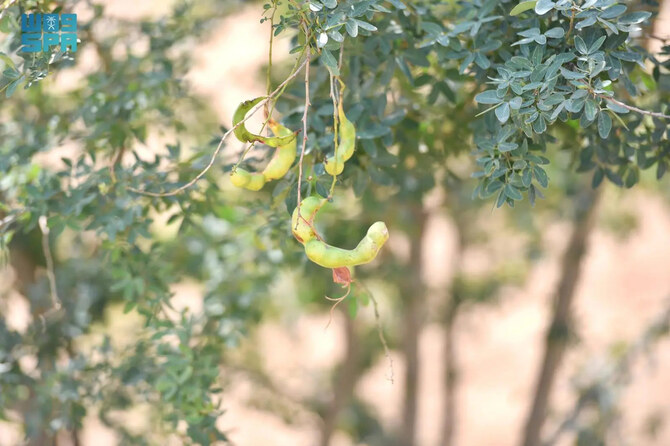
Indian almonds in Jazan: Tropical fruits at their best season

1 / 3
Indian almonds play a significant role in Jazan’s agricultural identity, thriving in the region’s warm environment and tropical climate, which foster their growth and bloom. (SPA)
2 / 3
Indian almonds play a significant role in Jazan’s agricultural identity, thriving in the region’s warm environment and tropical climate, which foster their growth and bloom. (SPA)
3 / 3
Indian almonds play a significant role in Jazan’s agricultural identity, thriving in the region’s warm environment and tropical climate, which foster their growth and bloom. (SPA)
Short Url
Updated 09 February 2025
Follow

Indian almonds in Jazan: Tropical fruits at their best season

  • Indian almonds play a significant role in Jazan’s agricultural identity
  • Heavy rains and relatively high temperatures in Jazan enhance production quality

JAZAN: In the heart of Jazan, the Indian almond has become a distinctive seasonal agricultural product for which the region in southwest Saudi Arabia is well known.

The almond tree is characterized by its dense foliage, abundant shade, and delectable fruit with a rich flavor.

Indian almonds play a significant role in Jazan’s agricultural identity, thriving in the region’s warm environment and tropical climate, the Saudi Press Agency reported. The fruit are highly sought after, whether enjoyed as a snack or valued for their natural oils.

The almond season in Jazan begins in February, marked by the blooming of white and yellow flowers that attract bees, which, along with the wind, aid in pollination.

Between May and July, the fruit gradually ripen, changing from green to yellow or red, signaling full maturity.

Peak production occurs in June and July, when the fruit are harvested and sold in local markets in substantial quantities and varying sizes, with each fruit weighing between 15 and 30 grams.


Indian almonds play a significant role in Jazan’s agricultural identity, thriving in the region’s warm environment and tropical climate, which foster their growth and bloom. (SPA)

Ripe almonds are prized for their soft texture and the ease with which the edible core can be extracted, reaching peak sweetness and exhibiting a more pronounced almond flavor.

Indian almonds are available in several markets, including the central Jazan market, as well as in the governorates of Sabia, Bish, Abu Arish, Samtah, and others throughout the region.

In Jazan, the combination of heavy rains and relatively high temperatures enhances production quality, increasing investment opportunities for cultivating the product.


Ripe almonds are prized for their soft texture and the ease with which the edible core can be extracted. (SPA)

This includes the development of packaging and marketing operations, locally and internationally, the establishment of factories for extracting Indian almond oil, and the expansion of organic agriculture to meet the rising demand for natural and healthy products.

These initiatives contribute significantly to the region’s agricultural and economic development.


Crown prince sponsors launch of world-class Arabic calligraphy center in Madinah

Updated 4 sec ago
Follow

Crown prince sponsors launch of world-class Arabic calligraphy center in Madinah

RIYADH: A new center for Arabic calligraphy under the patronage of Crown Prince Mohammed bin Salman officially opened in Madinah on Monday.

The Prince Mohammed bin Salman Global Center for Arabic Calligraphy was inaugurated by Prince Salman bin Sultan bin Abdulaziz, governor of Madinah region.

He was joined by Culture Minister Prince Badr bin Abdullah bin Farhan, touring the new facility’s exhibition spaces and receiving briefings on cultural programming and the center’s achievements.

They also viewed collections highlighting Arabic calligraphy’s artistic and historical importance.

Speaking at the opening, Prince Badr said: “From this land of enlightenment and scholarship, we proudly launch a global platform dedicated to Arabic calligraphy as an invaluable cultural asset.”

He went on to credit the crown prince’s “generous and boundless support” for the cultural sector.

The minister said that the center demonstrated to the world the legacy of Arabic calligraphy while underscoring Saudi Arabia’s commitment to safeguarding its cultural identity and heritage.

According to Prince Badr, the facility represents an ambitious vision to elevate Arabic calligraphy as both a universal communication tool and an integral element of Arab heritage, art, architecture and design.

The center further aims to enhance the Kingdom’s cultural identity and strengthen its international presence, targeting calligraphers, emerging talents, visual artists, Islamic arts researchers, educational and cultural institutions, as well as art and heritage enthusiasts worldwide.

It will deliver specialized programs including research and archival services, calligraphy instruction, academic grants, a permanent museum, touring exhibitions, an international calligraphy association and a business incubator supporting calligraphy enterprises.

Additional offerings feature artist residency programs, expert-led workshops, and standardized curriculum development, complemented by international educational partnerships aimed at heritage conservation and expanding global appreciation for this time-honored art form.

The center’s establishment in Madinah carries particular significance, given the city’s historical role as the cradle of Arabic calligraphy and its association with transcribing the Qur’an and preserving Islamic knowledge.