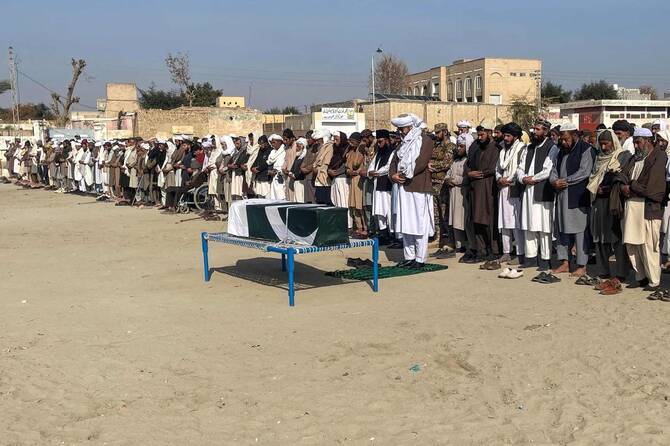

KARACHI: Pakistan’s military said on Thursday that it had concluded a week-long security operation against separatists in Balochistan, killing 216 militants in targeted offensives across the troubled southwestern province.
Balochistan, Pakistan’s largest and poorest province, was brought to a virtual standstill on Saturday when the separatist Baloch Liberation Army (BLA) stormed schools, banks, markets and security installations across the region in one of their largest operations ever.
The military said 22 security personnel and 36 civilians were killed in the attacks.
The BLA’s coordinated strikes in over a dozen locations began after the military launched its “intelligence driven” Radd Al-Fitna 1 (countering chaos) operation, which the army said began on January 29.
“Through meticulous planning, actionable intelligence, and seamless joint execution Pakistan’s security forces and law enforcement agencies with support of intelligence agencies under Operation Radd-ul-Fitna-1 responded with precision and resolve,” the military said in a statement, adding that 216 militants had been killed in all of Balochistan since the operation began.
Security officials and witnesses said the insurgents seized government buildings and police stations in several locations, including taking over the desert town of Nushki for three days before they were pushed out.
Helicopters and drones were deployed to Nushki to end the siege, security officials said. Mineral-rich Balochistan borders Iran and Afghanistan and is home to Beijing’s investment in the Gwadar deepwater port and other projects.
It has grappled with a decades-long insurgency led by ethnic Baloch separatists seeking greater autonomy and a larger share of its natural resources.