

Saudi Arabia important as Red Sea is its front yard, says chief of EU naval mission

1 / 2
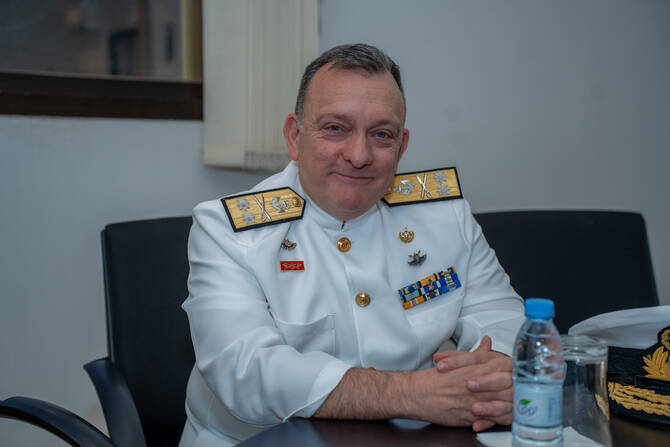
Rear Adm. Vasileios Gryparis, commander of the EU military mission EUNAVFOR Aspides. (AN photo by Loai Elkelawy)
2 / 2
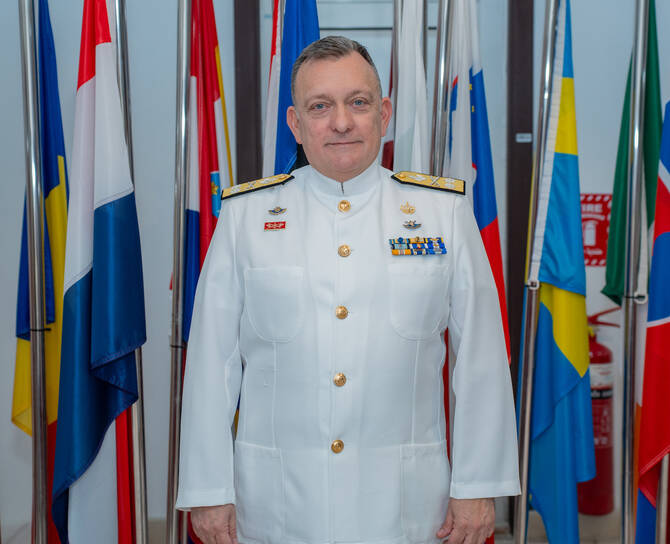
Rear Adm. Vasileios Gryparis, commander of the EU military mission EUNAVFOR Aspides. (AN photo by Loai Elkelawy)
Short Url
Updated 01 May 2025
Follow

Saudi Arabia important as Red Sea is its front yard, says chief of EU naval mission

  • ‘What we do is benefiting everybody,’ commander tells Arab News

RIYADH: Saudi Arabia is an important regional power that needs to be kept informed of security operations in the Red Sea, Rear Adm. Vasileios Gryparis, commander of the EU military mission EUNAVFOR Aspides, has told Arab News.

The EU on Feb. 19 last year launched a maritime security operation, EU Naval Force Operation Aspides, in response to escalating Iran-backed Houthi attacks on warships and merchant vessels in the Red Sea, northwestern Indian Ocean, and the Gulf.

In an interview with Arab News, Gryparis, who was in Riyadh as part of a regional tour, said that the Gulf countries, especially Saudi Arabia, were important to help safeguard the freedom of navigation in the region.

He said: “Among the very important countries in the area is Saudi Arabia. So, my intention here is to inform the Kingdom about what we are doing.

“Because the Red Sea, where we operate, is the front yard of the Kingdom, we believe and we are honest in that we have to inform all the countries in the area that what we do is benefiting everybody.”

He thanked the Gulf Cooperation Council countries’ authorities for their involvement in the MV Sounion tanker operation which helped to prevent 150,000 tonnes of oil from being spilled into the Red Sea.

He said: “This was dealing with probably an imminent environmental disaster. It’s one of the reasons for this visit, and also to thank the GCC authorities for their contribution.”

Commenting on Operation Aspides’ role in regional maritime security, he added: “It is crucial to build up the confidence of the shipowners and the shipping companies, and (that) they return gradually to their original trade. Of course, we are talking about civilians that are not used to being threatened in this way.”

He said that the actions of the force were “not only protecting the livelihoods of countries in the area, but also the lives of the local people.”

He added: “You can imagine that if we had had an oil spill from the MV Sounion tanker, this would have been three to four times worse than the Exxon Valdez oil spill, a major environmental disaster in Alaska in 1989.”

On the challenges posed by the Houthis, Gryparis said: “It is important to allow the shipping industry to understand that somebody is caring for them.

“We don’t mind about the nationality of the seafarers, because we believe in the freedom of navigation and the value of human life, so we are protecting exactly those values.”

Yemen’s maritime borders became a battleground in a wider regional and international power play following the start of the conflict in Gaza.

The Houthis have hindered maritime traffic through the Bab Al-Mandab Strait, which provides access to the Red Sea and Suez Canal.

On continuing the operation and its resulting challenges, Gryparis said: “This (the operation) is going to be here until this problem is solved.”

He added: “We are not allowed to enter the territorial seas and the airspace of Yemen. And any kinetic action that we take should always be necessary, proportionate and limited to the internal channel.”

The EU Council has recently extended the mandate of the maritime security operation until February 2026.

Gryparis said: “They trusted me and my operation that we are delivering. So, they understood the results that we have provided so far.

“They understood that the problem has not been solved yet, and they gave us extra time in order to reach the goal.

“Besides that, they entrusted me and my operation with new tasks. So, that means that they have good confidence in our capabilities.”


Jeddah students get closer look at electric motorsport

Updated 24 January 2026
Follow

Jeddah students get closer look at electric motorsport

  • A PIF-linked initiative highlights technical and engineering careers behind electric racing events

JEDDAH: Students from local and international schools in Jeddah were introduced to STEM-related career pathways in electric motorsport this week, as part of an education program linked to the UIM E1 World Championship held on the Red Sea.

The sessions formed part of Driving Force Presented by the Public Investment Fund, an initiative run by Formula E and its electric racing series partners, to familiarize students aged eight to 18 with science, technology, engineering and mathematics through electric racing and sustainability-focused industries.

The sessions for students formed part of Driving Force Presented by the Public Investment Fund, an initiative run by Formula E and its electric racing series partners. (Supplied)

The programme took place alongside the 2026 E1 Jeddah GP and included workshops, school visits and trackside access designed to show how engineering, data, broadcast technology and event operations function within professional motorsport.

According to organisers, the initiative reached more than 60,000 students globally in 2025, with further expansion planned this year. 

HIGHLIGHTS

• The program took place alongside the 2026 E1 Jeddah GP and included workshops, school visits and trackside access.

• Students learned about E1 races and their technical and environmental dimensions and discussed the engineering and marine aspects of electric boats.

• According to organisers, the initiative reached more than 60,000 students globally in 2025, with further expansion planned this year. 

John Williams, managing director at E1, told Arab News: “The PIF is absolutely vital to everything we do here at the E1. They were crucial initial investment partner since the start of the championship and they continue to support us in a number of ways and more specifically around the Driving Force program.”

The sessions for students formed part of Driving Force Presented by the Public Investment Fund, an initiative run by Formula E and its electric racing series partners. (Supplied)

Elaborating more on the program, he said: “What we are doing is presenting and showing these students the available careers of science, technology, engineering and mathematics, as well as careers in sports, not only pilots but also engineers and mechanics.”

Williams added that the main key to the program was bringing a new generation to the mechanism of sport.

“We are introducing to these exciting new technologies around the race but it could be our technology on the boat or our broadcast products, as well as how to manage the event its self. There are a range of opportunities to show it to the children in addition to enjoying the excitement of the race and meeting the pilots.”

The program’s Jeddah activities began at King Abdulaziz University’s faculty of maritime studies, where students took part in a hands-on workshop focused on STEM careers in the motorsport and sustainability areas conducted by technology experts and famous water pilots such as Dani Clos, Emma Kimilainen and Patricia Pita.

Students learned about E1 races and their technical and environmental dimensions and discussed the engineering and marine aspects of electric boats.

They also enjoyed exclusive behind-the-scenes access at the E1 Jeddah GP, pilot meet-and-greets, and front-row seats to watch the RaceBird boats in action.