Misinformation, online hate speech fuels panic in South Sudan

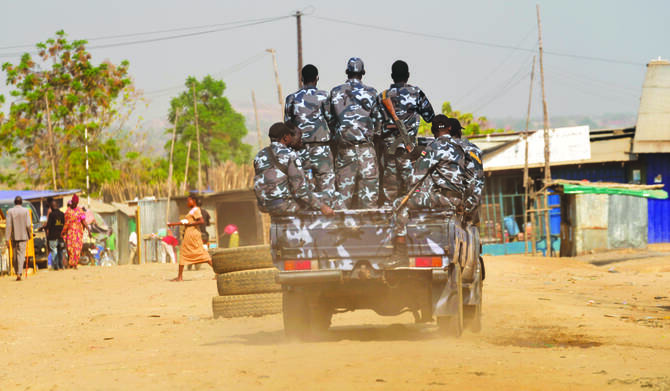
South Sudan soldiers patrol the street in Juba. (AP)
Short Url
Updated 29 March 2025
Follow

Misinformation, online hate speech fuels panic in South Sudan

NAIROBI: Misinformation and online hate speech are fueling panic and division in South Sudan at a time of acute political tensions that observers fear could drive the country back to war.
Ethnic divisions, particularly between the largest communities, the Dinka and Nuer, fueled the brutal civil war of 2013-18 in which some 400,000 people died.
After years of relative calm, there are worrying signs of renewed ethnic polarization, said Nelson Kwaje, chair of Digital Rights Frontlines, an organization based in the capital Juba that monitors hate speech and misinformation online.

FASTFACT

After years of relative calm, there are worrying signs of renewed ethnic polarization, said Nelson Kwaje, chair of Digital Rights Frontlines, an organization that monitors hate speech and misinformation online.

It comes as the 2018 peace agreement between President Salva Kiir and his long-time rival, First Vice President Riek Machar — who are respectively of Dinka and Nuer ethnicity — is hanging in the balance after Machar’s arrest on Wednesday.
He said mobile phone penetration in South Sudan is only 40 to 50 percent, and social media use around 10 percent at a conservative estimate.
However, those with access are often “the loudest voices,” and their messages spread through communities by more traditional means, helping poison the atmosphere.
Kwaje, speaking from Juba, said life in the city was still “relatively calm.”
But “social media disinformation and hate speech, which is very intense,” is stoking fears.
“There are rumors of assassinations, talk of retaliatory violence ... warnings about ethnic violence,” he said.
First, the brutal killing of an army general captured by members of a predominantly Nuer militia known as the White Army, and then a video appearing to show a young Dinka man being savagely treated by people with Nuer accents.
Ethnic polarization had reduced considerably in recent years, said Kwaje, but those videos have once again “radicalized people.”
“The polarization is obvious,” he said.
“If more incidents go in this direction, it will go to the next level of people taking up arms.”
“South Sudan has limited access to good information and free media. It creates a vacuum,” said Kwaje.
“The people who fill the vacuum are not all nefarious; many just want to share information to protect their community.
“But then you have actors who want to engage in fan engagement, and a small section who are politically motivated.”
He said it was hard to identify who was behind these political messages, but they were consistent and well-designed.
“When we see that level, we know there’s someone on a payroll,” said Kwaje.
“We have better shock absorbers now,” said Kwaje.
When the civil war broke out in 2013, there was an evident tribal divide “from day one,” he said.
The peace agreement that ended the war in 2018, “for all its faults,” engaged the international community, partially unified and disarmed Kiir and Machar’s respective armies, and installed an arms embargo that limited the supply of weapons to some extent, said Kwaje.
“Young people are also aware of the dangers of dividing along tribal lines. There is a lot of messaging about peace.
“But what pushes people to the edge is sharing content showing someone from your tribe being mistreated. Whether that content is factual or not, that immediately radicalizes you.”


US military launches strikes in Syria against Daesh fighters after American deaths

Updated 20 December 2025
Follow

US military launches strikes in Syria against Daesh fighters after American deaths

  • “This is not the beginning of a war — it is a declaration of vengeance,” Defense Secretary Pete Hegseth says
  • President Trump earlier pledged “very serious retaliation” but stressed that Syria was fighting alongside US troops

WASHINGTON: The Trump administration launched military strikes Friday in Syria to “eliminate” Daesh group fighters and weapons sites in retaliation for an ambush attack that killed two US troops and an American interpreter almost a week ago.
A US official described it as “a large-scale” strike that hit 70 targets in areas across central Syria that had Daesh (also known as Islamic State or IS) infrastructure and weapons. Another US official, who also spoke on condition of anonymity to discuss sensitive operations, said more strikes should be expected.
The attack was conducted using F-15 Eagle jets, A-10 Thunderbolt ground attack aircraft and AH-64 Apache helicopters, the officials said. F-16 fighter jets from Jordan and HIMARS rocket artillery also were used, one official said.
“This is not the beginning of a war — it is a declaration of vengeance. The United States of America, under President Trump’s leadership, will never hesitate and never relent to defend our people,” Defense Secretary Pete Hegseth said on social media.


President Donald Trump had pledged “very serious retaliation” after the shooting in the Syrian desert, for which he blamed Daesh. The troops were among hundreds of US troops deployed in eastern Syria as part of a coalition fighting the terrorist group.
Trump in a social media post said the strikes were targeting Daesh “strongholds.” He reiterated his support for Syrian President Ahmad Al-Sharaa, who he said was “fully in support” of the US effort to target the militant group.
Trump also offered an all-caps threat, warning the group against attacking US personnel again.
“All terrorists who are evil enough to attack Americans are hereby warned — YOU WILL BE HIT HARDER THAN YOU HAVE EVER BEEN HIT BEFORE IF YOU, IN ANY WAY, ATTACK OR THREATEN THE USA.,” the president added.
The attack was a major test for the warming ties between the United States and Syria since the ouster of autocratic leader Bashar Assad a year ago. Trump has stressed that Syria was fighting alongside US troops and said Al-Sharaa was “extremely angry and disturbed by this attack,” which came as the US military is expanding its cooperation with Syrian security forces.
Syria’s foreign ministry in a statement on X following the launch of US strikes said that last week’s attack “underscores the urgent necessity of strengthening international cooperation to combat terrorism in all its forms” and that Syria is committed “to fighting Daesh and ensuring that it has no safe havens on Syrian territory and will continue to intensify military operations against it wherever it poses a threat.”


Daesh has not claimed responsibility for the attack on the US service members, but the group has claimed responsibility for two attacks on Syrian security forces since, one of which killed four Syrian soldiers in Idlib province. The group in its statements described Al-Sharaa’s government and army as “apostates.” While Al-Sharaa once led a group affiliated with Al-Qaeda, he has had a long-running enmity with Daesh.
Syrian state television reported that the US strikes hit targets in rural areas of Deir ez-Zor and Raqqa provinces and in the Jabal Al-Amour area near Palmyra. It said they targeted “weapons storage sites and headquarters used by Daesh as launching points for its operations in the region.”

Trump this week met privately with the families of the slain Americans at Dover Air Force Base in Delaware before he joined top military officials and other dignitaries on the tarmac for the dignified transfer, a solemn and largely silent ritual honoring US service members killed in action.

President Donald Trump, from left, Defense Secretary Pete Hegseth and Chairman of the Joint Chiefs Air Force Gen. Dan Caine attend a casualty return ceremony at Dover Air Force Base, Delaware, on Dec. 17, 2025,of soldiers who were killed in an attack in Syria last week. (AP)

The guardsmen killed in Syria last Saturday were Sgt. Edgar Brian Torres-Tovar, 25, of Des Moines, and Sgt. William Nathaniel Howard, 29, of Marshalltown, according to the US Army. Ayad Mansoor Sakat, of Macomb, Michigan, a US civilian working as an interpreter, was also killed.
The shooting nearly a week ago near the historic city of Palmyra also wounded three other US troops as well as members of Syria’s security forces, and the gunman was killed. The assailant had joined Syria’s internal security forces as a base security guard two months ago and recently was reassigned because of suspicions that he might be affiliated with Daesh, Interior Ministry spokesperson Nour Al-Din Al-Baba has said.
The man stormed a meeting between US and Syrian security officials who were having lunch together and opened fire after clashing with Syrian guards.
When asked for further information, the Pentagon referred AP to Hegseth’s social media post.