Pakistan approves compensation as rescue ends 10 days after deadly Karachi plaza fire

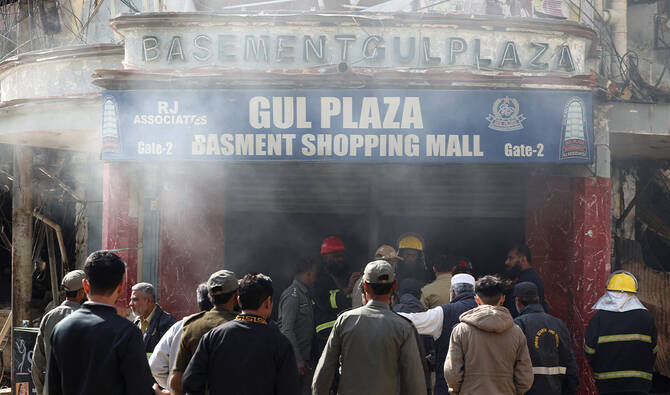
Rescue and emergency team members gather at the entrance, following a massive fire that broke out in the Gul Plaza Shopping Mall in Karachi, Pakistan, January 23, 2026. (Reuters/File)
Short Url
Updated 27 January 2026
Follow

Pakistan approves compensation as rescue ends 10 days after deadly Karachi plaza fire

  • 73 people killed in one of Karachi’s deadliest fires, which exposed gaps in fire safety enforcement
  • Forensic teams to inspect sealed Gul Plaza building to determine cause of blaze, officials say

ISLAMABAD: The Sindh cabinet on Tuesday approved a major compensation and rehabilitation package for victims of a fire at a shopping plaza in Karachi, as authorities formally concluded search and rescue operations more than 10 days after one of the city’s deadliest commercial blazes.

The fire, which broke out on Jan. 17 at the multi-story shopping complex in Karachi’s congested Saddar area, killed more than 70 people and took three days to extinguish. Rescue and relief efforts continued for over a week amid unstable debris and severely damaged structures, before the scorched building was sealed by the district administration on Tuesday.

Under the cabinet-approved package, families of those who died will receive Rs10 million ($35,800) each in compensation, while affected shopkeepers will be provided interest-free loans of Rs10 million per unit, with the provincial government bearing the cost of interest. An additional Rs500,000 ($1,790) per shopkeeper has been approved as immediate subsistence support.

“There can be no compromise on human life,” Chief Minister Syed Murad Ali Shah said during a cabinet meeting, adding that the government’s priority was to support affected families while ensuring accountability.

“Relief, justice and prevention must go hand in hand,” he added.

The cabinet also constituted a high-level subcommittee, headed by the chief minister, to review the findings of an inquiry committee tasked with determining responsibility for the incident and recommending further action.

Meanwhile, the district administration said rescue operations had officially ended and the Gul Plaza building had been sealed after being declared unsafe and dilapidated. 

“Gul Plaza has been sealed after the search was completed today [Jan.27], following 10 days of operation. Experts from the Lahore Forensic Laboratory and the Pakistan Engineering Council (PEC) will inspect the building. They will share the cause of the fire once the structure’s inspection is completed,” Javed Nabi Khoso, Deputy Commissioner of District South, where the plaza is located, told Arab News.

Dr. Summaiya, police surgeon in Karachi, told Arab News 73 sets of remains had been processed so far, of which 27 had been identified and one unknown profile had been generated. 

“Fifty-six family reference samples have been collected in connection with 65 missing persons,” she added. 

Fires have become an increasingly frequent occurrence in Karachi, a megacity of more than 20 million people, where fire services remain severely overstretched and under-resourced relative to population density and the scale of commercial activity.

Successive deadly incidents have drawn criticism of the provincial Sindh administration over lax enforcement of building codes, inadequate inspections and limited emergency response capacity.


Pakistan launches $136 million Ramadan relief package for 12.1 million families

Updated 8 sec ago
Follow

Pakistan launches $136 million Ramadan relief package for 12.1 million families

  • Rs13,000 per family to be transferred via bank accounts, mobile wallets under cashless system
  • Pakistan’s national space agency says the Muslim fasting month is likely to begin from Feb. 19

ISLAMABAD: Prime Minister Shehbaz Sharif on Saturday launched a Rs38 billion ($136 million) Ramadan relief package, pledging direct digital cash transfers of Rs13,000 ($47) each to 12.1 million low-income families across Pakistan.

Pakistan’s national space agency announced a day earlier the Ramadan crescent would likely be visible on Feb. 18, with the first fast expected to fall on Feb. 19, subject to official confirmation.

The government will distribute the relief package through bank accounts and regulated mobile wallet platforms, fully replacing the previous utility store-based subsidy model with a digital payment mechanism overseen by the State Bank of Pakistan.

“This year, Rs38 billion have been allocated ... that will not only be distributed to the rightful people in all four provinces, but also to Gilgit-Baltistan and Azad Kashmir through these wallets and digital bank accounts,” the prime minister said during a ceremony in the federal capital, adding that 12.1 million families would benefit.

The allocation marks a sharp increase from last year’s Rs 20 billion ($72 million) Ramadan program, as the government expands coverage and deepens its shift toward cash-based targeted subsidies.

Officials said Rs28 billion ($101 million) has been earmarked for families not currently receiving support under any federal income assistance program, while an additional Rs10 billion ($36 million) will go to those already registered under existing social protection schemes.

Syed Imran Shah, federal minister for poverty alleviation and social security, said the digital framework would allow transfers to be made in a “safe, effective and easy way,” reducing leakages and preserving beneficiaries’ dignity by eliminating long queues and physical distribution centers.

Amir Ali Ahmed, secretary of the Benazir Income Support Program (BISP), said the 2026 rollout builds on last year’s digital transition, when around two million beneficiaries received payments electronically.

A third-party validation report issued in December 2025 confirmed the transparency and operational effectiveness of the system, he added.

The prime minister said he would personally oversee periodic reviews of the program to ensure timely disbursement.

The government had scrapped the Utility Store-based Ramadan subsidy system last year, arguing that it led to quality concerns, long queues and administrative inefficiencies.

The digital transfer model aims to move toward a targeted subsidy regime aligned with broader efforts to expand financial inclusion and reduce cash-based leakages.