UN chief calls for action over ‘perfect storm’ engulfing South Sudan

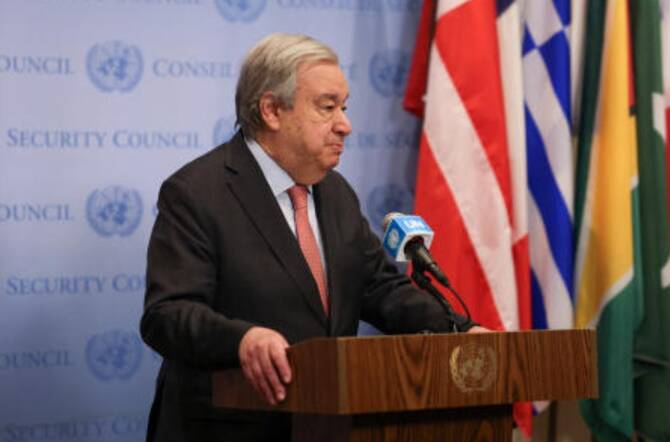
UN Secretary General Antonio Guterres makes comments on the security situation in South South Sudan, in New York City, US, Mar. 28, 2025. (Reuters)
Short Url
Updated 28 March 2025
Follow

UN chief calls for action over ‘perfect storm’ engulfing South Sudan

  • War-torn country ‘at a crossroads,’ Antonio Guterres warns amid escalating violence, attacks on civilians
  • ‘Horn of Africa cannot afford another conflict,’ Guterres says after urging an end to ‘politics of confrontation’

NEW YORK: UN Secretary-General Antonio Guterres on Friday urged both South Sudan’s leadership and the international community to act swiftly to prevent further devastation in the war-torn country, warning that ethnic and political targeting by security forces could spiral into a broader regional conflict.
Referring to the escalating violence in South Sudan, including airstrikes on civilians, Guterres said: “All the dark clouds of a perfect storm have descended upon the people of the world’s newest country — and one of the poorest.”
On Wednesday, an armed convoy led by the nation’s top security officials, including its defense minister, entered the home of First Vice President Riek Machar in Juba, disarmed his bodyguards and placed him under house arrest.
Tensions between Machar and President Salva Kiir had been worsening for several weeks. In August 2018, the two leaders reached a peace agreement that ended a five-year civil war between their forces, which had resulted in almost 400,000 deaths.
However, In the seven years since, their relationship has grown more strained due to ethnic conflicts and occasional outbreaks of violence. Machar’s party said his detention effectively signaled the collapse of the peace deal.
This week, the UN reported that barrel bombs thought to contain highly flammable liquid were used in airstrikes during clashes between the army and a rebel group formerly associated with Machar.
Speaking to reporters in New York, Guterres said that “the peace agreement is in shambles,” and called for the immediate release of all detained officials and the full restoration of the Government of National Unity, which he described as crucial to moving toward peace.
“The Horn of Africa is already in turmoil and cannot afford another conflict,” he warned, “and nor can the people of South Sudan.”
Directly addressing the South Sudanese leadership, Guterres said: “End the politics of confrontation. Release detained military and civilian officials now. Fully restore the Government of National Unity. And vigorously implement the promises you made through your commitments to the peace agreement — which is the only legal framework to peaceful, free and fair elections in December 2026.”
The humanitarian situation in South Sudan is alarming, with almost 75 percent of the population requiring aid and at least half facing severe food insecurity. A cholera outbreak is adding to the crisis.
Over 1 million refugees have fled to neighboring countries, primarily Sudan, since fighting erupted. Guterres also noted a catastrophic economic collapse, with oil revenues plummeting and inflation soaring to 300 percent.
With the world’s youngest country facing such dire circumstances, the UN secretary-general warned of the potential for a repeat of the civil wars in 2013 and 2016.
Guterres called for renewed diplomatic efforts, emphasizing the need for dialogue and de-escalation.
“South Sudan is at a crossroads,” he said. “For the sake of the long-suffering people, it is time for all parties to put down the weapons and focus on rebuilding the country.”
The UN chief said that he had spoken with the chairperson of the African Union Commission and expressed strong support for the AU’s initiative to deploy the “Panel of the Wise” and for continuing efforts by Kenyan President William Ruto’s special envoy.
Despite the urgency of the situation, Guterres lamented that South Sudan has largely faded from international attention. He pleaded for increased diplomatic and financial support to address the mounting crisis.
“The people of South Sudan are close to my heart. They had enormous hopes and aspirations, but sadly, they have not had the leadership they deserve.”
There have been increasing international calls for a unified stance on the peace process in South Sudan, with the UN, AU, and the Intergovernmental Authority on Development trade bloc all urging the restoration of peace and stability.


Palestinian PM: Gaza reconstruction advancing amid US talks, Saudi support

In an interview with Arab News, Mohammed Mustafa said “Palestinian objective is clear,’ but we need to ‘get Gaza right first.’
Updated 13 sec ago
Follow

Palestinian PM: Gaza reconstruction advancing amid US talks, Saudi support

  • In an interview with Arab News, Mohammed Mustafa said “Palestinian objective is clear,’ but we need to ‘get Gaza right first’
  • Speaking at Davos panel, PM calls Kingdom a key stakeholder in the Palestinian cause

DAVOS: Palestinian Prime Minister Mohammed Mustafa told Arab News that progress is underway in Gaza’s reconstruction talks, with clear dialogue between the Palestinian Authority, US President Donald Trump and Special Envoy Steve Witkoff.

“I think the Palestinian objective is pretty clear, it has been for a long time, which is to establish their own independent state, (achieve) international resolution,” Mustafa said, noting that “we need to get Gaza right first.”

Despite a ceasefire taking hold earlier in 2025, Gaza remains under what the international community describes as an Israeli-enforced blockade. Basic supplies such as food and medicine are still subject to Tel Aviv’s scrutiny, which controls all access in and out of the Strip.

On Sunday, Trump announced that his Gaza plan had entered its second phase, in which Hamas would release all remaining hostages, Israel would free more Palestinian prisoners and fully withdraw its forces — a step international actors say should pave the way from ceasefire to lasting peace.

The formation of a technocratic National Committee for the Administration of Gaza, or NCAG, composed of Palestinian figures, marks the first concrete step toward implementing the plan and restoring Palestinian ownership of the next phase.

A precise timeline for reconstruction remains unclear, with analysts warning that major works hinge on Hamas disarmament — a politically fraught task assigned to the Gaza Peace Board.

“It’s going to take more than two years to fix Gaza, but at least we want to make sure that things are in the right direction,” continued Mustafa, adding that the West Bank remains part of the broader conversation.

He stressed the urgency of reunifying Gaza’s institutions with the West Bank to achieve the PA’s political goal of independence. 

“Our priority is what’s happening to our people in Gaza today. Despite four months passing (after) the ceasefire, people are still dying. Yes, there is a ceasefire but it’s not fully observed due to Israeli military actions,” he said, stressing that “shelter is the biggest challenge” at the moment.

Mustafa revealed he held “very active and useful” talks with US officials on Tuesday, saying both sides “share the same goals” on the matter.

Later in his panel, Mustafa said a Palestinian reform plan is in the works with the help of partners including Saudi Arabia.

In a session at the World Economic Forum in Davos, Mustafa said Saudi Arabia and other partners such as Egypt and Jordan were not just contributors but key stakeholders in the Palestinian cause.

“Saudi Arabia along with France have been working with us on the two state solution and integrating it,” he said.

“We want to work with the board of peace to ensure that they do their part of things to prepare for reconstruction efforts,” he added.

Mustafa said although some view the Oslo treaty as outdated, it still holds its place as an internationally recognized framework.

“According to the Oslo agreement, Israel should have withdrawn from most of the West Bank and Gaza. We want to see Israel respecting this agreement,” he said.

“The Israelis did not respect the economic part of the treaty. We are praying for a heavy price, not only in Gaza and people being killed every day. But also actions on the ground in the West Bank. We said clearly, we want to achieve our goals by peaceful means,” he said.

“Israel today holds $4 billion of our government’s money. They control the borders and collect the tax fines. For the past four months they have sent zero dollars. Our ability to govern has been impacted due to this,” Mustafa said.

In a sideline interview with Arab News, Palestinian Ambassador to Switzerland Ibrahim Mohammad Khraishi said that he met an Egyptian minister who expressed hope that the Rafah crossing could soon reopen on both sides.

“We need the understanding from all,” Khraishi said. “Yes, we have this administrative committee (as part of the Gaza Peace Board), but without the Palestinian Authority, they cannot deliver. Because we have everything. We have the institutions, we have the government,” Khraisi said.

Commenting on recent West Bank developments, including Israeli bulldozers razing the UNRWA compound in occupied East Jerusalem on Tuesday, he warned: “This is the scenario for the Israelis. For them, there is nothing to talk about. It’s total crash and destruction. Now, what they are doing in West Bank is on the way.”