Pakistan cold wave to persist into February as more snow forecast in north

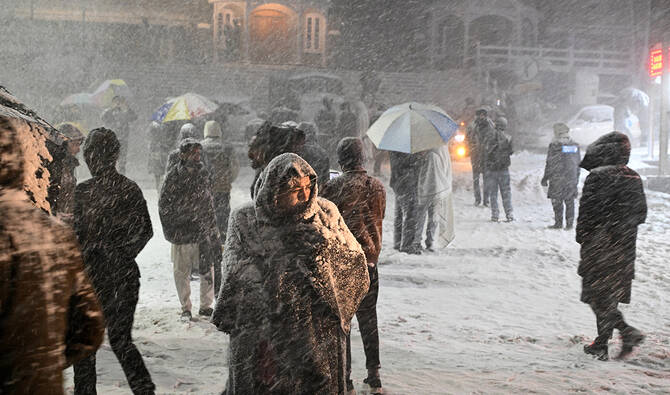
Tourist gather during a snowfall in Murree, some 60 km north of Islamabad on January 23, 2026. (AFP/file)
Short Url
Updated 27 January 2026
Follow

Pakistan cold wave to persist into February as more snow forecast in north

  • Cold wave to last until Feb 1 nationwide, longer in northern regions
  • Authorities urge tourists to avoid unnecessary travel during snowfall

ISLAMABAD: Pakistan’s ongoing cold wave is expected to persist across much of the country until the end of the month, with freezing conditions likely to continue into mid-February in mountainous northern regions as more rain and snowfall are forecast, a senior meteorological official said on Tuesday.

The warning comes as a fresh western weather system is set to bring intermittent rain and light-to-moderate snowfall to parts of Khyber Pakhtunkhwa, Gilgit-Baltistan, Kashmir and northern Punjab, raising concerns over travel disruptions and road safety in mountainous areas.

“The cold wave in the country will continue until February 1, but in Murree, the Galyat region, and other hilly areas, this wave will persist until February 15,” Anjum Nazir Zaigham, Deputy Director at the Met Department, told Arab News.

The Galyat region refers to a cluster of hill resorts and mountain towns in northern Pakistan, straddling parts of Murree and Abbottabad districts in Punjab and Khyber Pakhtunkhwa.

“This season, 102 inches of snow were recorded in Malam Jabba, 67 inches in Kalam, 37 inches in Babusar, and 30 inches in Murree,” he added.

Pakistan has experienced one of its harsher winter spells this season, with heavy snowfall recorded at several popular hill stations, prompting authorities to restrict vehicle movement in vulnerable areas and deploy additional personnel to manage traffic and emergency response, particularly in tourist destinations such as Murree.

In an advisory issued Tuesday afternoon, the Met Office said westerly winds were likely to bring further intermittent rain and snowfall over areas including Chitral, Dir, Swat, Kalam, Shangla, Kohistan, Battagram, Mansehra, Abbottabad, Buner, Murree, the Galyat region, Kashmir and Gilgit-Baltistan over the next few hours.

Authorities have also urged tourists to avoid unnecessary travel during snowfall, while local administrations have been coordinating snow clearance, traffic diversions and emergency services.

Tens of thousands of tourists flock to Pakistan’s scenic north every winter to witness snowfall, often neglecting warnings from disaster management authorities.

In January 2022, at least 21 people, including children, died after they were stuck in freezing temperatures during a snowstorm in the Pakistani hill station of Murree.


China backs Pakistan in fight against militancy after deadly Balochistan attacks

Updated 03 February 2026
Follow

China backs Pakistan in fight against militancy after deadly Balochistan attacks

  • China is a major ally and investor in Pakistan and has pledged over $65 billion in major infrastructure projects, including in Balochistan
  • Chinese Foreign Ministry spokesperson Lin Jian says ‘we mourn for lives lost, and our hearts go out to injured and those who lost loved ones’

ISLAMABAD: China condemns the recent attacks that killed more than 200 people in Pakistan’s southwestern Balochistan province, a Chinese foreign ministry spokesperson said on Tuesday, reaffirming Beijing’s support for Pakistan in its fight against militancy.

The Baloch Liberation Army (BLA) group launched coordinated attacks in several cities across Balochistan on Saturday, killing 33 civilians and 17 security personnel. Officials said 117 militants were killed in skirmishes and follow-up operations.

Balochistan, which borders Iran and Afghanistan, is the site of a decades-long insurgency waged by Baloch separatist groups who often attack security forces, foreigners and non-local Pakistanis and kidnap government officials.

China is a major ally and investor in Pakistan and has pledged over $65 billion in investment in road, infrastructure and development projects under the China-Pakistan Economic Corridor (CPEC).

“China strongly condemns the [Balochistan] attacks... We mourn for the lives lost, and our hearts go out to the injured and those who lost their loved ones,” Chinese Foreign Ministry spokesperson Lin Jian said at a press briefing on Tuesday.

“China firmly opposes any form of terrorism and will as always firmly support Pakistan in combating terrorism, maintaining solidarity and social stability, and protecting the safety of the people.”

Chinese nationals working in Pakistan have often been targeted by militants, particularly in the southwestern Balochistan province, where China is developing a deep seaport that is touted as the crown jewel of CPEC.

Interior Minister Mohsin Naqvi said last week the attacks, claimed by the separatist Baloch Liberation Army (BLA), were planned from India. New Delhi rejected the allegation as “baseless,” saying Islamabad was attempting to deflect attention from its internal challenges.

Balochistan is home to vast reserves of minerals and hydrocarbons. Separatist militant groups such as the BLA blame Islamabad for exploiting Balochistan’s natural resources and denying locals a share in them. The military and civilian government reject these allegations and say they are investing in the province’s development.