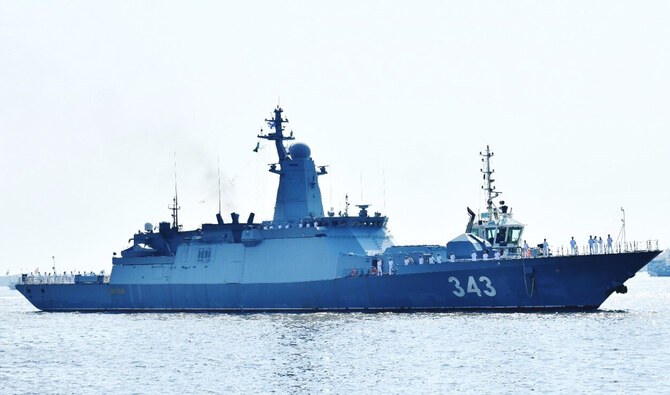
Russian naval ships visit Pakistan’s Karachi port to conduct joint exercises

In this handout photograph released by Pakistan Navy on March 16, 2025, Russian Navy frigate RFS REZKIY arrives at Karachi port in Karachi, Pakistan. (Photo courtesy: Pakistan Navy via APP)
Short Url
Updated 16 March 2025
Follow

Russian naval ships visit Pakistan’s Karachi port to conduct joint exercises

  • Pakistan and Russia, once Cold War rivals, have strengthened ties in recent years through increased cooperation in various sectors
  • The visit of the Russian flotilla marks a ‘significant milestone’ in maritime diplomacy and defense cooperation, Pakistan Navy says

KARACHI: A Russian navy flotilla has arrived in the southern Pakistani port city of Karachi to conduct joint exercises with Pakistan Navy, the Directorate General Public Relations (DGPR) of Pakistan Navy said.
Pakistan and Russia, once Cold War rivals, have strengthened their relations in recent years through increased dialogue as well as trade, energy and defense cooperation.
Regular port visits and joint exercises between Pakistan Navy and Russian Navy continue to strengthen bilateral ties, deepen naval collaboration, and foster mutual trust.
Upon arrival in Karachi, the Russian warships were accorded a warm welcome by officials of the Pakistan Navy and the Russian consulate, according to the DGPR.
“During the port call, the crew of the visiting ships will engage in professional discussions with Pakistan Navy personnel,” the DGPR said in a statement.
“Russian and Pakistani naval ships will conduct joint exercises aimed at enhancing interoperability and maritime cooperation.”
The Russian flotilla comprising RFS REZKIY and RFS ALDAR TSYDENZHAPOV frigates and medium-sized sea tanker RFS PECHENGA will be in Pakistan till March 18, according to the DGPR.
“The visit of Russian Flotilla marks a significant milestone in maritime diplomacy, reinforcing security and defense cooperation between the two nations,” it said.
Pakistan Navy regularly collaborates and holds joint military exercises with allies and friendly nations to increase synergy, promote regional peace and stability and deter piracy, drug trafficking and other illicit maritime activities.


Pakistan reviews austerity measures amid Middle East crisis, urges strict nationwide implementation

Updated 11 March 2026
Follow

Pakistan reviews austerity measures amid Middle East crisis, urges strict nationwide implementation

  • Deputy Prime Minister Ishaq Dar chairs review meeting of austerity steps
  • Officials briefed on salary cuts, school closures, four‑day week, petrol conservation

ISLAMABAD: Pakistan’s government on Wednesday assessed progress on a sweeping set of austerity measures introduced to mitigate the country’s economic strain from sharply rising global oil prices and supply disruptions linked to the ongoing war in the Middle East.

Prime Minister Shehbaz Sharif this week announced a series of austerity steps, including a four‑day work week for government offices, requiring 50  percent of staff to work from home, cutting fuel allowances for official vehicles by half, grounding up to 60  percent of the government fleet and closing all schools for two weeks to conserve fuel amid the global oil crisis.

The measures were unveiled in response to global oil market volatility triggered by the conflict involving the United States, Israel and Iran, which has disrupted supply routes such as the Strait of Hormuz and pushed crude prices sharply higher, straining Pakistan’s heavily import‑dependent energy sector.

“The meeting stressed the importance of strict and transparent adherence to the austerity measures, promoting fiscal responsibility and prudent use of public resources,” Deputy Prime Minister and Foreign Minister Senator Mohammad Ishaq Dar said in a statement.

He was chairing a meeting of the Committee for Monitoring and Implementation of Conservation and Additional Austerity Measures, constituted under the directions of the PM, bringing together federal and provincial officials to review execution of the broad cost‑cutting plan. 

Dar emphasized the government’s commitment to enforcing the PM’s austerity steps nationwide. The committee’s review also covered reductions in departmental expenditure, deductions from salaries of senior officials earning over Rs. 300,000 ($1,120), and coordination with provincial administrations to ensure uniform implementation of the plan.

Participants at the meeting reiterated that all ministries and divisions must continue strict monitoring and reporting, with transparent oversight mechanisms, as Pakistan navigates the economic pressures from the prolonged Middle East crisis and its fallout on global energy and trade markets.