

Canada’s incoming prime minister says he’ll meet Trump if Canadian sovereignty is respected

Canadian Prime Minister designate Mark Carney, third left, speaks to steel workers after touring the ArcelorMittal Dofasco steel plant in Hamilton, Ont., on March 12, 2025. (The Canadian Press via AP)
Short Url
Updated 13 March 2025
Follow

Canada’s incoming prime minister says he’ll meet Trump if Canadian sovereignty is respected

TORONTO: Canada’s incoming Prime Minister Mark Carney said Wednesday he’s ready to meet with US President Donald Trump if he respects Canadian sovereignty and is open to talk about a common approach to trade.
Trump has declared a trade war on his northern neighbor and continues to call for Canada to become the 51st state, a position that has infuriated Canadians. Trump has threatened economic coercion in his annexation threats and suggested Tuesday the border is a fictional line.
“I am ready to sit down with President Trump at the appropriate time under a position where there is respect for Canadian sovereignty and we are working for a common approach, a much more comprehensive approach for trade,” Carney said.
Carney, who will be sworn in Friday, spoke to reporters at a steel factory in Hamilton, Ontario after Trump officially increased tariffs on all steel and aluminum imports to 25 percent. Canada is the largest foreign supplier of steel and aluminum to the US
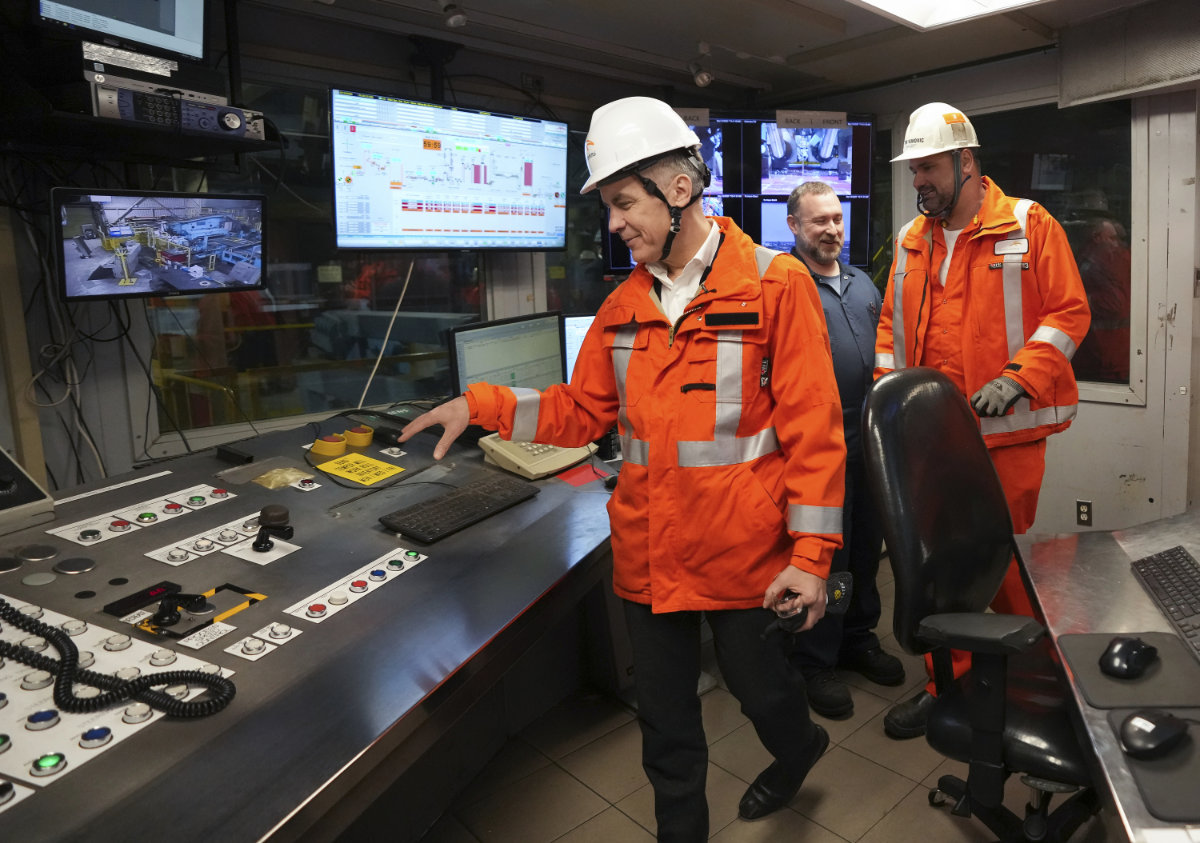


Canadian Prime Minister designate Mark Carney, left, tours the ArcelorMittal Dofasco steel plant in Hamilton, Ontario, on March 12, 2025. (Nathan Denette/The Canadian Press via AP)

A senior official, who spoke on condition of anonymity as they were not authorized to speak publicly on the matter, confirmed Carney and his new Cabinet will be sworn in Friday.
Carney said workers in both countries will be better off when “the greatest economic and security partnership in the world is renewed, relaunched. That is possible.”
He added he respects Trump’s concerns for American workers and about fentanyl.
“Today is a difficult day for Canada and the industry because of these unjustified tariffs that have been put on,” Carney said.
Canada responded with its own countermeasures. It plans to impose retaliatory tariffs of 29.8 billion Canadian dollars ($20.7 billion) starting Thursday in response to the US taxes on the metals. Canada’s new tariffs would be on steel and aluminum products, as well as US goods including computers, sports equipment and water heaters worth CA$14.2 billion ($9.9 billion).
“We don’t want to do this because we believe in open borders and free and fair trade but we are doing this in response,” Carney said.
Canada’s new tariffs are in addition to its 25 percent counter tariffs on CA$30 billion ($20.8 billion) of imports from the US that were put in place on March 4 in response to other Trump import taxes that he partially delayed by a month.
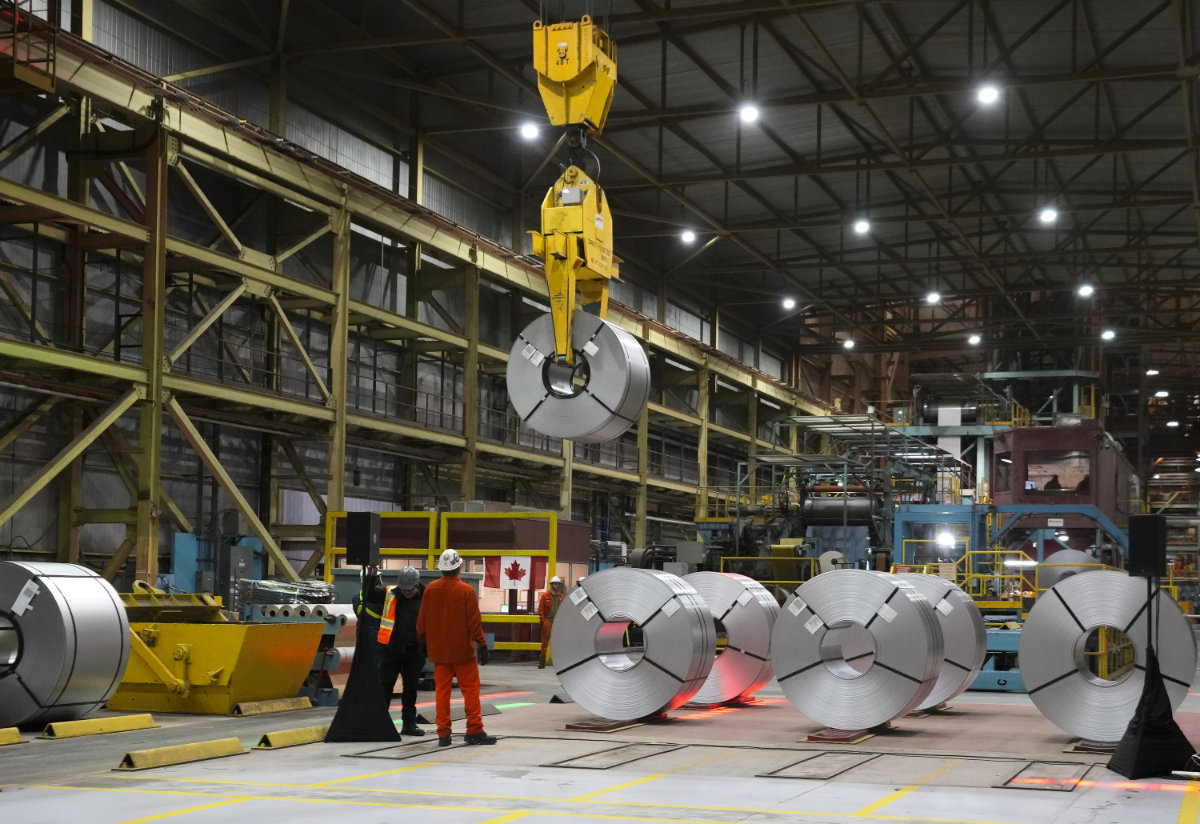


A view of the ArcelorMittal Dofasco steel plant in Hamilton, Ontario, Canada, on March 12, 2025. (The Canadian Press via AP)

Canadian Foreign Minister Mélanie Joly said Wednesday this is now the second round of unjustified tariffs leveled against Canada.
“The excuse for the first round was exaggerated claims about our border. We addressed all the concerns raised by the US,” Joly said.
“The latest excuse is national security despite the fact that Canada’s steel and aluminum adds to America’s security. All the while there is a threat of further and broader tariffs on April 2 still looming.”
Joly said the excuses for those tariffs shift every day.
“The only constant in this unjustifiable trade war seems to be President Trump’s talk of annexing our country through economic coercion. Yesterday he called our a border a fictional line and repeated his disrespectful 51st state rhetoric,” Joly said.
The US president has given a variety of explanations for his antagonism of Canada. He has said that his separate 25 percent tariffs on all imports from Canada, some of which have been suspended for a month, are about fentanyl smuggling and objections to Canada putting high taxes on dairy imports that penalize US farmers. He also continued to call for Canada to become part of the United States.
“Mr. Carney is a serious person, a serious man, and he’ll engage only if there are serious talks,” Joly said.


Geoeconomic confrontation tops global risks in 2026: WEF report

Updated 4 sec ago
Follow

Geoeconomic confrontation tops global risks in 2026: WEF report

  • Also armed conflict, extreme climate, public polarization, AI
  • None ‘a foregone conclusion,’ says WEF’s MD Saadia Zahidi

DUBAI: Geoeconomic confrontation has emerged as the top global risk this year, followed by state-based armed conflict, according to a new World Economic Forum report.

The Global Risks Report 2026, released on Wednesday, found that both risks climbed eight places year-on-year, underscoring a sharp deterioration in the global outlook amid increased international competition.

The top five risks are geoeconomic confrontation (18 percent of respondents), state-based armed conflict (14 percent), extreme weather events (8 percent), societal polarization (7 percent) and misinformation and disinformation (7 percent).

The WEF’s Managing Director Saadia Zahidi said the report “offers an early warning system as the age of competition compounds global risks — from geoeconomic confrontation to unchecked technology to rising debt — and changes our collective capacity to address them.

“But none of these risks are a foregone conclusion.”

The report assesses risks across three timeframes: immediate (2026); short-to-medium term (next two years); and long term (next 10 years).

Economic risks show the largest overall increase in the two-year outlook, with both economic downturn and inflation jumping eight positions.

Misinformation and disinformation rank fifth this year but rise to second place in the two-year outlook and fourth over the 10-year horizon.

The report suggests this reflects growing anxiety around the rapid adoption of artificial intelligence, with adverse outcomes linked to AI surging from 30th place in the two-year timeframe to fifth in the 10-year outlook.

Uncertainty dominates the global risk outlook, according to the report.

Surveyed leaders and experts view both the short- and long-term outlook negatively, with 50 percent expecting a turbulent or stormy global environment over the next two years, rising to 57 percent over the next decade.

A further 40 percent and 32 percent, respectively, describe the outlook as unsettled across the two- and 10-year timeframes, while just 1 percent anticipate a calm global outlook in either period.

Environmental risks ease slightly in the short-term rankings. Extreme weather fell from second to fourth place and pollution from sixth to ninth. Meanwhile, critical changes to Earth systems and biodiversity loss dropped seven and five positions, respectively.

However, over the next decade, environmental threats re-emerge as the most severe, with extreme weather, biodiversity loss, and critical changes to Earth systems topping the global risk rankings.

Looking ahead over the next decade, around 75 percent of respondents anticipate a turbulent or stormy environmental outlook, making it the most pessimistic assessment across all risk categories.

Zahidi said that “the challenges highlighted in the report underscore both the scale of the potential perils we face and our shared responsibility to shape what comes next.”

Despite the gloomy outlook, Zahidi signaled a positive shift in global cooperation.

 “It is also clear that new forms of global cooperation are already unfolding even amid competition, and the global economy is demonstrating resilience in the face of uncertainty.”

Now in its 21st year, the Global Risks Report highlights a core message: global risks cannot be managed without cooperation.

As competition intensifies, rebuilding trust and new forms of collaboration will be critical, with the report stressing that today’s decisions will shape future outcomes.

The report was released ahead of WEF’s annual meeting, which will be held in Davos from Jan. 19 to 23.