Trudeau slams Trump for starting a trade war with Canada while appeasing Putin

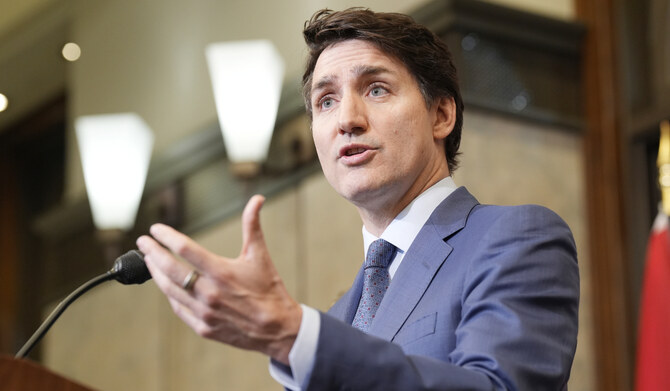
Prime Minister Justin Trudeau holds a news conference on imposed U.S. tariffs in Ottawa on Tuesday, March 4, 2025. (AP)
Short Url
Updated 05 March 2025
Follow

Trudeau slams Trump for starting a trade war with Canada while appeasing Putin

  • “I want to speak directly to one specific American, Donald,” Trudeau said
  • Trump has threatened Canada’s sovereignty, provoking anger in the country

TORONTO: Canadian Prime Minister Justin Trudeau on Tuesday called American tariffs “very dumb” and said that US President Donald Trump is appeasing Russia while launching a trade war against Canada.
In a blunt news conference during his final days in office, Trudeau said that Canada would plaster retaliatory tariffs on more than $100 billion of American goods in response to Trump’s 25 percent tariffs.
“Today the United States launched a trade war against Canada, their closest partner and ally, their closest friend. At the same, they are talking about working positively with Russia, appeasing Vladimir Putin, a lying, murderous dictator. Make that make sense,” a visibly angry Trudeau said.
Trump imposed tariffs against Washington’s three biggest trading partners, drawing immediate retaliation from Mexico, Canada and China and sending financial markets into a tailspin. Just after midnight, Trump put 25 percent taxes, or tariffs, on Mexican and Canadian imports, though he limited the levy to 10 percent on Canadian energy.
“What he wants to see is a total collapse of the Canadian economy because that will make it easier to annex us,” Trudeau said. “That is never going to happen. We will never be the 51st state.”
Trudeau addressed Trump directly by his first name.
“I want to speak directly to one specific American, Donald,” Trudeau said. “It’s not in my habit to agree with the Wall Street Journal, but Donald, they point out that even though you’re a very smart guy, this is a very dumb thing to do.”
Later Tuesday, US Commerce Secretary Howard Lutnick said the US would likely meet Canada and Mexico “in the middle,” with an announcement coming as soon as Wednesday.
Lutnick told Fox Business News that the tariffs would not be paused, but that Trump would reach a compromise.
“I think he’s going to figure out, you do more, and I’ll meet you in the middle in some way,” Lutnick said.
In a post on Truth Social earlier Tuesday, Trump said: “Please explain to Governor Trudeau, of Canada, that when he puts on a Retaliatory Tariff on the US, our Reciprocal Tariff will immediately increase by a like amount!”
Trump has threatened Canada’s sovereignty, provoking anger in the country. Canadian hockey fans have been booing the American national anthem at recent NHL and NBA games. Trudeau channeled the betrayal that many Canadians are feeling.
“Canadians are hurt. Canadians are angry. We are going to choose to not go on vacation in Florida,” Trudeau said. “We are going to choose to try and buy Canadian products ... and yeah we’re probably going to keep booing the American anthem.”
The premier of Ontario, Canada’s most populous province, said that he would issue a 25 percent export tax on electricity sold to the US and may later cut it off completely if the American tariffs persist. Ontario powered 1.5 million homes in the US in 2023 in Michigan, New York and Minnesota.
Ontario Premier Doug Ford also told The Associated Press that he would stop the sale of nickel and rare minerals to the US
Ontario and other provinces already began removing American liquor brands from government store shelves. The Liquor Control Board of Ontario sells nearly $1 billion Canadian dollars ($687 million) worth of American wine, beer, spirits and seltzers every year.


Japan prepares to restart world’s biggest nuclear plant, 15 years after Fukushima

Updated 7 sec ago
Follow

Japan prepares to restart world’s biggest nuclear plant, 15 years after Fukushima

NIIGATA: Japan took the final step to allow the world’s largest nuclear power plant to ​resume operations with a regional vote on Monday, a watershed moment in the country’s return to nuclear energy nearly 15 years after the Fukushima disaster. Kashiwazaki-Kariwa, located about 220 km (136 miles) northwest of Tokyo, was among 54 reactors shut after the 2011 earthquake and tsunami crippled the Fukushima Daiichi plant in the worst nuclear disaster since Chernobyl.
Since then, Japan has restarted 14 of the 33 that remain operable, as it tries to wean itself off imported fossil fuels. Kashiwazaki-Kariwa will be the first operated by Tokyo Electric Power Co. (TEPCO), which ran the doomed Fukushima plant. On Monday, Niigata prefecture’s assembly passed a vote of confidence on Niigata Governor Hideyo Hanazumi, who backed the restart last month, effectively allowing for the plant to begin operations again.
“This is a milestone, but this is not the end,” Hanazumi told reporters after the vote. “There is no end in terms of ensuring the safety of Niigata residents.”
While lawmakers voted in support of Hanazumi, the assembly session, the ‌last for the year, ‌exposed the community’s divisions over the restart, despite new jobs and potentially lower electricity bills.
“This is nothing ‌other ⁠than ​a political settlement ‌that does not take into account the will of the Niigata residents,” an assembly member opposed to the restart told fellow lawmakers as the vote was about to begin.
Outside, around 300 protesters stood in the cold holding banners reading ‘No Nukes’, ‘We oppose the restart of Kashiwazaki-Kariwa’ and ‘Support Fukushima’. “I am truly angry from the bottom of my heart,” Kenichiro Ishiyama, a 77-year-old protester from Niigata city, told Reuters after the vote. “If something was to happen at the plant, we would be the ones to suffer the consequences.”
TEPCO is considering reactivating the first of seven reactors at the plant on January 20, public broadcaster NHK reported.
Kashiwazaki-Kariwa’s total capacity is 8.2 GW, enough to power a few million homes. The pending restart would bring one 1.36 GW unit online next year and start another one with the same capacity around 2030.
“We remain firmly committed to never ⁠repeating such an accident and ensuring Niigata residents never experience anything similar,” said TEPCO spokesperson Masakatsu Takata. Takata declined to comment on timing. TEPCO shares closed up 2 percent in afternoon trade in Tokyo, higher than the wider ‌Nikkei index, which was up 1.8 percent.

RELUCTANT RESIDENTS WARY OF RESTART
TEPCO earlier this year pledged to ‍inject 100 billion yen ($641 million) into the prefecture over the next ‍10 years as it sought to win the support of Niigata residents.
But a survey published by the prefecture in October found 60 percent of residents did ‍not think conditions for the restart had been met. Nearly 70 percent were worried about TEPCO operating the plant.
Ayako Oga, 52, settled in Niigata after fleeing the area around the Fukushima plant in 2011 with 160,000 other evacuees. Her old home was inside the 20 km irradiated exclusion zone.
The farmer and anti-nuclear activist has joined the Niigata protests.
“We know firsthand the risk of a nuclear accident and cannot dismiss it,” said Oga, adding that she still struggles with post-traumatic stress-like symptoms from what happened at Fukushima.
Even Niigata Governor Hanazumi ​hopes that Japan will eventually be able to reduce its reliance on nuclear power. “I want to see an era where we don’t have to rely on energy sources that cause anxiety,” he said last month.

STRENGTHENING ENERGY SECURITY
The Monday vote was seen as the ⁠final hurdle before TEPCO restarts the first reactor, which alone could boost electricity supply to the Tokyo area by 2 percent, Japan’s trade ministry has estimated. Prime Minister Sanae Takaichi, who took office two months ago, has backed nuclear restarts to strengthen energy security and to counter the cost of imported fossil fuels, which account for 60 percent to 70 percent of Japan’s electricity generation.
Japan spent 10.7 trillion yen ($68 billion) last year on imported liquefied natural gas and coal, a tenth of its total import costs.
Despite its shrinking population, Japan expects energy demand to rise over the coming decade due to a boom in power-hungry AI data centers. To meet those needs, and its decarbonization commitments, it has set a target of doubling the share of nuclear power in its electricity mix to 20 percent by 2040.
Joshua Ngu, vice chairman for Asia Pacific at consultancy Wood Mackenzie, said public acceptance of the restart of Kashiwazaki-Kariwa would represent “a critical milestone” toward reaching those goals. In July, Kansai Electric Power, Japan’s top nuclear power operator, said it would begin conducting surveys for a reactor in western Japan, the first new unit since the Fukushima disaster.
But for Oga, who was in the crowd outside the assembly on Monday chanting ‘Never forget Fukushima’s lessons!’, the nuclear revival is a terrifying reminder of the potential risks. “At the time (2011), I never thought that TEPCO would operate a nuclear power ‌plant again,” she said.
“As a victim of the Fukushima nuclear accident, I wish that no one, whether in Japan or anywhere in the world, ever again suffers the damage of a nuclear accident.”