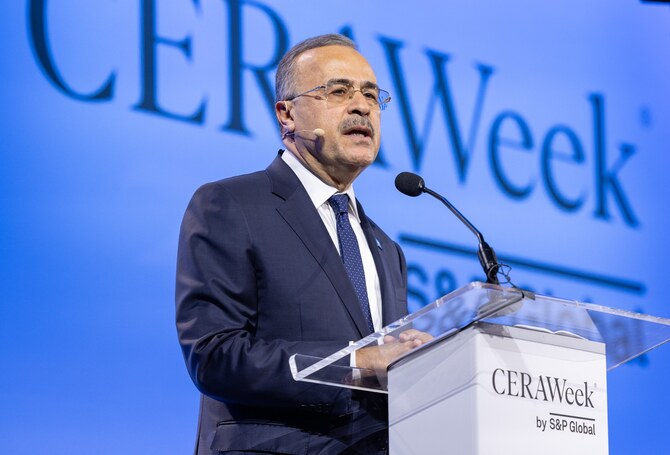
Aramco’s CEO calls for new global energy model during CERAWeek address

Short Url
Updated 11 March 2025
Follow

Aramco’s CEO calls for new global energy model during CERAWeek address

  • ‘Investments in all sources is needed,’ says Amin Nasser 

DHAHRAN: Aramco’s president and CEO has called for a fundamental shift in global energy transition planning, warning that the current approach risks severe economic and energy security consequences.

The planning of global energy transitioning needs a fundamental shift as the current approach is a severe economic risk, said Amin Nasser.

Delivering a keynote speech at CERAWeek 2025 in Houston on Monday, Nasser stressed the urgent need for a new global energy model that balanced sustainability, security, and affordability.

He pointed to annual funding needs of up to $8 trillion that would be required for global climate action and cautioned that neglecting conventional energy sources in the transition process could lead to dire outcomes, describing it as a “fast track to dystopia.”

Criticizing the belief that traditional energy sources could be rapidly phased out, Nasser said: “The greatest transition fiction was that conventional energy could be almost entirely replaced, virtually overnight. Hydrocarbons still provide over 80 percent of primary energy in the US, almost 90 percent in China, and even in the EU it is more than 70 percent.”

He added: “New sources add to the energy mix and complement existing sources; they do not replace them. New sources cannot even meet the growth in demand, while the proven sources needed to fill the gap are demonized and discarded. It is a fast track to dystopia, not utopia.”

Nasser also stressed that a new global energy model was essential to meet rising energy demand.

He said: “First, all sources must play a growing role in meeting rising energy demand in a balanced, integrated manner. Certainly, that includes new and alternative energy sources but they will complement conventional energy, not replace it in any meaningful way.

“So, we need investments in all sources. And to further free up such investments globally, we need extensive deregulation and greater incentives for financial institutions to provide unbiased financing. Second, the model must genuinely serve the needs of developed and developing nations alike, as originally promised, especially when it comes to technology. Third, and crucially, this has to be about delivering real results.”

Addressing the importance of reducing emissions, Nasser added that environmental concerns should remain at the forefront but must be approached pragmatically.

He said: “Let me be absolutely clear: This does not mean stepping back from our global climate ambitions. Reducing greenhouse gas emissions must still get the highest possible priority.

“That means prioritizing technologies that drive efficiency, lower energy use, and further reduce greenhouse gas emissions from conventional energy — and AI (artificial intelligence) will clearly be a game-changing enabler. But the future of energy is not only about sustainability; security and affordability must share the stage, with all energy sources working in harmony as one team, delivering real results.”

CERAWeek is one of the world’s most influential energy conferences, bringing together industry leaders, government officials, policymakers, and CEOs to discuss critical issues such as energy security, supply, climate, technology, and sustainability.

More than 10,000 participants from over 2,000 companies and 80 countries are attending this year’s event, which features over 1,400 expert speakers.


Saudi investment pipeline active as reforms advance, says Pakistan minister

Updated 7 sec ago
Follow

Saudi investment pipeline active as reforms advance, says Pakistan minister

ALULA: Pakistan’s Finance Minister Mohammed Aurangzeb described Saudi Arabia as a “longstanding partner” and emphasized the importance of sustainable, mutually beneficial cooperation, particularly in key economic sectors.

Speaking to Arab News on the sidelines of the AlUla Conference for Emerging Market Economies, Aurangzeb said the relationship between Pakistan and Saudi Arabia remains resilient despite global geopolitical tensions.

“The Kingdom has been a longstanding partner of Pakistan for the longest time, and we are very grateful for how we have been supported through thick and thin, through rough patches and, even now that we have achieved macroeconomic stability, I think we are now well positioned for growth.”

Aurangzeb said the partnership has facilitated investment across several sectors, including minerals and mining, information technology, agriculture, and tourism. He cited an active pipeline of Saudi investments, including Wafi’s entry into Pakistan’s downstream oil and gas sector.

“The Kingdom has been very public about their appetite for the country, and the sectors are minerals and mining, IT, agriculture, tourism; and there are already investments which have come in. For example, Wafi came in (in terms of downstream oil and gas stations). There’s a very active pipeline.”

He said private sector activity is driving growth in these areas, while government-to-government cooperation is focused mainly on infrastructure development.

Acknowledging longstanding investor concerns related to bureaucracy and delays, Aurangzeb said Pakistan has made progress over the past two years through structural reforms and fiscal discipline, alongside efforts to improve the business environment.

“The last two years we have worked very hard in terms of structural reforms, in terms of what I call getting the basic hygiene right, in terms of the fiscal situation, the current economic situation (…) in terms of all those areas of getting the basic hygiene in a good place.”

Aurangzeb highlighted mining and refining as key areas of engagement, including discussions around the Reko Diq project, while stressing that talks with Saudi investors extend beyond individual ventures.

“From my perspective, it’s not just about one mine, the discussions will continue with the Saudi investors on a number of these areas.”

He also pointed to growing cooperation in the IT sector, particularly in artificial intelligence, noting that several Pakistani tech firms are already in discussions with Saudi counterparts or have established offices in the Kingdom.

Referring to recent talks with Saudi Minister of Economy and Planning Faisal Alibrahim, Aurangzeb said Pakistan’s large freelance workforce presents opportunities for deeper collaboration, provided skills development keeps pace with demand.

“I was just with (Saudi) minister of economy and planning, and he was specifically referring to the Pakistani tech talent, and he is absolutely right. We have the third-largest freelancer population in the world, and what we need to do is to ensure that we upscale, rescale, upgrade them.”

Aurangzeb also cited opportunities to benefit from Saudi Arabia’s experience in the energy sector and noted continued cooperation in defense production.

Looking ahead, he said Pakistan aims to recalibrate its relationship with Saudi Arabia toward trade and investment rather than reliance on aid.

“Our prime minister has been very clear that we want to move this entire discussion as we go forward from aid and support to trade and investment.”