


RIYADH: While the falcon and camel are the creatures most associated with Arabia’s skies and deserts, cats have long captivated the hearts of the people, historically and religiously.
In his new novel, “City of Cats,” Rafael Hernandez de Santiago sets his narrative in Jeddah, Saudi Arabia, exploring where the past and future collide during urban transformation.
“City of Cats” follows Amir, an architect torn between the love he has for his city’s heritage and the push toward modernization. He and his allies face resistance from powerful, money-hungry developers as they propose a cultural park to protect one of Jeddah’s historic districts.
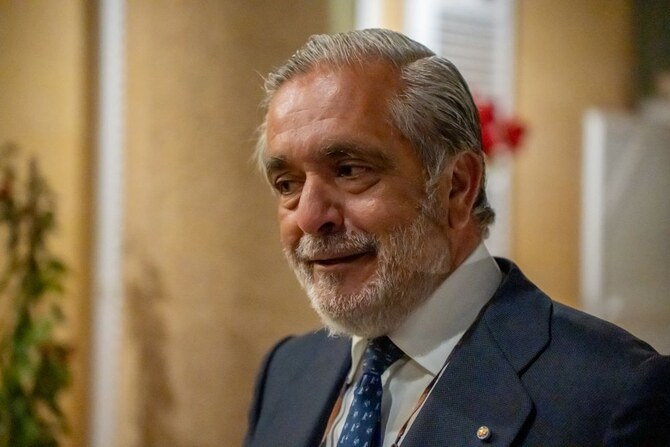
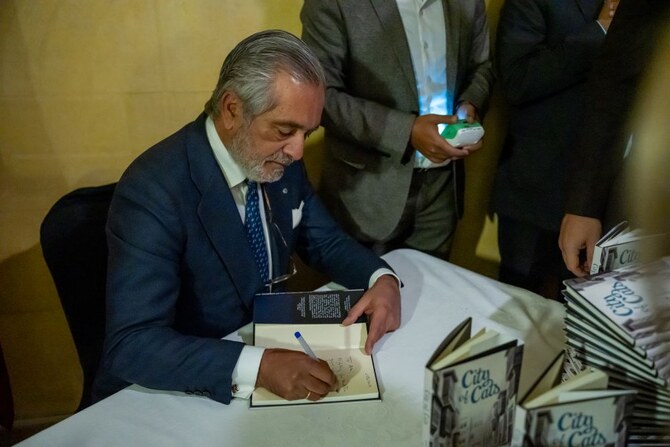
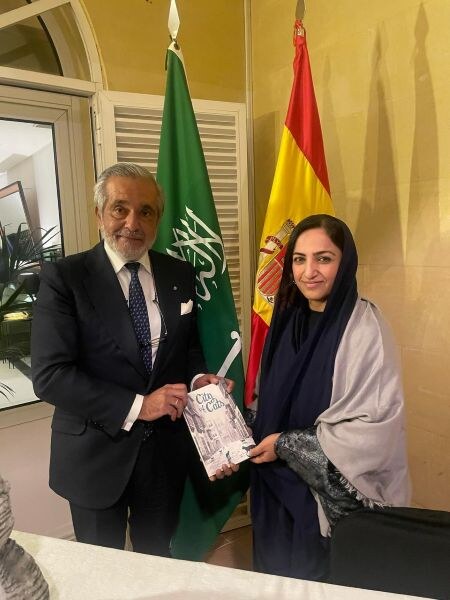
Hernandez draws the comparison that cats represent the soul of a city. Speaking to Arab News at his book launch hosted at the Spanish Embassy on Tuesday, he said: “The cats of Jeddah serve as a metaphor for the city’s enduring spirit, quietly witnessing and adapting to its ever-changing landscape.”
The novel delves into themes of preservation versus progress, communal unity, and resilience of tradition in the face of relentless modernization.
Hernandez is a director and senior researcher at the Gulf Research Center and a prominent newspaper columnist who regularly writes on matters relating to politics, international relations, and data and AI.
Of his reasons for delving into the world of fiction writing, Hernandez said, contrary to the straight edge of fact and policy analysis that his columns require, fiction allows for a more interactive curiosity on complex issues and more emotional engagement.
“Instead of debating urban development and cultural preservation through articles, I wanted readers to feel the impact of these changes through the eyes of characters living through them.”
The Spanish citizen, who has lived in Saudi Arabia for almost 25 years, said that from the ancient Nabatean city of AlUla to the rise of modern metropolises such as Riyadh, the Kingdom balances rich traditions and heritage stories with an ambitious vision for the future, making it a compelling setting for a novel.
“My time here has given me a deep appreciation for its history, traditions, and the unique identity of its cities.
“The experience of witnessing Jeddah’s evolution firsthand played a significant role in shaping the story of ‘City of Cats,’” he said.
Hernandez said that Jeddah is a city where history and modernity coexist side by side. Al-Balad, its historic district, carries stories of merchants, travelers, and families through the generations, who give it a distinct identity. Yet it is constantly evolving, with new skyscrapers and developments.
“While Spain has its own rich history and cities undergoing similar transformations, Jeddah’s story feels particularly urgent. It’s a city at a crossroads, and I wanted to capture that moment.”
Hernandez spoke about how Jeddah acting as Makkah’s gateway gives it a unique character. And that characteristic furnishings, from coral stone houses to intricate mashrabiya windows, reflect the story of the Red Sea and its maritime trade routes.
Contrary to Jeddah’s openness and free-flowing nature, Riyadh’s soul mirrors that of a wise and progressive leader who still stands strong in his structure and heritage, according to Hernandez.
“Like the stray cats that roam both cities, their souls are defined by their ability to survive, adapt, and persist despite the changes around them,” he said.
“City of Cats” is available in English, with Arabic and Spanish translations expected to follow.
Hernandez hopes to turn the novel into a musical one day, as the arts and entertainment scene in the Kingdom rapidly grows.
“The story lends itself beautifully to the format … Musicals are a celebration of storytelling, culture, and emotion — and Saudi Arabia is overflowing with stories and traditions waiting to be expressed in new, creative ways.”
He said that if Saudi Arabia were to start producing musicals, it would open the door for local talent; composers, lyricists, set designers, and actors who are eager to share their creativity with the world.