

Lucid CEO steps down, company expects to more than double vehicle production this year

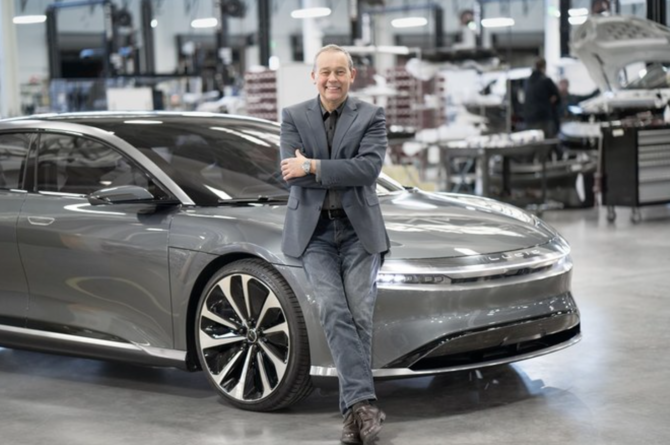
Peter Rawlinson has stepped down as Lucid CEO. File
Short Url
Updated 26 February 2025
Follow

Lucid CEO steps down, company expects to more than double vehicle production this year

BENGALURU: Electric vehicle maker Lucid Group said on Tuesday that Peter Rawlinson, its CEO for over 5 years, is stepping down from the role, and forecast its vehicle production will more than double this year, sending the company’s shares up 10 percent in extended trading.

Through his 12-year tenure as part of the top brass at Lucid, Rawlinson helped launch the company’s Air models and guided it through its public offering.

The company’s operating chief, Marc Winterhoff, will take the position of interim CEO.

Saudi Arabia’s Public Investment Fund is the majority shareholder in Lucid Group via Ayar Third Investment Co., and in October it invested an additional $1.5 billion into the EV producer.

“Now that we have successfully launched the Lucid Gravity, I have decided it is finally the right time for me to step aside from my roles at Lucid,” Rawlinson said.

The firm also forecast vehicle production this year to be around 20,000, compared with around 9,000 cars it made in 2024.

Andres Sheppard, senior equity analyst at Cantor Fitzgerald, said the CEO transition is “surprising” but not unexpected given the company’s previous underperformances, adding that the production forecast is “encouraging.”

The company hired veteran finance professional Taoufiq Boussaid as its chief financial officer last month. Boussaid previously helped reduce debt load for his former company.

As the EV demand in the US remains uncertain, Lucid has been trying to diversify its product lineup and step into the SUV market with the Gravity model, going toe-to-toe with Tesla’s model X and Rivian’s R1S vehicles.

The success of the Gravity SUV is seen as crucial to Lucid’s long-term outlook, as it burns through cash ramping up production while its Air sedans have seen price cuts due to slower demand.

“They (Lucid) still have an amazing product. Now it’s just a matter of can they turn the company around, can they increase demand and production with the Gravity, and really that’s going to bridge the gap to their mid-size vehicle in 2026,” Sheppard said.

The company continues to lose tens of thousands of dollars per vehicle, while rivals such as Rivian move aggressively to cut costs in a bid to make profits.

Lucid reported revenue of $234.5 million, beating Wall Street expectations of $214.2 million, according to data compiled by LSEG.

It posted a loss of $397.2 million in the quarter ended Dec. 31, compared with a loss of $653.8 million a year ago.

Demand for pure battery cars in the US has been slow as people gravitate more toward cheaper hybrids owing to high interest rates and economic uncertainty.


First EU–Saudi roundtable on critical raw materials reflects shared policy commitment

Updated 57 min 54 sec ago
Follow

First EU–Saudi roundtable on critical raw materials reflects shared policy commitment

RIYADH: The EU–Saudi Arabia Business and Investment Dialogue on Advancing Critical Raw Materials Value Chains, held in Riyadh as part of the Future Minerals Forum, brought together senior policymakers, industry leaders, and investors to advance strategic cooperation across critical raw materials value chains.

Organized under a Team Europe approach by the EU–GCC Cooperation on Green Transition Project, in coordination with the EU Delegation to Saudi Arabia, the European Chamber of Commerce in the Kingdom and in close cooperation with FMF, the dialogue provided a high-level platform to explore European actions under the EU Critical Raw Materials Act and ResourceEU alongside the Kingdom’s aspirations for minerals, industrial, and investment priorities.

This is in line with Saudi Vision 2030 and broader regional ambitions across the GCC, MENA, and Africa.

ResourceEU is the EU’s new strategic action plan, launched in late 2025, to secure a reliable supply of critical raw materials like lithium, rare earths, and cobalt, reducing dependency on single suppliers, such as China, by boosting domestic extraction, processing, recycling, stockpiling, and strategic partnerships with resource-rich nations.

The first ever EU–Saudi roundtable on critical raw materials was opened by the bloc’s Ambassador to the Kingdom, Christophe Farnaud, together with Saudi Deputy Minister for Mining Development Turki Al-Babtain, turning policy alignment into concrete cooperation.

Farnaud underlined the central role of international cooperation in the implementation of the EU’s critical raw materials policy framework.

“As the European Union advances the implementation of its Critical Raw Materials policy, international cooperation is indispensable to building secure, diversified, and sustainable value chains. Saudi Arabia is a key partner in this effort. This dialogue reflects our shared commitment to translate policy alignment into concrete business and investment cooperation that supports the green and digital transitions,” said the ambassador.

Discussions focused on strengthening resilient, diversified, and responsible CRM supply chains that are essential to the green and digital transitions.

Participants explored concrete opportunities for EU–Saudi cooperation across the full value chain, including exploration, mining, and processing and refining, as well as recycling, downstream manufacturing, and the mobilization of private investment and sustainable finance, underpinned by high environmental, social, and governance standards.

From the Saudi side, the dialogue was framed as a key contribution to the Kingdom’s industrial transformation and long-term economic diversification agenda under Vision 2030, with a strong focus on responsible resource development and global market integration.

“Developing globally competitive mineral hubs and sustainable value chains is a central pillar of Saudi Vision 2030 and the Kingdom’s industrial transformation. Our engagement with the European Union through this dialogue to strengthen upstream and downstream integration, attract high-quality investment, and advance responsible mining and processing. Enhanced cooperation with the EU, capitalizing on the demand dynamics of the EU Critical Raw Materials Act, will be key to delivering long-term value for both sides,” said Al-Babtain.

Valere Moutarlier, deputy director-general for European industry decarbonization, and directorate-general for the internal market, industry, entrepreneurship and SMEs at European Commission, said the EU Critical Raw Materials Act and ResourceEU provided a clear framework to strengthen Europe’s resilience while deepening its cooperation with international partners.

“Cooperation with Saudi Arabia is essential to advancing secure, sustainable, and diversified critical raw materials value chains. Dialogues such as this play a key role in translating policy ambitions into concrete industrial and investment cooperation,” she added.