At least 24 killed in separate road crashes in Pakistan

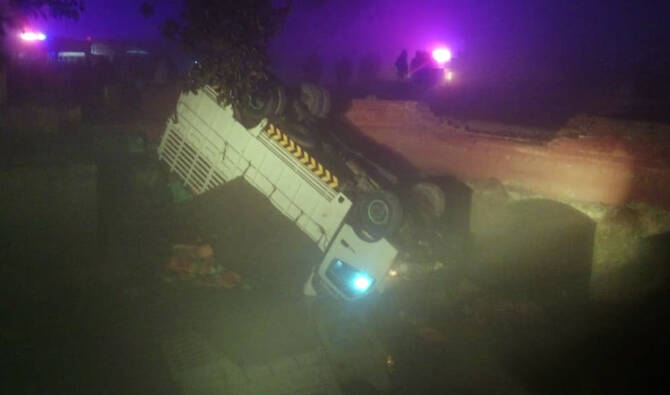
A truck lies overturned in the dry Ghalapur Bangla canal after an accident in Sargodha, Pakistan, on January 17, 2026. (Facebook/@VoiceOfSargodhaReal)
Short Url
Updated 17 January 2026
Follow

At least 24 killed in separate road crashes in Pakistan

  • A truck carrying passengers fell into a dry canal near Sargodha at a time of low visibility to fog, killing 14 people
  • 10 others, including a young girl, were killed after a passenger bus overturned in the southwestern Balochistan province

ISLAMABAD: At least 24 people were killed in two separate road crashes in Pakistan’s Punjab and Balochistan provinces, officials and state media reported on Saturday.

In the first incident, a truck carrying passengers fell into a dry canal near Sargodha at a time of low visibility on road due to fog, according to Rescue 1122 officials.

“At least fourteen people have died in the fog-related traffic accident,” the Radio Pakistan broadcaster reported.

Nine others sustained injuries in the crash.

Dense fog is a recurring hazard on Pakistan’s highways during the winter months, particularly across Punjab and parts of Sindh, where poor visibility often leads to serious road accidents.

But fog is not the only reason behind these crashes as some of the incidents have also resulted from speeding and reckless driving, poor awareness of traffic rules, overloading and weak enforcement of laws.

In the second incident, a passenger bus en route to Jiwani from Karachi overturned near Ormara in the Balochistan province, according to Edhi rescue service

“Ten people, including a young girl, have died as a result of overturning of the passenger coach,” said Faisal Edhi, who heads the Edhi rescue service. “An Edhi mobile morgue has been dispatched to transport the bodies to Karachi.”

Fatal road accidents are common in Pakistan, where traffic rules are rarely followed while such incidents are particularly common in Pakistan’s mountainous Balochistan province where single carriage roads connect various cities while local bus drivers usually avoid traffic rules and speed limit on national highways. 

On Friday, at least five people were killed in Pakistan’s southwestern Balochistan province after a vehicle transporting smuggled Iranian oil hit another vehicle coming from the opposite direction, a police official said. The collision occurred in the Washuk district that borders Iran.


Pakistan urges pilgrims to complete biometrics for Hajj visa as deadline expires today

Updated 4 sec ago
Follow

Pakistan urges pilgrims to complete biometrics for Hajj visa as deadline expires today

  • Pakistan says biometric verification to obtain Hajj visa from Saudi Arabia is mandatory 
  • Pilgrims can complete biometric verification from homes using the ‘Saudi Visa Bio’ app 

ISLAMABAD: Pakistan’s religious affairs ministry on Sunday urged aspiring pilgrims to complete biometric verification in line with Saudi Arabia’s Hajj visa requirements, cautioning that the deadline for the process expires today. 

The development takes place as preparations for the annual Islamic pilgrimage gather pace in Pakistan. The Ministry of Religious Affairs (MoRA) has said biometric verification is mandatory to obtain a Saudi Hajj visa. 

“Today is the last day to complete Saudi visa biometrics,” MoRA said. “Hajj pilgrims can complete their biometrics from home through the Saudi Visa Bio app.”

The ministry said that for the pilgrims’ convenience, Saudi Tasheer Centers will also remain open today from 9 am to 5 pm. 

The ministry urged aspiring pilgrims to keep a printed copy of the biometric confirmation email with them. 

Saudi Arabia has allocated Pakistan a quota of 179,210 pilgrims for Hajj 2026, with the majority of seats reserved under the government scheme and the remainder allocated to private tour operators.

Regulations for private Hajj operators have been tightened and their quota reduced following widespread complaints last year, when tens of thousands of pilgrims were unable to travel under the private Hajj scheme.