
Saudi foreign ministry welcomes second phase of Gaza peace plan, formation of transitional committee

1 / 2
Ali Shaath, head of the Palestinian technocratic committee for managing the Gaza Strip, arrives at a hotel in Cairo on January 16, 2026. (AFP)
2 / 2
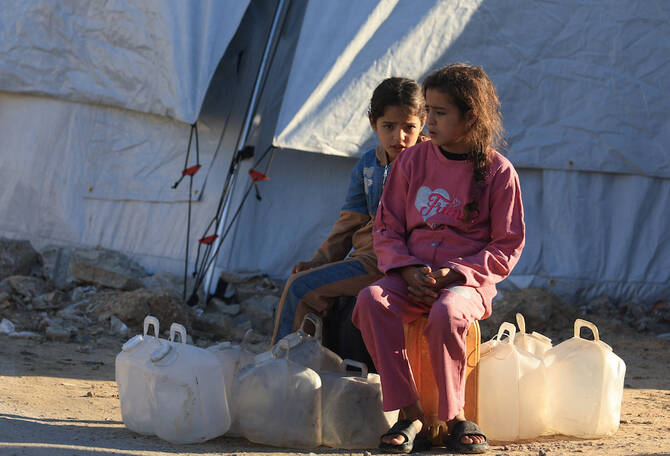
Displaced Palestinian children sit at a tent camp, after the United States said on Wednesday it is launching the second phase of its plan to end the Gaza war, in Gaza City, January 15, 2026. (Reuters)
Short Url
Updated 16 January 2026
Follow

Saudi foreign ministry welcomes second phase of Gaza peace plan, formation of transitional committee

  • Ministry also thanked US President Donald Trump for his leadership and efforts to end the war in Gaza

RIYADH: The Saudi Ministry of Foreign Affairs on Friday welcomed the announcement of the second phase of a comprehensive peace plan for Gaza, the Saudi Press Agency reported.

The ministry said it also welcomed the formation of the Palestinian National Committee for the Administration of the Gaza Strip as a temporary transitional body, established under UN Security Council Resolution 2803, which met in Cairo on Friday.

In a statement, the ministry also thanked US President Donald Trump, who declared the formation of the Gaza “board of peace,” for his leadership and efforts to end the war in Gaza.

It highlighted his commitment to the withdrawal of Israeli forces, the prevention of any annexation of parts of the West Bank, and efforts to advance sustainable peace in the region.

The ministry commended the role of mediators Qatar, Egypt and Turkiye, stressing the importance of international and regional cooperation in supporting the peace process.

It underlined the need to support the work of the temporary Palestinian National Committee in managing the daily affairs of Gaza’s residents, while preserving the institutional and geographical link between the West Bank and the Gaza Strip, ensuring Gaza’s unity and rejecting any attempts to divide it.

The statement also called for consolidating the ceasefire, halting violations, ensuring the unhindered delivery of humanitarian aid, and accelerating early recovery and reconstruction efforts across Gaza.

It said these steps were essential to enabling the Palestinian National Authority to resume its responsibilities in the Gaza Strip, leading to an end to the Israeli occupation of Palestinian territory in Gaza and the West Bank and the establishment of an independent Palestinian state in line with UN resolutions, the Arab Peace Initiative and the two-state solution.


Saudi Arabia launches initiative to reroute Gulf cargo to Red Sea ports

Updated 13 March 2026
Follow

Saudi Arabia launches initiative to reroute Gulf cargo to Red Sea ports

  • The initiative comes as shipping through the Strait of Hormuz has been severely disrupted by the widening conflict in the region
  • Since the US and Israel struck Iran last month, Tehran has moved to restrict passage through the waterway


RIYADH: Saudi Arabia has launched an initiative to redirect shipping from ports in the Arabian Gulf to its Red Sea ports amid the ongoing US-Israel-Iran war.

Transport Minister Saleh Al-Jasser, who also chairs the Saudi Ports Authority (Mawani), launched the Logistics Corridors Initiative alongside Zakat, Tax and Customs Authority Governor Suhail Abanmi, Mawani President Suliman Al-Mazroua, and other officials, the Saudi Press Agency reported.

The initiative will establish dedicated operational corridors to receive containers and cargo redirected from ports in the Kingdom's Eastern Region and other Gulf Cooperation Council states to Jeddah Islamic Port and other Red Sea coast ports.

Al-Jasser said the Kingdom was committed to ensuring supply-chain stability and the smooth flow of goods through global trade routes. Jeddah Islamic Port and other west coast ports, he added, were already playing a key role in accommodating shipments redirected from the east, while also linking Gulf cargo to regional and international markets.

The initiative comes as shipping through the Strait of Hormuz has been severely disrupted by the widening conflict in the region. Iran has long threatened to close the strait — the world's most critical oil and gas chokepoint, through which roughly a fifth of global oil supplies pass — in the event of a war.

Since the US and Israel struck Iran last month, Tehran has moved to restrict passage through the waterway, sending freight rates soaring and forcing shipping companies to seek alternative routes.

Saudi Arabia's Red Sea ports offer a viable bypass, connecting Gulf cargo to global markets without passing through the strait.