

EV maker Lucid becomes first global automotive manufacturing company to join ‘Made in Saudi’ program

1 / 4
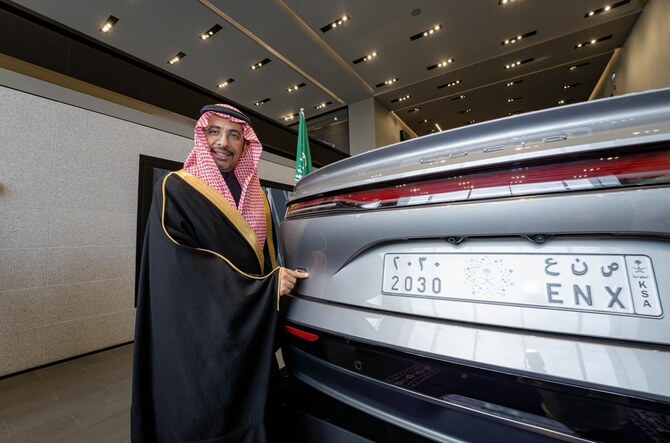
Lucid Motors joins ‘Made in Saudi’ program to boost the Saudi Arabia’s leadership in electric vehicle manufacturing. X/@BAlkhorayef
2 / 4
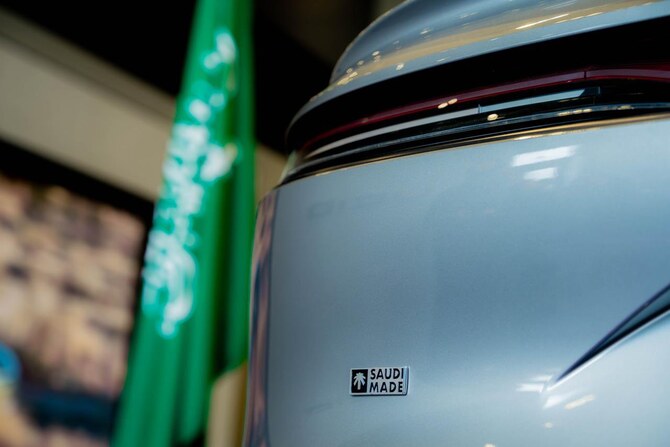
Lucid Motors joins ‘Made in Saudi’ program to boost the Saudi Arabia’s leadership in electric vehicle manufacturing. X/@BAlkhorayef
3 / 4
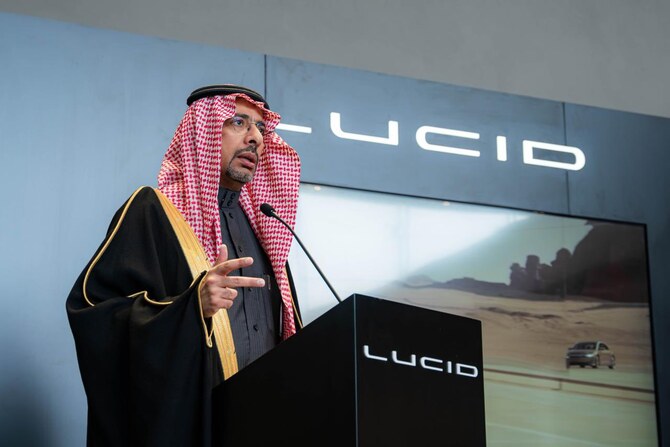
Lucid Motors joins ‘Made in Saudi’ program to boost the Saudi Arabia’s leadership in electric vehicle manufacturing. X/@BAlkhorayef
4 / 4
Lucid Motors joins ‘Made in Saudi’ program to boost the Saudi Arabia’s leadership in electric vehicle manufacturing. X/@BAlkhorayef
Short Url
Updated 03 April 2025
Follow

EV maker Lucid becomes first global automotive manufacturing company to join ‘Made in Saudi’ program

  • Aims to increase industrial sector’s contribution to GDP to at least 20% by 2025
  • Move seeks to attract additional investments, enhance non-oil exports, and create sustainable job opportunities

RIYADH: Electric vehicle manufacturer Lucid Motors has become the first global automotive company to join the Kingdom’s “Made in Saudi” program as the country continues strengthening its industrial capabilities. 

The milestone grants Lucid the right to use the “Saudi Made” label on its products, symbolizing the nation’s focus on quality and innovation. 

The strategy aims to increase the industrial sector’s contribution to the gross domestic product to at least 20 percent by 2025, tripling the current industrial base. 

It also seeks to attract additional investments, enhance non-oil exports, and create sustainable job opportunities, aligning with Vision 2030’s economic diversification goal.

“This is a step that represents a strong push to enhance the image of the national industry and attract investments and global companies, which consolidates the Kingdom’s position as a global center for innovative manufacturing,” Minister of Industry and Mineral Resources Bandar Alkhorayef said in a post on his X account. 

In a separate statement, the minister said that Lucid Motors’ inclusion in the program underscores Saudi Arabia’s strategic transformation toward creating a fully integrated electric vehicle manufacturing ecosystem. 

The minister added that this initiative aligns with the objectives of the National Industrial Strategy, which focuses on empowering promising sectors and attracting high-value investments in advanced industries.

Lucid’s participation in the program follows the launch of its first international manufacturing plant in Saudi Arabia in September 2023. 

Located in King Abdullah Economic City, the facility is the Kingdom’s first-ever car manufacturing plant and represents a key milestone in its efforts to build a domestic automotive industry. 

The facility can currently assemble 5,000 Lucid vehicles annually during its first phase. Once fully operational, the complete manufacturing plant, including the assembly line, is expected to produce up to 155,000 electric cars per year. 

Saudi Arabia is aggressively promoting the adoption of electric vehicles as part of its Vision 2030 strategy, which aims to achieve net-zero carbon emissions by 2060. 

A critical target of the initiative is for 30 percent of all vehicles in Riyadh to be electric by 2030, contributing to a broader goal of reducing emissions in the capital by 50 percent. 

To support the transition, the Public Investment Fund — a major backer of Lucid Motors — has been instrumental in establishing a domestic EV manufacturing sector. 

In addition to its stake in Lucid Motors, PIF has launched Ceer, the Kingdom’s first locally branded electric vehicle manufacturer, as part of its efforts to bolster the industry. 

Infrastructure development is also a core focus, with the Kingdom planning to deploy 5,000 fast chargers across Saudi Arabia by 2030 to facilitate the adoption of EVs. 

Consumer interest in EVs is steadily growing, with over 40 percent of Saudi consumers considering purchasing an electric vehicle within the next three years, according to a 2024 report by London-based professional services network PwC. 

Faisal Sultan, vice president and managing director for the Middle East at Lucid Motors, expressed the company’s pride in joining the program, saying: “We are delighted to join the ‘Made in Saudi’ program and have the honor of using the ‘Saudi Made’ label, which represents quality and excellence.”

He added: “We are committed to embodying the values of this national identity, such as sustainability, innovation, and excellence. With the increasing focus on electric vehicles in the Kingdom, we aim to deliver an advanced and unique experience to our customers.”

The minister said that Saudi Arabia has emerged as a central hub for electric vehicle production, supported by modern infrastructure, incentivizing policies, and a highly skilled workforce. 

He also said that major players like Lucid Motors strengthen the Kingdom’s position as a global center for future-focused industries while contributing to increased local content, non-oil exports, industrial localization, and knowledge transfer. 

Launched in March 2021, Saudi Arabia’s Made in Saudi program promotes domestic products and services, encouraging local consumption and boosting non-oil exports. 

The move aligns with Saudi Arabia’s broader industrial strategy, which aims to increase the sector’s gross domestic product contribution to 20 percent by 2025 and drive investments in advanced industries. 

It also supports Vision 2030’s goal of reducing the nation’s reliance on oil by fostering high-value sectors like electric vehicle manufacturing.


‘The future is renewables,’ Indian energy minister tells World Economic Forum

Updated 22 January 2026
Follow

‘The future is renewables,’ Indian energy minister tells World Economic Forum

  • ‘In India, I can very confidently say, affordability (of renewables) is better than fossil fuel energy,’ says Pralhad Venkatesh Joshi during panel discussion
  • Renewables are an increasingly important part of the energy mix and the technology is evolving rapidly, another expert says at session titled ‘Unstoppable March of Renewables?’

BEIRUT: “The future is renewables,” India’s minister of new and renewable energy told the World Economic Forum in Davos on Wednesday.
“In India, I can very confidently say, affordability (of renewables) is better than fossil fuel energy,” Pralhad Venkatesh Joshi said during a panel discussion titled “Unstoppable March of Renewables?”
The cost of solar power has has fallen steeply in recent years compared with fossil fuels, Joshi said, adding: “The unstoppable march of renewables is perfectly right, and the future is renewables.”
Indian authorities have launched a major initiative to install rooftop solar panels on 10 million homes, he said. As a result, people are not only saving money on their electricity bills, “they are also selling (electricity) and earning money.”
He said that this represents a “success story” in India in terms of affordability and “that is what we planned.”
He acknowledged that more work needs to be done to improve reliability and consistency of supplies, and plans were being made to address this, including improved storage.
The other panelists in the discussion, which was moderated by Godfrey Mutizwa, the chief editor of CNBC Africa, included Marco Arcelli, CEO of ACWA Power; Catherine MacGregor, CEO of electricity company ENGIE Group; and Pan Jian, co-chair of lithium-ion battery manufacturer Contemporary Amperex Technology.
Asked by the moderator whether she believes “renewables are unstoppable,” MacGregor said: “Yes. I think some of the numbers that we are now facing are just proof points in terms of their magnitude.
“In 2024, I think it was 600 gigawatts that were installed across the globe … in Europe, close to 50 percent of the energy was produced from renewables in 2024. That has tripled since 2004.”
Renewables are an increasingly important and prominent part of the energy mix, she added, and the technology is evolving rapidly.
“It’s not small projects; it’s the magnitude of projects that strikes me the most, the scale-up that we are able to deliver,” MacGregor said.
“We are just starting construction in the UAE, for example. In terms of solar size it’s 1.5 gigawatts, just pure solar technology. So when I see in the Middle East a round-the-clock project with just solar and battery, it’s coming within reach.
“The technology advance, the cost, the competitiveness, the size, the R&D, the technology behind it and the pace is very impressive, which makes me, indeed, really say (renewables) is real. It plays a key role in, obviously, the energy demand that we see growing in most of the countries.
“You know, we talk a lot about energy transition, but for a lot of regions now it is more about energy additions. And renewables are indeed the fastest to come to market, and also in terms of scale are really impressive.”
Mutizwa asked Pan: “Are we there yet, in terms of beginning to declare mission accomplished? Are renewables here to stay?”
“I think we are on the road but (its is) very promising,” Pan replied. There is “great potential for future growth,” he added, and “the technology is ready, despite the fact that there are still a lot of challenges to overcome … it is all engineering questions. And from our perspective, we have been putting in a lot of resources and we are confident all these engineering challenges will be tackled along the way.”
Responding to the same question, Arcelli said: “Yes, I think we are beyond there on power, but on other sectors we are way behind … I would argue today that the technology you install by default is renewables.
“Is it a universal truth nowadays that renewables are the cheapest?” asked Mutizwa.
“It’s the cheapest everywhere,” Arcelli said.