


RIYADH: A new barometer for measuring the progress of critical mineral value-chain development across the key markets has been launched on the first day of the Future Minerals Forum in Riyadh on Tuesday.
The FMF Barometer, which focuses on the so-called “Super Region” spanning Africa, Western Asia, Central Asia, and Latin America, sets the first comprehensive baseline for how governments, companies, and investors are advancing resilient, responsible mineral supply chains.
Developed in collaboration with McKinsey & Co. and leading industry experts, the barometer establishes the first comprehensive baseline for assessing how governments, corporations, and investors are advancing resilient and responsible mineral supply chains. It integrates stakeholder sentiment, market data, project-level evidence, and intelligence into a single authoritative platform to guide global decision-making.
Early insights from the barometer reveal that in the first three quarters of 2025, global mining mergers and acquisitions reached approximately $30 billion, with 74 percent of deal value concentrated in Latin America. Deal values in the region have surged over 200 percent since 2021, while Africa’s mining deal value fell by 79 percent over the same period, reflecting changing risk perceptions. This occurs despite the Super Region holding more than 50 percent of global critical mineral reserves, yet maintaining the lowest exploration expenditure of any mining region worldwide.
“These data points offer a snapshot of how capital, risk, and confidence are shaping global critical minerals markets,” the FMF report notes. “They reveal where investment is concentrating, where it is retreating, and the widening gap between mineral endowment and capital allocation.” Against this baseline, the FMF Barometer will track shifts in risk perception, investment flows, and progress toward more resilient mineral value chains.
Saudi Vice Minister of Industry and Mineral Resources for Mining Affairs Khalid Al-Mudaifer highlighted the significance of the tool: “It is the first global effort to benchmark the readiness of critical mineral ecosystems amid surging demand for electric mobility, renewable energy, digital infrastructure, and defense applications.”
He added that Saudi Arabia, through FMF, is championing the creation of a transparent, reliable pulse check for the entire global minerals ecosystem.
The barometer is underpinned by the Future Minerals Framework, developed with input from 47 experts representing multilateral organizations, NGOs, and private companies. Introduced at the 2025 Ministerial Roundtable, the framework provides a strategic blueprint to build sustainable, resilient mineral value chains across exploration, mining, logistics, processing, and advanced manufacturing — each stage strengthened by coordinated action among governments, industry, and communities.
Jeffrey Lorch, partner at McKinsey & Co., emphasized the practical application of the research: “By integrating market data, stakeholder sentiment, and value-chain benchmarks, the FMF Barometer and State of Sector Surveys provide companies with a strategic roadmap to navigate volatility and unlock long-term growth.”
Critical minerals—including lithium, cobalt, nickel, copper, manganese, silicon, and rare earth elements—have become central to economic and strategic priorities, particularly as nations accelerate toward low-carbon energy systems. These resources are essential for electric vehicles, renewable energy technology, and battery storage.
Industry leaders underscored the urgency of sustaining mineral supply. Robert Friedland, founder of Ivanhoe Mines, Ivanhoe Electric, and I-Pulse, stated: “Electrifying the world’s power systems, digitizing every corner of the economy, and the explosive growth of artificial intelligence are converging into a single, metals-intensive future. The truth is simple: you cannot decarbonize, compute, or transmit without mining.”
Duncan Wanblad, CEO of Anglo American, added: “Global demand for copper is projected to grow by 75 percent, to 56 million tonnes per annum by 2050. To meet this demand and offset declines from aging mines, the industry will need to bring around 60 new mines like Quellaveco online in the next decade alone.”
Gustavo Pimenta, CEO of Vale, highlighted the broader implications for sustainability: "I cannot imagine the future without mining — at least not one that is sustainable, combining economic development with environmental preservation and social responsibility. Mining is essential to everything. From Artificial Intelligence processing units to electric car batteries, wind turbine towers, or even everyday devices such as cell phones, they all require strategic and critical minerals.”
Global demand projections reinforce the critical role of these minerals. The International Energy Agency’s Net-Zero Emissions scenario anticipates a 250 percent increase in demand for critical minerals by 2030, with battery-electric vehicles alone accounting for 40 percent of global rare-earth element consumption. Digital expansion is expected to increase material requirements even further, Al-Mudaifer noted.
These trends underpin the FMF Critical Minerals Framework, designed to unlock the potential of end-to-end mineral value chains.
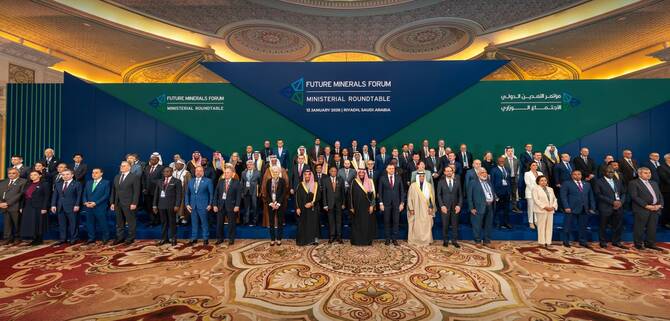
FMF 2026, hosted in Riyadh, is also featuring the world’s largest ministerial roundtable on minerals, drawing 18,000 participants from 165 countries, including 89 government representatives. The Tuesday ministerial session focused on the theme, “Dawn of a global cause: Minerals for a new era of development,” and aims to set the global agenda through initiatives such as establishing an international critical minerals framework, creating centers of excellence for capacity building, defining sustainability standards, and developing an infrastructure corridor.
Over three days, FMF 2026 will convene decision-makers to foster collaboration, catalyze investment, and shape a new era of mineral production that supports global development and creates opportunities for young people across both supplier and consumer nations.
Launched in 2022, FMF has rapidly evolved into a premier gathering, bringing together senior government officials, industry leaders, NGOs, academia, trade associations, and stakeholders across the mineral value chain to collectively shape the future of the global minerals industry.


