

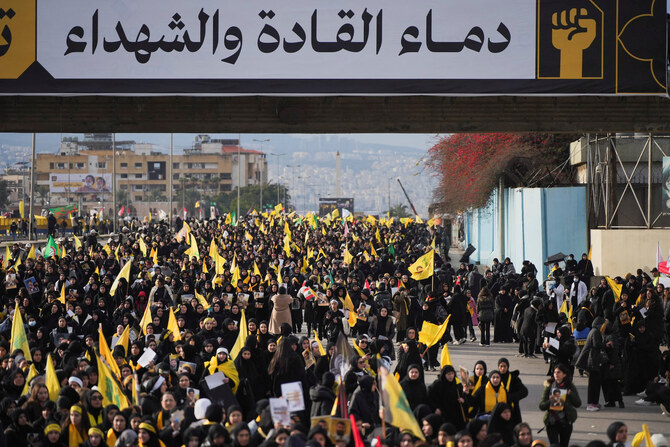
Tens of thousands mourn Hezbollah’s slain leader Nasrallah

1 / 2
People gather for the funeral ceremony of the Lebanon's late Hezbollah leaders Hassan Nasrallah and Hashem Safieddine at the Sports City Stadium in Beirut, Lebanon, Sunday, Feb. 23, 2025. (AP)
2 / 2
Tens of thousands of people gathered in Beirut early Sunday to attend the funeral of Hezbollah’s former leader, nearly five months after he was killed in an Israeli airstrike on a southern suburb of the Lebanese capital. (Reuters)
Short Url
Updated 23 February 2025
Follow

Tens of thousands mourn Hezbollah’s slain leader Nasrallah

  • Killing of Hassan Nasrallah was one of the opening salvos in an Israeli escalation that badly weakened Hezbollah
  • 55,000-seat Camille Chamoun Sports City stadium was nearly full hours before the ceremony was set to start

BEIRUT: Tens of thousands of people gathered on the outskirts of Beirut on Sunday to pay their respects to Hezbollah’s slain leader Hassan Nasrallah, nearly five months after he was killed in an Israeli airstrike in a stunning blow to the Iran-backed group.

The killing of Nasrallah, who led the Shiite Muslim group through decades of conflict with Israel and oversaw its transformation into a military force with regional sway, was one of the opening salvos in an Israeli escalation that badly weakened Hezbollah.

Carrying pictures of Nasrallah and Hezbollah flags, supporters gathered early on Sunday for a mass funeral for Nasrallah and other slain leaders of the group at a stadium in the Hezbollah-controlled southern suburbs of Beirut.

The 55,000-seat Camille Chamoun Sports City stadium was nearly full hours before the ceremony was set to start.

Iranian Foreign Minister Abbas Araqchi, an Iraqi delegation including Shiite politicians and militia commanders, and a delegation from Yemen’s Houthis were expected to attend.

The mass funeral is aimed at showing strength after Hezbollah emerged battered from last year’s war with Israel, which killed most of its leadership and thousands of fighters and wreaked destruction on south Lebanon.

The impact on Hezbollah was compounded by the ousting of its ally Bashar Assad in Syria, severing a key supply route.

“We may have lost a great deal as a man, but we have not lost the value of the resistance because the resistance is clinging on,” said Hassan Nasreddine, a Lebanese man headed to the ceremony from the south.

The funeral was also being held for Hashem Safieddine, who led Hezbollah for a week after Nasrallah’s death. He was killed in an Israeli strike before he had been publicly announced as Nasrallah’s successor.

After his death, Nasrallah was buried temporarily next to his son, Hadi, who died fighting for Hezbollah in 1997. His official funeral was delayed to allow time for the withdrawal of Israeli forces from south Lebanon under the terms of a US-backed ceasefire which ended last year’s war.

Though Israel has largely withdrawn from the south, its troops continue to hold five hilltop positions in the area, and Israel carried out airstrikes on southern Lebanon on Sunday, saying it had identified Hezbollah activity.

The conflict spiralled after Hezbollah opened fire in support of its Palestinian ally Hamas at the start of the Gaza war in October 2023.


US senator urges military action if Hamas, Hezbollah remained armed

Updated 4 sec ago
Follow

US senator urges military action if Hamas, Hezbollah remained armed

  • Graham’s remarks came a day after mediators urged Hamas and Israel to uphold Gaza ceasefire
  • The 2nd phase of the Gaza truce envisages the demilitarization of the territory, including the disarmament of Hamas

JERUSALEM: US Senator Lindsey Graham called on Sunday for renewed military action against Hamas and Hezbollah if they fail to disarm and accused the Palestinian Islamist group of consolidating its power in Gaza.
The Republican politician, on a visit to Israel, is a staunch ally of US President Donald Trump.
Beginning in October, a fragile ceasefire has so far halted two years of war between Israel and Hamas in the Gaza Strip despite both sides trading accusations of truce violations.
A separate ceasefire between Israel and Lebanon’s Hezbollah also came into effect in November 2024 after more than a year of hostilities, though Israel continues to carry out strikes on Lebanese territory.
Israel has made dismantling the arsenals of both groups, allies of its arch-foe Iran, a key condition for any lasting peace.
“It’s imperative we come up with a plan quickly, put Hamas on a time clock, give them a period of time to achieve the goal of disarmament,” Graham said at a press conference during his visit.
“And if you don’t, I would encourage President Trump to unleash Israel to go finish off Hamas.”
“It’s a long, brutal war, but you cannot be successful anywhere in the region until you deliver in dealing Hamas out of the future of Gaza and disarming them,” Graham added, insisting that the second stage of the truce would fail if Hamas remains armed.
“Ninety days after the ceasefire, they are consolidating power in Gaza,” Graham said.
He also called for military engagement against Hezbollah if it too does not surrender its weapons.
“If Hezbollah refuses to give up their heavy weapons, down the road we should engage in military operations working with Lebanon, Israel and the United States, where we fly with Israel... to take Hezbollah out,” Graham said.

-- Opposition to Turkiye --

The Lebanese government has begun to disarm Hezbollah, starting in the country’s south, and insists it will complete the plan.
Israel, however, has questioned the effectiveness of the Lebanese military, and Hezbollah itself has repeatedly refused to lay down its weapons.
Graham’s remarks came a day after mediators the United States, Qatar, Egypt and Turkiye urged both sides in the Gaza war to uphold the ceasefire.
The mediators are pressing for the implementation of the second phase of the truce, which would involve an Israeli withdrawal from Gaza, the deployment of an international stabilization force and the establishment of an interim authority to govern the territory in place of Hamas.
The second phase of the Gaza truce also envisages the demilitarization of the territory, including the disarmament of Hamas.
Graham backed Israel’s opposition to Turkiye being included in the stabilization force, saying it would “rock Israel to its core.”
“There is no political support anywhere in Israel for having Turkiye being involved in the stabilising force,” he said.
Hamas, meanwhile, has called on the mediators and Washington to stop Israeli “violations” of the ceasefire in Gaza.
On Sunday, Israeli artillery shelling was reported in several parts of Gaza’s southern area of Khan Yunis, according to the civil defense agency, which operates under the authority of Hamas.
On Friday, six people, including two children, were killed in an Israeli bombing of a school serving as a shelter for displaced people, according to the agency.